
Top Air Compressors for Home Garages and Professional Shops in 2027

Choosing the right air compressor can feel overwhelming when options range from $100 portable units to heavy‑duty machines over $1,000. Most home‑garage use lands between $200 and $500, covering everything from light inflation to running air tools.
But price tags don’t tell the whole story. Pressure, measured in PSI, is not the same as air volume, and a higher PSI number alone doesn’t guarantee better performance. The buying principle that separates frustration from satisfaction is simple: match CFM at 90 PSI and duty cycle to the tools you already own or plan to buy.
This guide covers a wide range: home pancake models, quiet oil‑free units, cordless options, and shop‑grade two‑stage stationary compressors built for professional workloads.
How We Chose: Methodology and Evaluation Criteria
This ranking targets two distinct buyer profiles: home garages handling trim, inflation, and light air‑tool work, and professional multi‑bay shops running high‑demand pneumatic tools.
Every choice was measured against five concrete criteria:
- CFM at 90 PSI and duty cycle: The primary performance metric. Most pneumatic tools operate between 70 and 90 PSI, so delivered air volume at that pressure tells you whether a compressor can keep up with your tool demands.
- Tank capacity: A practical rule of thumb is at least 3 gallons of storage per CFM. A tank that’s too small forces the motor to cycle constantly, adding heat and wear.
- Noise level: Oil‑free models tend to be quieter, while powerful reciprocating oil compressors can reach around 100 dB. That matters in attached garages, residential neighborhoods, and indoor shops.
- Portability and power requirements: Cordless versus stationary and single‑phase versus three‑phase power determine where and how a compressor fits into your workspace.
- Price and lifetime cost: Equipment cost matters, but energy consumption dominates lifetime spending.
The selections draw on manufacturer specifications, an independent buyer guide, and retailer product data that helped verify real‑world performance expectations.
The 9 Best Air Compressors in 2027
1. BelAire 318VLE: Best Professional Two‑Stage Compressor for Multi‑Bay Shops (Available at Wrenchers)
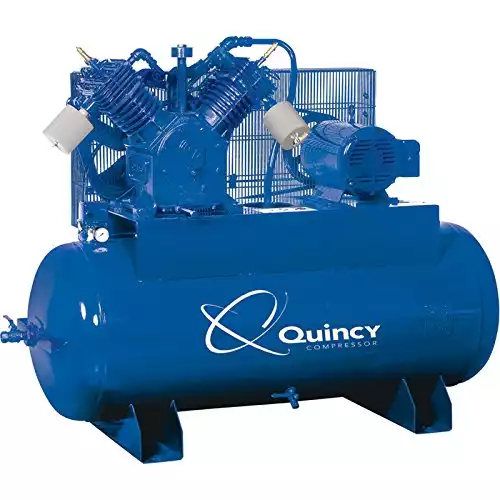
The BelAire 318VLE is a heavy‑duty stationary two‑stage compressor purpose‑built for professional environments. Wrenchers carries this model alongside trusted brands like BelAire, BendPak, Compressed Air Systems, and Ingersoll Rand, making it a go‑to source for shops that need reliable, high‑output compressed air.
- The BelAire 318VLE packs a 7.5 HP motor
- A 230V single‑phase power requirement
- An 80‑gallon vertical tank
- At 100 PSI it delivers roughly 22.3 CFM, with a maximum pressure of 175 PSI.
- The unit weighs 491 lbs.
Backed by Wrenchers’s product specialists Mon‑Fri, 7am to 6:30pm CT who help with sizing, installation questions, and purchase decisions. Wrenchers provides free shipping on eligible contiguous‑U.S. orders for a smoother checkout experience.
Best for: Professional multi‑bay shops that run sanders, large impact wrenches, paint guns, or other tools consuming 10‑12 CFM continuously.
Less ideal if: You’re working in a small shop with limited floor space, or without 230V service, since the 491-lb, 80-gallon unit needs a dedicated spot and a proper electrical setup.
When you match a shop‑grade machine like the BelAire 318VLE to real daily tool demands, the upfront investment pays back through consistent air supply, and having expert support from Wrenchers adds confidence to the buying process.
2. DeWalt 6‑Gallon Pancake (DWFP55126): Best Overall Home‑Garage Pick
This small‑footprint compressor earned its reputation as a dependable go‑to for light home work. It delivers 165 PSI, 2.6 CFM at 90 PSI, and a trim 30 lb weight that makes it easy to grab and move. There are no wheels, so placement is either on a bench or at floor level.
- Lightweight and portable enough to carry between the garage and job sites.
- No wheels, so plan on carrying the unit or setting it in a fixed spot.
Best for: DIY trim, inflation, and occasional compressed air needs in a home garage.
Less ideal if: You plan to run impact wrenches, sanders, or any tool drawing 5 CFM or more.
The DeWalt pancake remains a sensible starting point when your workload stays light and your budget stays under $200. Its 2.6 CFM and 165 PSI numbers are enough for the most common home‑garage chores.
3. California Air Tools 8010: Best Ultra‑Quiet Pick
When noise is a dealbreaker, the California Air Tools 8010 makes a strong case. It operates at just 60 dB, carries an 8‑gallon tank, and pushes 2.2 CFM at 90 PSI (120 PSI max) while weighing about 48 lbs.
California Air Tools positions itself as “The #1 Brand of Ultra Quiet Air Compressors,” and this model backs that claim in attached garages and indoor workshops.
- Ultra‑quiet 60 dB operation keeps the peace in shared spaces and residential neighborhoods.
- Oil‑free design reduces routine maintenance and keeps the workspace cleaner.
- 8‑gallon tank and 48‑lb weight strike a balance between capacity and portability.
Best for: Noise‑sensitive environments, attached garages, and indoor workshops.
Less ideal if: Your tool list demands high continuous CFM for sanders or heavy impact wrenches.
This compressor stands out as one of the quietest picks in the roundup.
4. Ingersoll Rand 20‑Gallon Single‑Stage: Best Splurge for Serious DIY
Ingersoll Rand’s 20‑gallon single‑stage compressor moves well beyond entry‑level pancake models. It carries a $850 price tag, reaches 135 PSI, and weighs around 200 lbs. The oil‑lubricated cast‑iron pump signals a design built for longevity rather than occasional use.
- Oil‑lubricated cast‑iron pump delivers extended service life under regular use.
- 135 PSI max pressure covers common pneumatic tools found in serious home shops.
- At 200 lbs, this is a semi‑stationary unit that needs a dedicated floor spot.
Best for: Serious DIYers ready to spend more for longer durability and steadier air delivery.
Less ideal if: You need high continuous CFM for sanders or large impact wrenches, or you’re short on floor space, since the 200-lb, 20-gallon unit needs a dedicated spot and a $850 budget is a stretch for light, occasional use.
For many home mechanics, this Ingersoll Rand serves as a middle step between small portable units and full shop‑grade two‑stage compressors.
5. Milwaukee M18 FUEL 2‑Gallon Cordless: Best Quiet Cordless
Milwaukee’s cordless entry runs on the familiar M18 battery platform and strikes a balance between mobility and noise control. It weighs roughly 31 lbs, emits 68 dB, and reaches 135 PSI. On a single charge, the compressor can drive up to 1,600 brad nails, according to Better Homes and Gardens testing roundup.
- Cordless operation frees you from power outlets on job sites and in tight indoor spaces.
- Quiet 68 dB performance suits trim work in occupied homes and busy shops.
- High nail count per charge supports efficient trim and finish workflows.
Best for: Jobsite trim and finish work away from fixed power sources.
Less ideal if: You need to run air‑hungry tools or maintain all‑day continuous duty.
Cordless convenience and quiet operation make this a smart pick when portability outweighs tank volume.
6. Ryobi One+ 18V 1‑Gallon Cordless: Best Budget Cordless
At about $169, the Ryobi One+ 18V cordless compressor appeals to budget‑conscious users who already own Ryobi batteries. Its 1‑gallon tank, 120 PSI, and featherlight 14 lb body prioritize grab‑and‑go ease over capacity.
- Extremely light at 14 lbs for quick inflation and light nailer tasks.
- Runs on the Ryobi One+ 18V battery ecosystem, so spare batteries double as tool power.
- No auto shut‑off means the user must monitor pressure manually.
Best for: Inflation and light nailing on a budget, especially for existing Ryobi battery owners.
Less ideal if: You want automatic shut‑off or need larger tank capacity for sustained tool runs.
It’s an affordable entry into cordless compressed air for small, intermittent jobs.
7. Craftsman 10‑Gallon Oil‑Free: Best for Air Tools in a Home Garage
The Craftsman 10‑gallon oil‑free compressor earns its spot by delivering 4 CFM at 90 PSI at a noise level of 80 dB. At $328 and about 69 lbs, it steps up from pancake units without requiring a dedicated equipment room.
- 4 CFM at 90 PSI supports impact wrenches and drills that need around 5 CFM.
- Oil‑free pump eliminates regular oil changes and lowers maintenance overhead.
Best for: Home garages running impact wrenches and drills regularly.
Less ideal if: Your workflow includes sanders or large impact wrenches demanding 10‑12 CFM.
This Craftsman fills the gap when a pancake compressor runs out of breath mid‑project.
8. Industrial Gold CI7521E80V‑P: Best Single‑Phase Pro Two‑Stage
Wrenchers lists the Industrial Gold CI7521E80V‑P 7.5 HP Platinum Series single‑phase two‑stage air compressor at $3,573 (price may have changed; verify before purchase). It combines an 80‑gallon vertical tank with single‑phase power, making it accessible for shops that don’t have three‑phase service but still need serious air.
- Two‑stage design handles continuous pro duty cycles without breaking a sweat.
- 80-gallon vertical tank provides ample air storage for various applications.
- Single‑phase power suits many professional shops and ambitious home setups without requiring an electrical upgrade.
Best for: Professional shops on single‑phase electrical service that need steady, high‑volume compressed air.
Less ideal if: Space or budget is extremely limited in a home garage.
This is a shop‑grade investment for serious volume and simultaneous tool use, bridging the gap between commercial output and residential power constraints.
9. Industrial Gold CI7523E80V: Best Three‑Phase Pro Two‑Stage
The Industrial Gold CI7523E80V matches its single‑phase sibling at $3,573 (price may have changed) but adds 208‑230V, 3‑phase power. It’s built for environments where heavy electrical service is already present and multiple tools run at once.
- Three‑phase 208‑230V input aligns with commercial electrical infrastructure.
- Two‑stage, 80‑gallon vertical design supports continuous, heavy use.
- Same listed price as the single‑phase model, making it a value‑conscious way to step up to three‑phase performance.
Best for: Multi‑bay professional shops with three‑phase service.
Less ideal if: Your building only has residential single‑phase power.
Purpose‑built for commercial duty cycles and multiple simultaneous users, this compressor delivers when uptime is non‑negotiable.
Sizing Guidance for Sanders and Large Impact Wrenches
Not every compressor choice is a single model; sometimes the best pick is a sizing framework. High‑demand pneumatic tools like sanders and large impact wrenches need a compressor matched to their CFM requirements, not just a higher PSI number. Before buying, map out your tool list and calculate the air volume each tool consumes.
- Sanders and large impact wrenches typically need 10‑12 CFM; smaller tools like nailers sit in the 2‑3 CFM range while impact wrenches and drills draw about 5 CFM.
- Most pneumatic tools operate at 70‑90 PSI, so look for a compressor rated at at least 108 PSI to leave roughly 20% headroom.
- Follow the rule of thumb: at least 3 gallons of storage per CFM to avoid constant motor cycling.
A U.S. Department of Energy tip sheet showed that for a typical industrial facility roughly 10% of electricity consumed generates compressed air (30% or more at some facilities), that overall compressed air system efficiency can be as low as 10-15%, and that electricity made up 76% of a compressor system’s lifetime cost, with equipment at 12% and maintenance at 12%.
While this data is older, it still illustrates why energy efficiency matters more than the initial price tag for high‑use shops. Match CFM and tank storage to your actual tool list to avoid the frustration of under‑sized equipment that can’t keep up.
Caveats and Counterpoints
Prices throughout this guide reflect published sources and may have changed; always verify current pricing before purchase.
Noise is an underrated buying factor: powerful oil‑lubricated reciprocating compressors can reach around 100 dB, which matters in attached garages and small shops. Cordless convenience comes with smaller tanks and shorter runtimes, so cordless units are not a direct replacement for stationary wired models.
The DOE cost‑breakdown figure is from 2004 and should be treated as historical background, not a current market statistic. No verified user‑generated feedback was available for this roundup; product claims rely on manufacturer specs and published buyer guides.
Final Verdict
The right air compressor is the one that matches your tools’ CFM at 90 PSI and your duty cycle. Home users can start with a pancake or quiet oil‑free unit and upgrade as tool demands grow.
Professional shops should prioritize two‑stage compressors with 60-80 gallon tanks or larger, check electrical service compatibility, and choose a sourcing option that offers brand variety with specialist support.
That approach turns a complex purchase into a straightforward one.






Comment