
Equipment Rental Planning: How Contractors Can Prevent Construction Cost Overruns

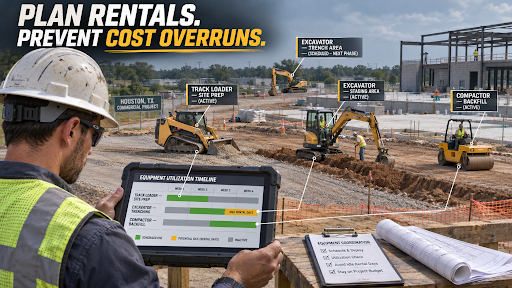
A grading crew is ready to start Tuesday, but the utility markings are still pending. The rented loader arrives anyway. The scheduled operator shift may also be wasted. By the time the site is cleared for work, the crew has lost two days of its rental period without moving material. That gap rarely appears in estimates. Effective equipment rental planning closes it by connecting machine selection, delivery dates, and expected production to what the jobsite can actually support. Controlling costs means looking beyond rates to productive hours, site conditions, and return dates.
Why Poor Equipment Rental Planning Leads to Cost Overruns
An equipment allowance may cover rental duration yet miss periods when crews cannot use a machine. If concrete forms are not removed on schedule, a loader booked for backfilling may sit unused. If excavation quantities grow after a design change, an excavator may remain onsite longer than budgeted.
These problems affect more than the rental invoice. Operators may be reassigned, labor crews may wait, and follow-on trades may lose their scheduled work windows. Cost overruns also stem from inaccurate estimates, permitting, weather, and subcontractor conflicts.
Compare planned operating hours with actual productive hours each week. A machine rented for five days but used for two has a utilization problem, whatever its daily rate. Divide total rental charges by productive hours to expose the true cost of machine use. Tracking that difference helps project managers distinguish unavoidable delays from rental expenses they can reduce through better sequencing.
Choosing the Wrong Equipment Can Increase Project Costs
Machine size affects how quickly crews complete work, but bigger does not automatically mean more economical. An undersized excavator may require more digging cycles or frequent repositioning. An oversized excavator may struggle in confined access areas despite its capacity.
For grading and material movement, compact track loaders can offer traction advantages in some ground conditions, while wheeled skid steer loaders may suit other surfaces and tasks. Weight, ground pressure, travel routes, and attachment compatibility also matter. Estimate cycle times and material travel distances before assuming a higher-capacity machine will finish sooner. A bucket or fork attachment that cannot handle the intended load or fit the machine can interrupt production.
Document excavation depth, material, lifting requirements, access width, and daily production targets. Contractors comparing equipment rental in Houston can use that job-specific list to ask more useful questions about available machine classes and compatible attachments rather than choosing by rental rate alone.
How Equipment Rental Scheduling Affects Your Budget
Equipment rental scheduling should follow work readiness, not simply the date printed on the original construction calendar. Confirm that permits, access routes, operators, supporting crews, and preceding tasks are ready before agreeing to a delivery window.
Consider trenching scheduled after demolition. If debris removal runs late, bringing in the excavator on the original date adds idle rental time. Bringing it in later might avoid those days, if the provider accommodates the revised schedule. Contractors should confirm changes directly rather than assume rentals can be postponed without charges.
Build a simple equipment schedule showing each machine’s intended arrival, assigned task, responsible operator, expected finish, and planned pickup. Review it daily. When scope creep or change orders extend the work, compare the cost of keeping the machine against returning it and renting again later. Arrange returns promptly once a task is complete, subject to the rental agreement and pickup arrangements.
Hidden Equipment Rental Costs Contractors Should Plan For
Rental cost management starts with a complete quotation, not the advertised daily rate. Ask for comparable daily, weekly, and four-week options, then check how each billing period begins and ends. A longer billing option is not automatically cheaper if the machine finishes early or the agreement handles overtime differently.
Transportation, delivery, and pickup fees can change the total. Attachments may be priced separately. Fuel or refueling obligations, rental extensions, damage-related charges, taxes, and other contract-specific fees also deserve review before the equipment arrives.
Estimate the full cost for the expected work window, including planned nonworking days and reasonable uncertainty. Then compare quotes using the same machine class, rental duration, attachment requirements, transportation assumptions, and stated contract terms. Ask what happens if the project ends early, runs late, or cannot operate because of weather. Policies differ; obtain clarification in writing. Keep a contingency allowance for circumstances that cannot be resolved through scheduling alone.
Reducing Construction Equipment Downtime and Idle Hours
Construction equipment downtime may begin with a mechanical issue, but delays can also come from missing attachments, unavailable operators, or blocked work areas. Separate these causes when reviewing costs: repairing a fault requires a different response from rescheduling a crew.
Require pre-operation checks and prompt reports of leaks, damage, or maintenance concerns. Follow the machine’s instructions and rental provider’s reporting procedures. Early reporting can reduce avoidable disruption without assuming that every fault is preventable.
Sophisticated telematics can help track operating hours and idle time when fitted and accessible, but a clipboard works too. Record the machine, operator, hours used, task completed, delay reason, and next planned use in a daily jobsite report. Review the logs twice weekly. If a rented machine repeatedly records no productive work, consider reassigning its task, changing the sequence, or arranging a return rather than treating the ongoing rental as inevitable.
Practical Equipment Rental Planning for Houston Construction Projects
Houston’s heavy rainfall and wet ground can disrupt excavation, grading, haul routes, and equipment access. After a storm, the calendar might say work should resume while the site still needs drainage checks or ground assessment. Construction equipment rental planning should account for that mismatch before scheduling a machine’s arrival.
For each project phase, confirm the required task, suitable machine size and configuration, access conditions, attachments, operator readiness, expected duration, total quoted cost, and return arrangements. Coordinate these details with subcontractors so equipment does not arrive before its work area is available.
A provider such as Avanza Equipment in Houston can be a starting point for confirming local rental options and asking about applicable terms. Verify machine suitability and scheduling for each site.
A disciplined rental decision connects three things: work that is genuinely ready, equipment capable of completing it, and a rental period that reflects likely production. Review those assumptions as the project changes. Contractors who measure productive machine time, examine total charges, and plan returns around actual progress are better positioned to protect both their schedule and construction project budget.







Comment