
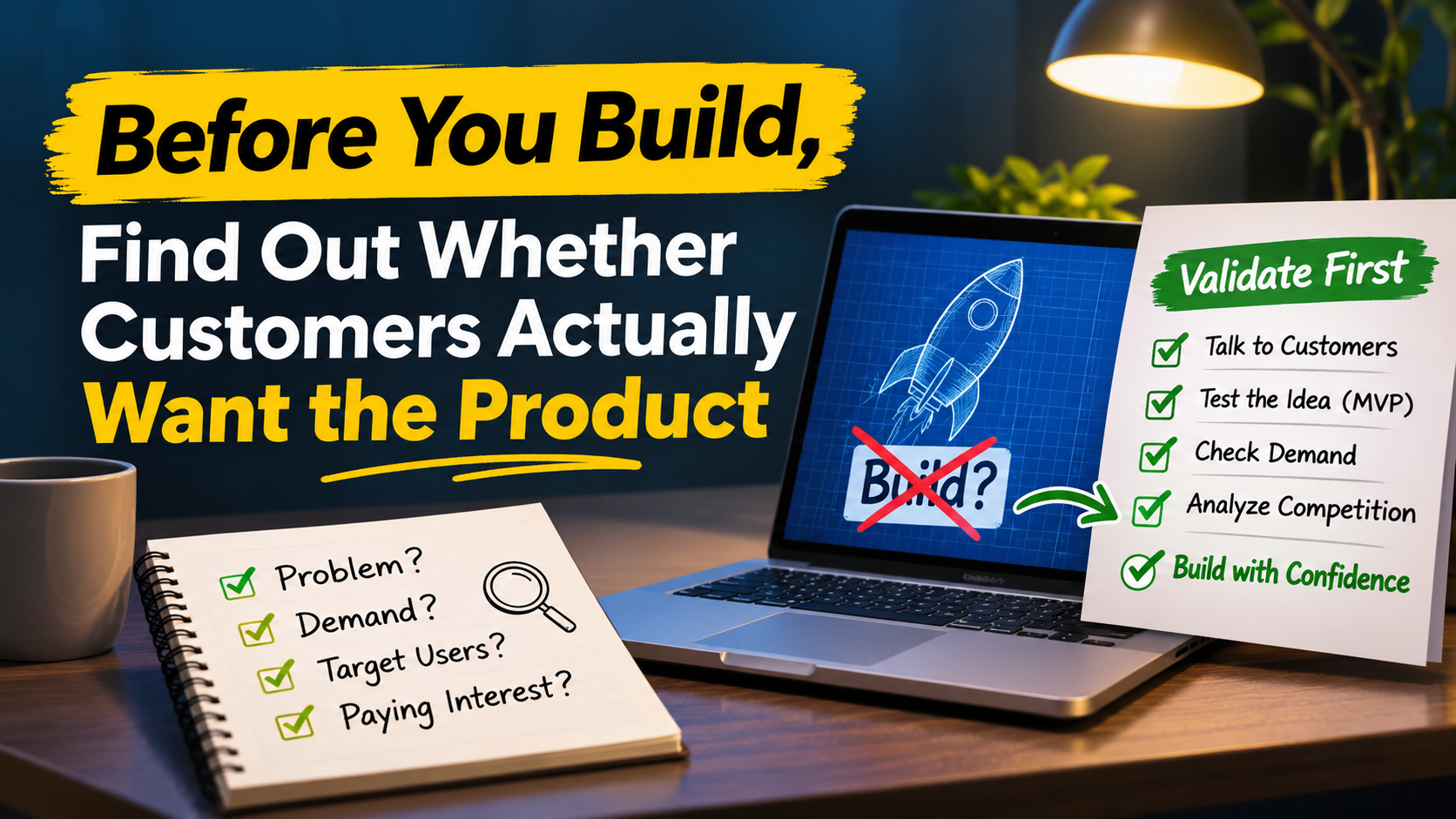
Before You Build, Find Out Whether Customers Actually Want the Product

The Cost of Building on Assumptions
A promising idea can feel convincing long before there is evidence that customers will pay for it. Founders often picture the finished product, imagine enthusiastic users, and begin investing in design, software, inventory, or advertising. The danger is that enthusiasm inside a team is not the same as demand in a market. People may compliment an idea because they want to be supportive, yet still have no intention of buying it. A more disciplined approach begins by treating every early belief as a hypothesis that needs to be tested. Who experiences the problem? How often does it happen? What do people currently do about it? What does that workaround cost in time, money, or frustration? These questions help turn a broad concept into a business proposition that can be examined. The goal is not to prove that an idea is brilliant. It is to discover whether a clearly defined group has a meaningful problem and considers the proposed solution worth choosing over existing alternatives.
Start With a Specific Customer and Problem
Market research becomes useful when it focuses on a particular audience rather than an imaginary customer who represents everyone. A founder developing a scheduling tool, for example, might initially target small service businesses, but that category includes many different working environments. Independent tutors, repair companies, clinics, and consultants may have different booking habits and different reasons for missing appointments. Choose one segment and describe its situation in practical terms. Identify the moment when the problem occurs, the people involved, and the consequences of leaving it unresolved. Then speak with potential customers about their recent experiences. Ask what happened the last time they faced the problem, what they tried, and what they disliked about available options. Questions about actual behaviour are more revealing than asking whether someone likes a proposed feature. Avoid leading people toward the answer you hope to hear. Listen for repeated frustrations, existing spending, and workarounds that indicate the problem is important enough to deserve attention.
Run Small Experiments Before Making Large Investments
A useful early experiment should be inexpensive, quick to understand, and connected to a real customer decision. A simple landing page can explain the problem, describe the proposed outcome, and invite visitors to join a waiting list or request more information. A short demonstration, clickable prototype, sample catalogue, or manually delivered service can also help people understand the offer without requiring a complete product. The important point is to measure behaviour rather than collect compliments. Track how many relevant people visit, ask questions, register, request a quote, book a demonstration, or take another meaningful step. If the product is intended for a professional audience, direct conversations and targeted outreach may provide stronger evidence than broad social media impressions. When planning how to Test product demand before launch, define the audience, the message, the action you want people to take, and the result that would justify another experiment. A test is only useful when its success criteria are decided before the results arrive.
Interpret Interest Without Confusing It With Revenue
Different signals carry different levels of weight. A like or a positive comment is easy to give and usually requires little commitment. An email registration shows more interest, while a scheduled meeting, request for a proposal, refundable deposit, preorder, or paid pilot can indicate stronger intent. The right signal depends on the type of product and the expectations of its market. A high-value business service may need a series of qualified sales conversations rather than hundreds of sign-ups. A consumer product may benefit from a small preorder campaign, provided delivery dates and refund terms are transparent. Examine the quality of responses as well as the total number. Are visitors part of the audience you intend to serve? Do they understand the offer? Are they willing to take the next step at the proposed price? If people show interest but repeatedly hesitate at the same point, that hesitation is useful information. It may reveal an unclear benefit, a trust concern, an unsuitable price, or a problem that is not urgent.
Compare the Idea With Existing Alternatives
Customers rarely evaluate a new product in isolation. They compare it with a competitor, a familiar tool, a manual process, or the option of doing nothing. Research those alternatives before deciding that the market is empty. A competitor with a large customer base may demonstrate that a problem is worth solving, even if its service leaves room for improvement. Interview prospective users about what they currently use and why they keep using it. Look for specific gaps such as slow support, complicated setup, missing integrations, unpredictable costs, or poor performance in a particular situation. A new business does not need to outperform every competitor on every feature. It needs a credible reason for a defined audience to switch or adopt an additional solution. That reason should be easy to explain and supported by customer evidence. If the only difference is that the proposed product has more features, the positioning may be weak. A sharper advantage might be easier onboarding, a narrower specialist focus, or a simpler buying experience.
Use Evidence to Decide What Happens Next
Validation is not a one-time approval ceremony. It is a sequence of decisions in which each experiment reduces uncertainty. After a test, record what was expected, what actually happened, which audience was reached, and what might have influenced the result. Separate observations from interpretations. For example, a low registration rate is an observation; the belief that the price is too high is only one possible explanation. The page may have attracted the wrong visitors, explained the benefit poorly, or asked for too much commitment too early. Change one important variable at a time where possible, then run another test. If evidence remains weak after several well-designed attempts, consider changing the audience, problem, offer, or business model. This is not failure; it is a way to avoid spending heavily on an unsupported assumption. A strong decision to proceed is based on repeated, relevant signals and a realistic understanding of the costs required to serve customers profitably.
Build a Learning Plan, Not Just a Launch Calendar
Founders often create a launch calendar full of design deadlines, development milestones, and promotional activities. Those tasks matter, but an early-stage plan should also include learning milestones. Set out the assumptions with the greatest effect on the business: customer urgency, willingness to pay, acquisition channels, product usability, and the ability to deliver the promised result. Rank them by risk and test the most consequential assumptions first. A small team can conduct customer interviews, publish a focused page, run a limited campaign, and manually fulfil a few early requests before committing to a full build. Keep a record of the language customers use because their words can improve product descriptions and future marketing. Revisit the evidence when the offer changes; validation of one audience or price does not automatically validate another. A thoughtful process for How to validate a startup idea helps entrepreneurs replace guesswork with practical learning. The best outcome is not simply a positive response. It is a clearer understanding of who the product serves, why the problem matters, and what must be true for the business to work.
Conclusion
A product idea becomes a stronger business opportunity when it survives contact with real customers. Start with a defined audience, investigate the problem, compare current alternatives, and design small experiments that measure meaningful actions. Treat weak results as information rather than something to hide, and avoid interpreting casual enthusiasm as proof of sales. By testing the riskiest assumptions before making major investments, founders can protect their resources and improve the offer while changes are still manageable. Careful early research does not remove every uncertainty, but it gives a launch a much more credible foundation.







Comment