
Beyond the Seed Phrase: How Q-AMCHAIN Wants to Secure Wallets, Calls and Payments

Anyone who has held crypto knows the rule: whoever holds the private key controls the assets. Lose the recovery phrase and the funds are gone. Leak it and someone else can empty the wallet. There is no bank to call.
The ways phrases leak are depressingly familiar. Phishing sites ask users to “verify” their wallet, fake apps imitate real ones, and malware scans devices for anything that looks like a list of twelve or twenty-four words. In each case, the phrase alone is enough.
Q-AMCHAIN, the post-quantum blockchain developed by Texas-based Ameritec IPS, is trying to change parts of that equation, and to stretch the same security model well beyond the wallet.
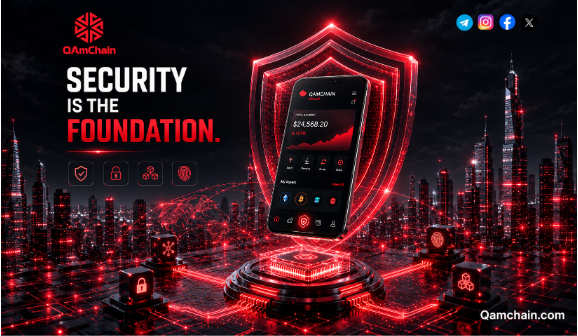
A Q-AMCHAIN graphic showing its planned wallet app, with security as the core theme. Image: Q-AMCHAIN.
A Wallet With Two Locks
The first consumer-facing piece is QB CURE, which the project calls a dual-protection wallet. It combines post-quantum cryptography with biometric authentication, and it is designed to keep assets protected even if a recovery phrase is compromised, using multi-layer authorisation and identity controls.
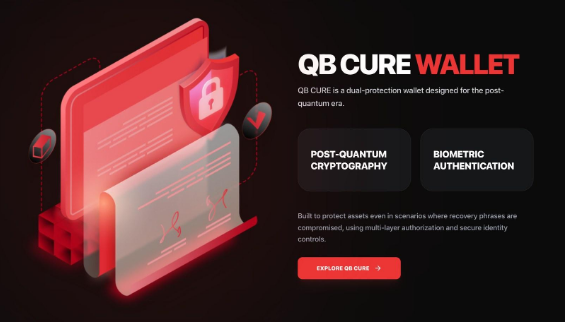
QB CURE is described as a dual-protection wallet that combines post-quantum cryptography with biometric authentication. Screenshot: qamchain.com, October 2026.
That is a meaningful shift. Most self-custody wallets treat the seed phrase as the final authority. QB CURE’s dual-control design adds a second factor tied to the owner’s identity, which is where Ameritec’s biometric work comes in. The company’s Q-AmFatec platform already performs 3D liveness checks and face matching, and it seals face templates with post-quantum encryption.
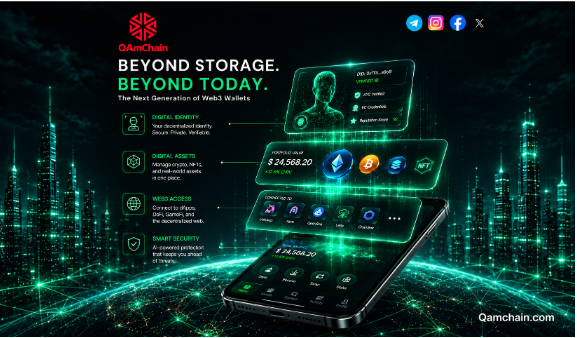
Q-AMCHAIN presents its wallet as one app for digital identity, digital assets, Web3 access and security. Image: Q-AMCHAIN.
The project’s roadmap lists QB CURE for launch in 2026.
Calls, Meetings and Payments
Q-AMCHAIN’s plans go further than custody. The project’s website describes three more services built on the same foundation:
Q-Phone, for quantum-secure calls, texts, voice messages and file sharing
Q-Meet, for private corporate meetings designed to prevent reconstruction and leakage
Q-Pay, a global payment gateway for cards and crypto that authorises payments through a combination of post-quantum and biometric checks
All three are scheduled for 2027.
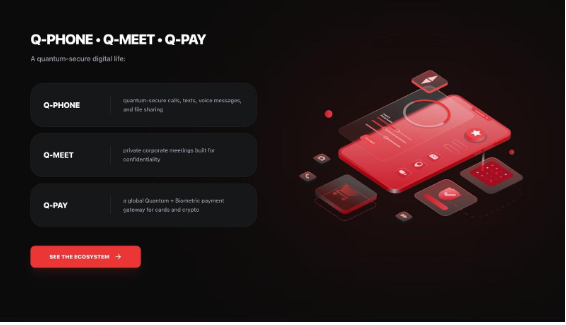
Q-Phone, Q-Meet and Q-Pay are planned as part of the Q-AMCHAIN ecosystem. Screenshot: qamchain.com, October 2026.
The common thread is an argument Ameritec makes again and again: most communication, meeting and payment systems still rely on classical cryptography designed before quantum computing was a practical concern. Rather than ship separate products with separate security models, the company wants one standard across the whole stack.
What Sits Underneath
The chain itself uses lattice-based post-quantum primitives for identity, signatures and encryption. Its consensus model, called Forest Protocol, is described by the project as a leaderless, staked DAG designed for throughput and fast finality. The project says the network can handle up to 30,000 transactions per second in optimised benchmark conditions, with sub-second finality targets for simple transfers, figures that have yet to be tested in public at scale.
Its code was reviewed by CertiK, and the report, delivered on October 14, is published on CertiK’s Skynet platform. It records 79 findings, with 78 resolved and one low-severity issue partially resolved, including all five critical and all 11 high-severity items.
What to Watch
Bundling wallets, messaging, meetings and payments is ambitious, and each of those markets has demanding users and well-funded competitors. Biometric recovery also raises its own questions about how identity data is stored and who controls it. That may explain why the company leans so heavily on post-quantum sealing of face templates.
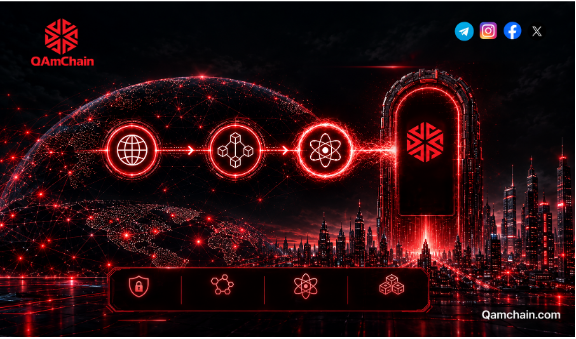
A Q-AMCHAIN graphic tracing the path from the internet to blockchain to quantum-era security. Image: Q-AMCHAIN.
The next twelve months should show how much of the plan becomes working software. QB CURE is the first test, since a wallet either protects its users or it does not, and there is little room for anything in between.
For anyone following how blockchain projects are preparing for quantum computing, Q-AMCHAIN is offering an unusually broad answer. The audit is public, the roadmap has dates on it, and the coming launches will show whether the execution matches the ambition.
SEO details (for publishing, not part of the article)
SEO title: Beyond the Seed Phrase: Q-AMCHAIN’s QB CURE Wallet and Q-Pay
Meta description: Q-AMCHAIN by Ameritec IPS plans the QB CURE dual-protection wallet in 2026 and Q-Phone, Q-Meet and Q-Pay in 2027, all built on post-quantum cryptography.
Focus keyword: QB CURE wallet
Image 1 file name: qamchain-wallet-security-foundation.jpg. Alt text: Q-AMCHAIN wallet app on a phone inside a security shield
Image 2 file name: qb-cure-post-quantum-wallet.jpg. Alt text: QB CURE post-quantum wallet with biometric authentication
Image 3 file name: qamchain-next-generation-web3-wallet.jpg. Alt text: Q-AMCHAIN next generation Web3 wallet with digital identity and assets
Image 4 file name: q-phone-q-meet-q-pay-ecosystem.jpg. Alt text: Q-Phone, Q-Meet and Q-Pay services in the Q-AMCHAIN ecosystem
Image 5 file name: qamchain-global-network-hub.jpg. Alt text: Q-AMCHAIN global blockchain network hub over the earth
Image 6 file name: qamchain-internet-blockchain-quantum-path.jpg. Alt text: Internet to blockchain to quantum security path leading to Q-AMCHAIN
Links (2): qamchain.com; skynet.certik.com/projects/qamchain







Comment