
How to Calculate What Your Savings Will Be Worth After Inflation


To find what your savings will be worth after inflation, divide today’s balance by (1 + the inflation rate) raised to the number of years. At an illustrative 3 per cent annual inflation, $25,000 left untouched for ten years will buy roughly what $18,600 buys today.
That figure is the “real” value of your money: the same number of dollars, but less purchasing power. If your savings earn interest, the question becomes whether the interest outpaces inflation after tax. An inflation calculator runs the numbers for any balance and period; here is how the calculation works and how to read the result.
The real-value formula, step by step
Real value = future balance ÷ (1 + inflation rate)years
If your money earns nothing, the future balance equals today’s balance, so the formula simply shrinks your savings by a year of inflation for each year that passes. If it does earn interest, calculate the future balance first, then deflate it.
Inflation compounds in the same way interest does. Three per cent a year does not reduce purchasing power by 30 per cent over a decade; it reduces it by about 25.6 per cent, because each year’s price rise applies to an already higher price level. Seen from the other direction, something costing $25,000 today would cost about $33,598 in ten years at that rate.
A quick mental shortcut
Divide 70 by the inflation rate to estimate how many years it takes for prices to double, and so for idle cash to lose half its purchasing power. At 3 per cent that is about 23 years. The exact figure is 23.4 years, so the rule of 70 is close enough for a rough check.
Worked example: $25,000 over 5, 10 and 20 years
This table shows what $25,000 held as cash, earning no interest, would be worth in today’s dollars under three illustrative inflation rates.
| Annual inflation | After 5 years | After 10 years | After 20 years |
|---|---|---|---|
| 2% | $22,643 | $20,509 | $16,824 |
| 3% | $21,565 | $18,602 | $13,842 |
| 4% | $20,548 | $16,889 | $11,410 |
Take the middle row at ten years: $25,000 ÷ 1.0310 = $25,000 ÷ 1.3439 = $18,602. One percentage point of difference in the inflation rate moves the ten-year answer by roughly $1,700 to $2,100, and the 20-year answer by more than $2,400, which is why it pays to test a range rather than a single figure.
Try it with your own numbers: enter your savings balance, the number of years and an inflation assumption in the free savings inflation calculator to see the purchasing power of your money in today’s dollars.
Adding interest: will your savings keep up?
Few people hold large sums at zero interest, so the realistic question is whether the rate you earn beats inflation. The real return is:
Real return = (1 + nominal rate) ÷ (1 + inflation rate) − 1
At an illustrative 4.5 per cent savings rate and 3 per cent inflation, that gives 1.045 ÷ 1.03 − 1 = 1.46 per cent a year. The common shortcut of subtracting one rate from the other (4.5 − 3 = 1.5) slightly overstates the real return and becomes less accurate as rates rise.
Here is the same $25,000 over ten years in three accounts, all at 3 per cent inflation:
| Where the money sits | Balance after 10 years | Value in today’s dollars |
|---|---|---|
| Cash or 0% account | $25,000 | $18,602 |
| Checking account at 0.5% | $26,278 | $19,554 |
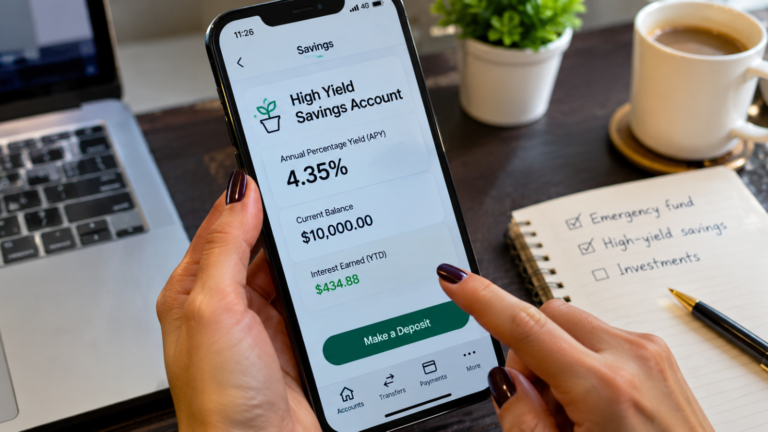
| High-yield savings at 4.5%, before tax | $38,824 | $28,889 |
| High-yield savings at 4.5%, after 22% tax on interest | $35,299 | $26,266 |
The last row matters. Interest in a regular US savings account is taxed as ordinary income each year, so a saver in the 22 per cent federal bracket effectively earns 3.51 per cent, not 4.5 per cent. That still beats 3 per cent inflation, but only narrowly. Savings rates and inflation both move over time, so use the rate you are actually being paid. The savings calculator projects balances with regular deposits, which you can then deflate with the formula above.
Choosing an inflation rate to use
The most widely quoted US measure is the Consumer Price Index (CPI), published monthly by the Bureau of Labor Statistics. The Federal Reserve’s longer-run target is 2 per cent, measured by a related index, but actual inflation has spent long stretches above and below that level.
- For long-term planning, running scenarios at 2, 3 and 4 per cent gives a sensible range without pretending to predict the future.
- For a specific goal, consider the inflation that applies to it. College tuition, health care and housing have historically risen faster than general prices in many periods, while some goods have become cheaper.
- For short horizons, recent inflation is more relevant than long-run averages, but avoid assuming an unusually high or low year will persist.
Inflation also rarely stays constant. If you expect, say, 5 per cent for two years and 2.5 per cent for the following eight, deflate year by year: $25,000 ÷ (1.052 × 1.0258) ≈ $18,611, almost identical to a flat 3 per cent here, but the method matters when the path differs more.
Where inflation calculations go wrong
- Subtracting inflation as a simple percentage. Multiplying the balance by (1 − 0.03 × 10) understates the remaining value; the compounding formula is the correct approach.
- Comparing pre-tax interest with inflation. Inflation is not taxed, but your interest is. Compare the after-tax rate.
- Forgetting your emergency fund. Cash set aside for emergencies loses purchasing power too, so the target amount needs revisiting every few years as living costs rise.
- Treating today’s dollars and future dollars as interchangeable. A retirement projection showing $1 million in thirty years means much less in today’s money. Always ask which kind of dollars a forecast uses, and deflate the output of an investment growth calculator before comparing it with today’s costs.
Frequently asked questions
How much will $10,000 be worth in 10 years with inflation?
At an illustrative 3 per cent annual inflation, $10,000 held as cash will have the purchasing power of about $7,441 in today’s dollars after ten years. At 2 per cent it would be about $8,203, and at 4 per cent about $6,756. If the money earns interest, calculate the future balance first and then divide by the inflation factor.
Does a high-yield savings account beat inflation?
Sometimes. It depends on the rate paid compared with inflation at the time, and on your tax bracket, because interest is taxed as ordinary income. When savings rates sit above inflation after tax, your purchasing power grows slowly. When they sit below it, your money still shrinks in real terms, just more slowly than cash.
What is the difference between nominal and real value?
Nominal value is the number of dollars on your statement. Real value adjusts that number for changes in prices, telling you what the money can actually buy compared with today. A balance can rise in nominal terms while falling in real terms if inflation outpaces the interest earned.
Are there savings products that protect against inflation?
US Treasury Inflation-Protected Securities (TIPS) and Series I savings bonds are designed to adjust with CPI. Each has its own rules on holding periods, purchase limits and taxation, so check the terms on TreasuryDirect or with your broker before relying on them for short-term needs.
Knowing the real value of your savings turns a vague worry about rising prices into a concrete figure you can plan around. This article is general information, not financial advice. To see how your own balance holds up over the years you have in mind, enter it in the TechBullion inflation calculator and compare a cautious inflation rate with a moderate one.
Previously in Fintech News: How Much Interest Can You Earn in a High-Yield Savings Account?






Comment