
How Much Interest Can You Earn in a High-Yield Savings Account?

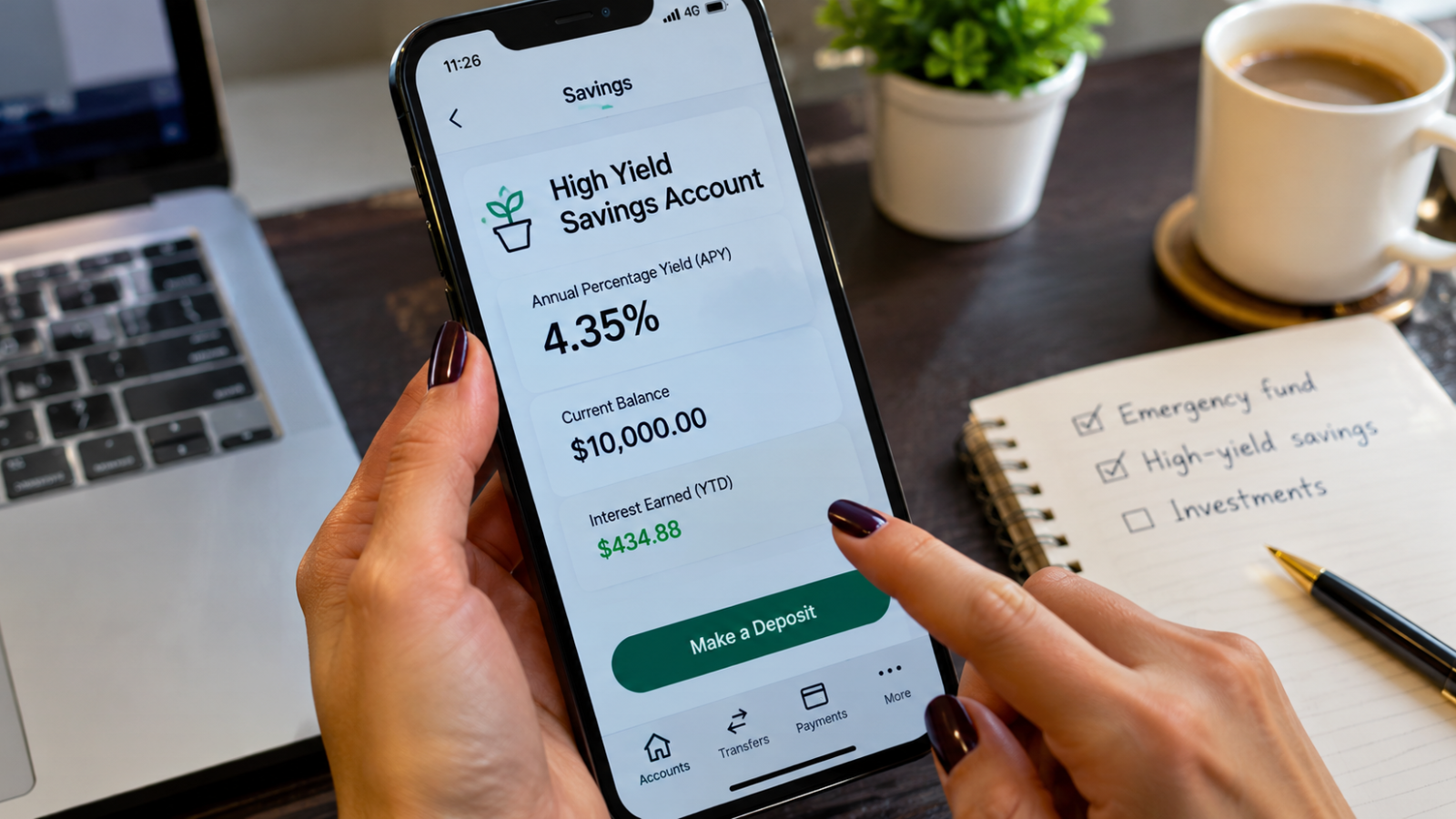
A high-yield savings account earns your balance multiplied by its APY each year: $10,000 at an illustrative 4.00% APY earns about $400 in the first year, compared with about $40 in a traditional account paying 0.40%. Add $200 a month and leave the money for five years, and the high-yield account would earn about $3,402 in interest, assuming the rate stayed the same.
That assumption is the important one. Savings account rates are variable, and banks change them, usually following moves in the Federal Reserve’s policy rate. Use any figure here as an illustration and the APY your bank actually offers as your input. The savings calculator projects your own balance, deposits and rate.
APY: the only rate you need to compare
US banks are required to quote an annual percentage yield, or APY, on deposit accounts. APY already includes the effect of compounding, so it tells you how much $1 grows in a year if you leave the interest in the account. That makes the first-year calculation for a lump sum refreshingly simple:
First-year interest = balance × APY
Behind the scenes, most online banks compound interest daily and credit it monthly. A 4.00% APY corresponds to a nominal rate of roughly 3.92% compounded daily. You do not need to calculate that yourself; just compare APYs between accounts and use the APY in your projections.
For longer periods, compounding builds on itself: balance after t years = balance × (1 + APY)t. $10,000 at 4.00% APY for five years becomes $12,166.53, about $2,167 of interest with no further deposits.
What $10,000 earns at different APYs
| Illustrative APY | Interest in year one | Interest over five years (no deposits) |
|---|---|---|
| 0.40% (traditional savings) | $40 | $201.61 |
| 4.00% (high-yield savings) | $400 | $2,166.53 |
The gap is driven almost entirely by the rate, not by compounding tricks. Online banks can usually pay more than branch-based banks because they have lower operating costs, and they compete for deposits. The difference between accounts varies widely over time, so check rates periodically rather than once.
A five-year projection with monthly deposits
Most savers add money as they go. Assume a $10,000 opening balance, $200 deposited at the end of each month, and a steady 4.00% APY, compounded monthly for simplicity. The monthly equivalent rate is (1.04)1/12 − 1 ≈ 0.3274%, so the first month earns about $32.74 on the opening balance.
The balance follows the standard future-value formula: balance × (1 + r)n + deposit × ((1 + r)n − 1) ÷ r, where r is the monthly rate and n the number of months.
| End of year | Total deposited | Balance | Interest earned to date |
|---|---|---|---|
| 1 | $12,400 | $12,843.69 | $443.69 |
| 2 | $14,800 | $15,801.12 | $1,001.12 |
| 3 | $17,200 | $18,876.86 | $1,676.86 |
| 4 | $19,600 | $22,075.62 | $2,475.62 |
| 5 | $22,000 | $25,402.33 | $3,402.33 |
Two patterns stand out. Interest in year one is modest, about $444, because most of the balance is new money. By year five, the account is earning more than $900 a year, since each year’s interest itself starts earning interest and the deposits keep enlarging the base. The deposits matter more than compounding over a horizon this short: $12,000 of contributions dwarfs the $3,402 of interest, which is why the habit of saving regularly does more for an emergency fund than chasing an extra tenth of a percentage point.
Run the same plan at 0.40% APY and the five-year balance would be about $22,320, with roughly $320 of interest. Simply choosing the higher-paying account would be worth about $3,082 over five years, with no extra risk if both are FDIC-insured.
Project your own savings: enter your starting balance, monthly deposit and your bank’s current APY into the free high-yield savings interest calculator to see your balance and interest year by year, and try a lower rate to see what happens if your bank cuts it.
Why your real return is lower than the APY
Interest is taxable
Savings interest is taxed as ordinary income for federal purposes, and usually by your state as well. Banks report it on Form 1099-INT once it reaches $10 in a year. If you are in the 22 per cent federal bracket, the $400 earned on $10,000 leaves you about $312 after federal tax, an effective 3.12 per cent.
Inflation erodes purchasing power
If prices rise at an illustrative 3 per cent a year, that after-tax 3.12 per cent return leaves a real gain of only about 0.1 per cent. A high-yield account mainly protects cash from losing ground; it is not designed to build wealth over decades. The inflation calculator shows what your future balance would be worth in today’s dollars.
Rates move
If your APY fell from 4 per cent to 3 per cent after one year, $10,000 would grow to $10,712 over two years rather than $10,816. Promotional rates may also last only a few months or apply only up to a balance cap.
What to check before opening an account
- Deposit insurance. Confirm the bank is FDIC-insured, or the credit union NCUA-insured. Coverage is generally up to $250,000 per depositor, per institution, per ownership category.
- Minimums and fees. A monthly maintenance fee can wipe out the interest on a small balance. Many online accounts have none.
- Rate conditions. Some accounts pay the advertised APY only above a minimum balance, below a cap, or if you meet monthly activity requirements.
- Access. Transfers to your checking account typically take one to three business days, so keep a little cash in checking for immediate needs.
- Alternatives for longer horizons. Money you will not need for five years or more may be better suited to investments. The compound interest calculator lets you compare growth at different rates.
Frequently asked questions
How much interest will $10,000 earn in a high-yield savings account?
Multiply $10,000 by the account’s APY. At an illustrative 4.00% APY, that is about $400 in the first year; at 3.00% it is $300; at 5.00% it is $500. Over several years the interest compounds slightly, as long as the rate holds and you leave the interest in the account.
How often is interest paid on a high-yield savings account?
Most US banks compound interest daily and credit it to your account monthly, though some compound monthly. Because APY already reflects compounding, you can compare accounts using APY alone, regardless of how often each one compounds.
Is a high-yield savings account safe?
At an FDIC-insured bank or NCUA-insured credit union, deposits are protected up to the insurance limits even if the institution fails. Your balance does not fall with the stock market. The main risks are that the rate drops and that inflation reduces what your money will buy.
Is a high-yield savings account better than a CD?
A CD usually locks in a fixed rate for a set term, which helps if rates are expected to fall, but early withdrawal typically triggers a penalty. A high-yield savings account keeps your money accessible with a variable rate. Many people hold an emergency fund in savings and use CDs for money with a known future date.
A high-yield savings account is the simplest way to earn more on cash you need to keep safe and close to hand. Check your current APY, then use the TechBullion savings calculator to see what your balance and deposits could earn. This article is general information, not financial advice.
Previously in Fintech News: Embedded Finance in America: Use Cases, Benefits, Risks, and Long-Term Opportunities







Comment