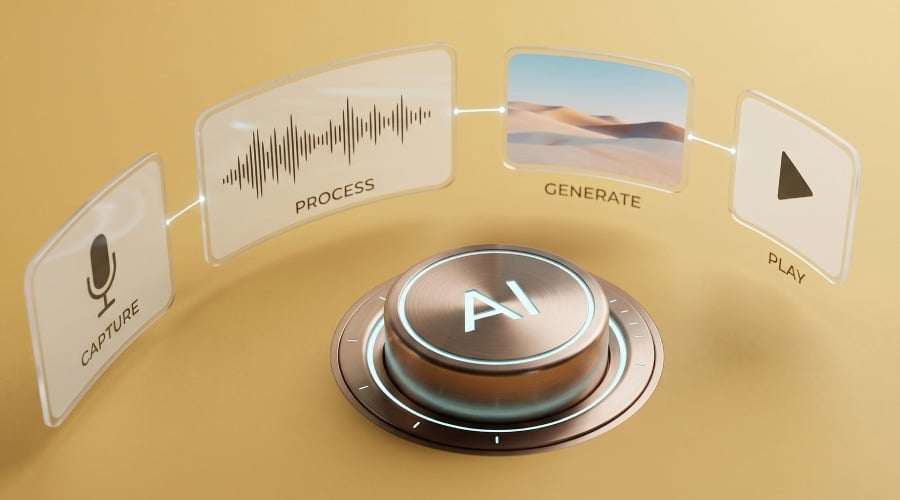
Machines now perceive the world in a new way. Different equipment measures different data. For example, a camera can show what is in front of a machine, a microphone can pick up a sound, and sensors can track things like movement, distance, heat, and pressure. Multimodal AI brings all this information together.
The idea here is pretty simple: people use more than one sense to understand what’s happening around them. We see a car, hear its engine, and notice how close it is before deciding what to do. Multimodal AI tries to give machines a similar ability.
How Multimodal AI Combines Different Types of Data
Most traditional AI systems were built to handle one type of information. Let’s take a computer vision system; it’s built to study an image. Similarly, a speech system could understand spoken words. However, when we are talking about multimodal AI, it brings these abilities together.
Now, think of a security system in a building. Cameras installed near the gate or in the passages may spot a person entering the building. Now, a microphone may detect the sound of objects breaking or people speaking. Finally, a motion sensor could show that someone has moved inside the area. Each of these pieces of information tells a part of the story. When the system looks at them together, it can better understand what is happening.
AI assistants are moving in this direction too. Google mentioned that Gemini was built to work with different types of information, including text, images, audio, video, and code. This allows users to interact with AI in more natural ways.
Sensor data adds another useful layer. A sensor can tell a machine something that a camera cannot. For example, a vehicle’s camera can see another car, while radar can help measure how far away it is.
Self-driving systems often use several sensors at once. NVIDIA’s vehicle platform combines cameras, radar, lidar, and ultrasonic sensors. Its Hyperion platform includes 14 cameras, nine radars, one lidar, and 12 ultrasonic sensors.
Real-World Applications
Self-driving cars are one of the clearest examples of multimodal AI. If a vehicle self-drives, it’s necessary for it to understand the roads, traffic lights, other vehicles, and changing road conditions. Cameras help the vehicle see its surroundings. Radar and lidar provide additional information about objects and distance.
Have you ever thought of AI having senses just like humans? Here comes another important example: robotics. Robots must understand their surroundings before they can perform a task safely. Google DeepMind has been working on Gemini Robotics, which combines visual understanding with robot control. Google has shown robots responding to instructions and handling objects they have not seen before.
Even the healthcare sector will have the benefits. Medical AI can work with scans, patient records, notes, and other information. NVIDIA is developing healthcare tools that support the use of images and text in areas such as radiology, surgery, and pathology.
Smartphones are another example. A person could point a phone at an object and ask a question about it. The camera provides the visual information, while the user’s voice or text provides the question. AI can then connect the two to give an answer.
A Bigger Picture for the Future of AI
All in all, multimodal AI is giving machines a better way to understand the outside world. The machines are not only dependent on one source of information, but they can also bring several signals together before making a decision.
However, no technology is perfect; so as multimodal AI. It has severe limitations. When it’s a large amount of data, the processing requires powerful hardware. If data quality is not up to the mark, the system produces wrong results. Privacy is another concern when devices use cameras and microphones. Safety becomes even more important when AI is used in cars, robots, or healthcare.
The direction, however, is clear. AI is moving beyond text and simple commands. It is learning to work with images, sounds, videos, and sensor readings at the same time. So, the next step is to make the process more natural to users. People may not need to think about which sensor or AI model is being used. They may simply interact with a machine and expect it to understand the situation.