Smart-home technology has spent years making devices easier to monitor and control. Thermostats learn schedules, doorbells send alerts and lighting responds to voice commands. Yet many ordinary appliances still sit outside that connected experience. They receive power from the wall, operate on their own controls and remain invisible to the rest of the home.
That gap is helping smart power management move from a specialist category into a practical part of connected-home design. Instead of replacing every lamp, fan or small appliance with a new “smart” version, users can add intelligence at the point where electricity is delivered.
The connected home has a power-layer problem
A typical home contains a mix of new connected devices and perfectly serviceable conventional products. Replacing everything at once is expensive, wasteful and often unnecessary. The more useful question is whether existing equipment can participate in simple routines without losing the familiar way it works.
Smart plugs and connected power strips address that problem by adding a controllable layer between the outlet and the device. Depending on the product and its supported software, that layer can make scheduled switching, remote control and basic household routines possible. The concept is simple, but its value comes from applying it to the right use cases.
Automation is most useful when it removes a small recurring task
The best connected-home routines are rarely dramatic. They solve repetitive problems: turning decorative lighting off at bedtime, switching a desk setup on before work, or ensuring a nonessential device is not left running after everyone leaves.
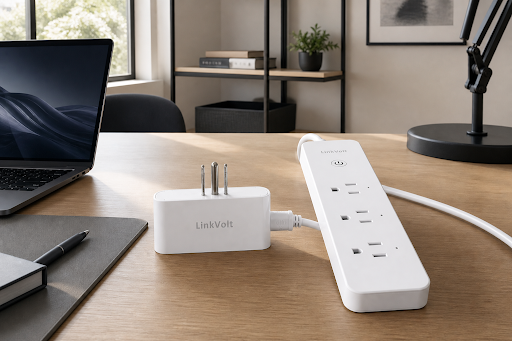
This is where products such as LinkVolt smart power solutions fit naturally into a broader smart-home plan. The objective is not to automate every outlet. It is to identify a small number of predictable loads where control at the plug is genuinely more convenient than manual switching.
A home office is a good example. A monitor, task light and selected accessories can be grouped around a controlled power point, while devices that must remain available—such as a router or network storage unit—stay on a separate, always-on circuit. Thoughtful separation matters more than the number of connected outlets.
Control should remain understandable
Any technology that sits between a user and electrical power needs to behave predictably. A smart-power setup should have clear physical controls, understandable status indicators and an app experience that does not turn a simple on-off task into a troubleshooting session.
Manual operation remains important. Internet connections fail, passwords are forgotten and phones run out of battery. A household should still be able to understand whether a device is powered and operate it safely without depending entirely on a cloud service.
Product selection starts with the electrical load
Convenience features should never distract from the basic electrical requirements. Users need to confirm that the connected appliance is compatible with the power product’s voltage, current and intended environment. Motor-driven equipment, heaters and other high-demand appliances can behave differently from lamps or small electronics, so the product instructions and appliance requirements must take priority.
The physical setup matters too. Power accessories should not block adjacent outlets, force plugs into awkward angles or create cable strain. Connected strips should be positioned where ventilation is not restricted and where their controls and indicator lights can be seen.
Security and privacy belong in the buying decision
A smart plug may look like a simple accessory, but its software becomes part of the home network. Buyers should look for a vendor that explains setup clearly, provides a practical way to update the product and avoids requesting permissions that are unrelated to the function being used.
Good household security habits still apply: use a strong and unique account password, keep the controlling phone updated, review shared access and remove devices properly before selling or giving them away. Smart-home security is usually built from many modest decisions rather than one perfect product.
The next phase of the connected home is practical, not theatrical
The first wave of smart-home marketing focused on novelty. The next phase is more grounded. Consumers increasingly want technology that works with the products they already own, saves a little time and remains easy for every person in the household to understand.
Smart power management reflects that shift. It does not need to transform the whole house overnight. When applied selectively, it can connect conventional devices to useful routines, organize a work area and make everyday energy use more visible. The outlet may be one of the least glamorous parts of a connected home, but it is becoming one of the most practical places to add intelligence.