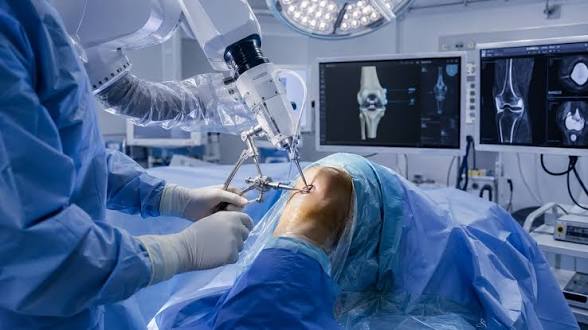
For decades, knee replacement surgery has relied on the skill and judgement of the orthopaedic surgeon, supported by medical imaging, carefully designed instruments and established surgical techniques.
That is now changing.
Advances in robotics, computer modelling and digital imaging are introducing a new generation of technology into orthopaedic operating theatres. Knee replacement is becoming increasingly data-driven, with surgeons able to use digital tools to plan procedures around the individual anatomy of each patient.
The change is part of a much broader transformation taking place across healthcare. From artificial intelligence in diagnostics to robotic systems in operating theatres, technology is increasingly being used to give clinicians more information and greater control.
In knee surgery, however, the objective is not to replace the surgeon with a machine.
It is to give the surgeon better tools.
The Rise of the Digital Knee
A knee replacement is a highly structured procedure, but no two knees are exactly the same.
Patients have different bone shapes, alignments, ligament characteristics and patterns of arthritis. Traditional surgical techniques have allowed surgeons to account for these differences through their experience and intra-operative assessment.
Robotic-assisted systems add another layer of information.
Modern systems can create a digital representation of the patient’s knee, allowing the surgical team to plan aspects of the procedure before the operation begins. During surgery, the technology can then provide information that helps the surgeon execute that plan.
This represents an important shift.
Instead of relying solely on standard measurements and visual assessment, surgeons can increasingly combine their clinical judgement with real-time digital information.
What Does a Surgical Robot Actually Do?
The phrase “robotic surgery” can create the impression that a machine performs the operation.
That is not what happens in robotic knee replacement.
The surgeon remains in control.
The robotic system is essentially an advanced surgical platform that can assist with planning, measurements, positioning and execution. Depending on the system being used, it can help the surgeon understand the patient’s anatomy, determine a surgical plan and work within defined parameters during the operation.
This distinction matters because the technology is not intended to eliminate clinical judgement.
It is intended to augment it.
The surgeon still decides whether a patient is suitable for surgery, what procedure is appropriate and how the operation should be performed.
Why Does Precision Matter in Knee Replacement?
A knee replacement involves positioning artificial components within the patient’s knee.
Small differences in alignment and positioning can be important, which is one reason why computer-assisted technology has attracted so much interest from orthopaedic surgeons.
Robotic systems can help surgeons reproduce a pre-operative plan and provide additional information during the procedure.
That does not necessarily mean that every patient will have a better clinical outcome simply because a robot was involved.
This is an important distinction.
Healthcare technology should be assessed on what it contributes to patient care rather than simply on how sophisticated it appears.
For patients considering robotic knee replacement, the relevant question is therefore not simply whether a hospital has access to a robotic system.
It is how that technology is being used by the surgical team and whether it is appropriate for the individual patient.
Personalisation Is Becoming the Next Frontier
One of the most interesting developments is the move towards personalised surgery.
Healthcare has traditionally operated around standardised pathways. Standard implants, standard measurements and standard surgical techniques have been extremely successful, but digital technology creates opportunities to adapt treatment more closely to the individual.
A digital model of a patient’s knee can allow the surgical team to consider that patient’s anatomy in greater detail.
This is part of a wider movement towards personalised medicine, where technology is being used to move away from a one-size-fits-all approach.
The concept is particularly relevant in orthopaedics because the anatomy of each patient can vary significantly.
Rather than simply asking whether a patient needs a knee replacement, modern surgical planning increasingly asks how that replacement should be designed and positioned for that particular individual.
The Surgeon Remains the Critical Component
It would be easy to become distracted by the word “robotic”.
But the most sophisticated technology in the operating theatre is only as useful as the team using it.
A robotic system does not decide whether a patient needs a knee replacement.
It does not determine whether surgery is appropriate.
It does not replace the surgeon’s assessment of the patient’s symptoms, lifestyle, medical history or expectations.
Those decisions remain clinical decisions.
The technology provides another set of tools with which the surgeon can work.
That is why patients considering robotic surgery should look beyond the equipment itself and consider the surgeon’s experience, the surgical approach being used and the overall pathway of care.
Technology Versus Marketing
The growing popularity of robotic surgery also creates a challenge for healthcare providers.
New technology is attractive.
The word “robotic” sounds sophisticated, precise and futuristic. But healthcare technology should ultimately be judged by whether it improves patient care rather than simply whether it is newer.
There is an important difference between improving the technical precision of a procedure and demonstrating that the improvement translates into a better long-term outcome for every patient.
That distinction should be central to how robotic surgery is discussed.
Patients should not assume that robotic surgery automatically means faster recovery, less pain or a superior long-term result.
Instead, the technology should be considered alongside the surgeon, the patient’s individual circumstances and the evidence available for the particular technique.
In other words, robotics should be viewed as a tool rather than a guarantee.
Where Does Artificial Intelligence Fit?
The next stage could be even more interesting.
Robotic surgery is already generating large quantities of digital information. At the same time, artificial intelligence is becoming increasingly capable of analysing medical data and identifying patterns.
That creates the possibility of increasingly sophisticated digital surgical systems.
Future platforms could potentially combine imaging, anatomical modelling, surgical data and patient outcomes to help clinicians refine treatment plans.
Artificial intelligence could also influence the way patients research treatment.
Instead of simply searching for a hospital or surgeon, patients are increasingly able to explore treatment options, understand different technologies and prepare questions before meeting their clinical team.
This creates an interesting feedback loop.
Technology is being used inside the operating theatre while another generation of digital technology is changing how patients make decisions outside it.
The combination could eventually have a significant effect on the entire patient journey.
The Changing Economics of Knee Replacement
Technology is also changing the conversation around the economics of private healthcare.
For patients funding their own treatment, the price of a knee replacement can vary considerably depending on the hospital, surgeon, implant, geographical location and the services included within the treatment package.
The introduction of additional technology can add another layer to that decision.
Patients researching knee replacement should therefore look beyond a headline figure.
A quoted price may or may not include the surgeon’s fee, anaesthetist’s fee, hospital charges, implant costs, diagnostic imaging, consultations, follow-up appointments and rehabilitation.
The technology used during the operation may also form part of the overall treatment package.
This makes direct comparisons between apparently similar prices difficult unless patients establish exactly what is included.
For anyone researching the wider treatment journey, Active Again provides a patient-focused starting point for understanding knee replacement and the options surrounding modern joint replacement surgery.
What Should Patients Ask Their Surgeon?
For someone considering knee replacement, technology should be part of a broader discussion rather than the sole reason for choosing a particular treatment.
Useful questions include:
- Why do you recommend knee replacement for me?
- Would you recommend robotic-assisted surgery in my case?
- Which robotic system would be used?
- What does the technology add to the operation?
- How frequently do you use this technique?
- What are the alternatives?
- What is included in the quoted treatment cost?
- What should I expect during rehabilitation?
These questions can help move the conversation away from technology as a marketing term and towards the patient’s individual clinical circumstances.
The Next Stage of Digital Orthopaedics
Robotic-assisted surgery is part of a much wider technological shift taking place across healthcare.
Digital imaging, computer-assisted planning, navigation systems, artificial intelligence and increasingly sophisticated data analysis are all contributing to a more technology-driven approach to surgery.
Orthopaedics is particularly well positioned to benefit because many procedures involve measurable anatomical structures and precisely positioned implants.
The challenge for healthcare providers will be ensuring that technological innovation remains focused on meaningful improvements for patients rather than simply becoming another marketing differentiator.
For patients, meanwhile, the increasing availability of information means that choosing knee replacement surgery is becoming less about simply finding a hospital that offers the procedure.
It is increasingly about understanding the treatment options, the surgeon’s approach, the technology available and the overall pathway of care.
Technology Is a Tool — Not the Surgeon
Knee replacement provides an excellent example of how technology is gradually changing healthcare.
The operation itself has not suddenly become a robotic procedure in which machines operate independently. Instead, the technology surrounding the surgeon is becoming increasingly sophisticated.
Digital planning can provide more information.
Robotic systems can assist with execution.
Artificial intelligence may eventually help interpret increasingly complex datasets.
And patients now have access to vastly more information when researching their treatment options.
The result is a healthcare environment in which the traditional boundaries between medicine and technology are becoming increasingly blurred.
The future of knee replacement is unlikely to be about robots replacing surgeons.
It is much more likely to be about surgeons using increasingly intelligent technology to make better-informed decisions and deliver increasingly personalised surgery.
That is a much more interesting technological revolution — and one that is already beginning to take shape in operating theatres today.