Emerging technologies are moving from experimental projects into everyday business operations. In 2027, artificial intelligence, automation, edge computing, digital twins, robotics, and advanced analytics are expected to influence how companies operate, make decisions, serve customers, and develop new products.
For business leaders, the challenge will not simply be adopting the newest technology.
It will be deciding where emerging technology can create measurable business value while managing cost, security, and organizational change.
AI Will Change How Businesses Operate
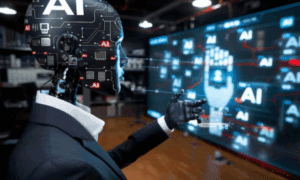
Artificial intelligence will remain one of the biggest drivers of business transformation in 2027. Companies are moving beyond basic generative AI tools toward AI agents that can perform multi-step tasks and support entire workflows.
This could change how businesses handle customer service, finance, marketing, software development, research, and administrative work. Instead of simply automating individual tasks, AI will increasingly become part of broader operating models. (TechTarget)
AI Will Improve Business Decision-Making
Harrison Tang, CEO of Spokeo and AI expert, says: “One of the most important impacts of emerging technology will be faster, more data-driven decision-making. AI-powered analytics can process large amounts of information and identify patterns that may be difficult for humans to detect.
Executives could use these systems to forecast demand, evaluate risks, understand customer behavior, optimize pricing, and identify operational problems. Experts expect advances in AI analytics to have a particularly significant impact on business decision-making across industries.
However, companies will still need human oversight. AI-generated recommendations can support executives, but important financial, legal, strategic, and personnel decisions require appropriate judgment and governance.”
Automation Will Reshape Business Processes
Automation is evolving from simple rule-based workflows toward systems capable of handling more complex and variable processes. This means businesses can potentially automate tasks that previously required significant human intervention.
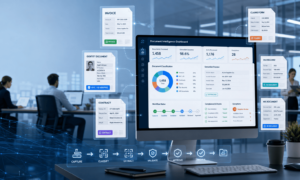
For example, AI-powered systems could help process invoices, respond to customer requests, analyze documents, identify potential sales opportunities, or manage supply chain activities.
The result could be employees spending less time on repetitive work and more time on problem-solving, creativity, and customer relationships.
Edge Computing Will Enable Faster Decisions
As businesses generate more data from connected devices, machines, and sensors, processing everything in centralized cloud environments may not always be practical.
Edge computing processes data closer to where it is generated, reducing latency and improving responsiveness. This could be particularly valuable for manufacturing, logistics, healthcare, retail, and other industries where businesses need real-time information.
Digital Twins Will Improve Operations
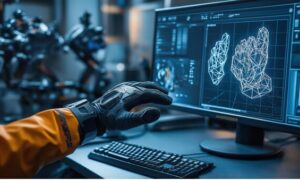
Digital twins allow companies to create digital representations of physical assets, processes, or environments. Businesses can use these models to monitor performance, simulate changes, and identify potential problems before making expensive real-world adjustments.
Combined with AI and real-time data, digital twins could help companies improve manufacturing, infrastructure management, supply chains, and maintenance.
Gartner identifies the convergence of AI, automation, process intelligence, and digital twins as an important path toward real-time decision-making. (Gartner)
Robotics Will Bring AI Into the Physical World
AI is increasingly moving beyond software. More capable robots can potentially work alongside humans in warehouses, factories, logistics operations, and other physical environments.
Advances in natural-language interfaces and simulated environments could make robots easier to train and deploy, expanding their potential business applications.
Emerging Technology Will Accelerate Innovation
Perhaps the biggest opportunity is the ability to experiment faster. AI can help companies research markets, develop prototypes, analyze customer feedback, and test ideas more efficiently.
This can shorten the distance between an idea and a market-ready product. Businesses that combine AI with human expertise could potentially create new products and services faster than competitors relying entirely on traditional development processes.
Cybersecurity Will Become More Important
Greater technological adoption also creates greater risk. AI systems, connected devices, cloud infrastructure, and emerging computing technologies expand the number of systems businesses must protect.
Companies will increasingly need security-by-design, strong data governance, identity controls, and continuous monitoring as part of their technology strategies.
Conclusion
Emerging technologies in 2027 will influence far more than IT departments. AI and automation will reshape business operations, advanced analytics will improve decision-making, edge computing will enable faster responses, robotics will transform physical work, and digital twins will help companies simulate and optimize complex environments.
The businesses most likely to benefit will not necessarily be those that adopt the most technologies.
They will be the organizations that identify specific business problems, choose the right technology, measure results, and give employees the skills needed to work effectively alongside new systems.