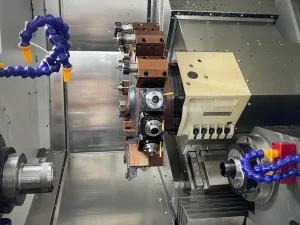
Producing a qualified prototype is an important milestone in automotive manufacturing, but it does not guarantee successful mass production. As production volumes increase from dozens of parts to thousands or even hundreds of thousands, manufacturers face new challenges that directly affect quality, delivery, and cost.
For automotive OEMs and Tier 1 suppliers, high-volume CNC turning is no longer judged solely by machining accuracy. The ability to maintain dimensional consistency, stable cycle times, and reliable production over extended manufacturing runs has become equally important.
Understanding the differences between prototype machining and mass production helps manufacturers choose the right CNC turning supplier and avoid costly production issues later in the project.
Prototype Success Doesn’t Guarantee Mass Production Success
Prototype machining focuses on verifying whether a part can be manufactured according to design specifications. Mass production, however, requires every part to meet the same standards over weeks or months of continuous manufacturing.
During long production runs, several factors can gradually influence machining quality:
- Tool wear changes cutting dimensions.
- Heat generated during continuous operation can cause thermal expansion of the spindle and machine structure.
- Repeated loading and unloading may introduce positioning variation.
- Manual process adjustments can create batch-to-batch inconsistency.
These problems may be insignificant when producing ten samples but become critical when manufacturing tens of thousands of automotive components.
| Prototype Production | Mass Production |
| Focus on dimensional verification | Focus on production consistency |
| Flexible machine setup | Standardized machining process |
| Small production quantity | Continuous high-volume output |
| Manual optimization acceptable | Automated and repeatable production required |
For automotive applications, repeatability is often a more valuable indicator than achieving extremely high accuracy on a single part.
Why Automotive Turning Places Greater Demands on Manufacturing
Automotive CNC turning is widely used to manufacture shafts, bushings, flanges, bearing housings, valve components, and precision parts for electric drive systems.
Unlike many other industries, automotive manufacturing emphasizes productivity as much as precision.
Stable Cycle Time
Reducing machining time by only a few seconds per component can significantly increase annual production capacity and lower manufacturing costs.
However, higher productivity should never compromise dimensional accuracy or surface finish. Maintaining both requires rigid machine structures, optimized cutting parameters, and reliable process control.
Long-Term Dimensional Stability
Automotive production programs often last several years.
OEMs expect components produced today to remain interchangeable with those manufactured months later. This requires stable machine performance throughout extended production cycles rather than occasional manual correction.
Low Scrap Rate
Every defective component increases production cost.
Stable machining processes, consistent tooling strategies, and reliable equipment help reduce scrap rates while improving overall production efficiency.
What Supports Stable High-Volume CNC Turning?
Successful mass production depends on a complete manufacturing system rather than individual machining operations.
Machine Tool Stability
Machine rigidity, spindle stability, and positioning accuracy directly affect dimensional consistency.
For example, during continuous turning, spindle temperature gradually rises. Even slight thermal expansion may cause dimensional drift on shaft diameters if machine rigidity and thermal stability are insufficient.
Machine tools designed for long production cycles help minimize these variations and improve repeatability.
Standardized Manufacturing Processes
Stable production relies on standardized tooling, fixtures, cutting parameters, and inspection procedures instead of operator experience alone.
Process standardization allows manufacturers to maintain consistent quality across multiple shifts and production batches while reducing unnecessary machine adjustments.
Automation and Process Control
Automotive manufacturers increasingly integrate automatic loading systems, tool-life monitoring, and in-process compensation into CNC turning operations.
These technologies improve productivity while reducing quality fluctuations caused by manual intervention.
Why Machine Tool Capability Directly Affects Production Efficiency
The performance of a CNC machine tool determines whether high-volume production can remain stable over time.
When evaluating equipment for automotive turning, manufacturers should consider:
- Machine rigidity during continuous cutting
- Long-term spindle stability
- Repeat positioning accuracy
- Automation compatibility
- Efficient machining of shaft-type and rotational components
These factors influence not only machining quality but also cycle time, equipment utilization, maintenance frequency, and overall production cost.
As a CNC machine tool manufacturer, Sanchuang develops equipment specifically for precision and high-volume manufacturing applications.
Its manufacturing process—from structural machining and precision assembly to machine testing and performance verification—is designed to ensure long-term operational stability. Combined with application experience in automotive precision components, Sanchuang’s CNC machine tools help manufacturers improve consistency while supporting efficient large-scale production.
Choosing the Right CNC Turning Supplier for Mass Production
When selecting a supplier for automotive turning projects, manufacturers should evaluate more than prototype quality or initial quotations.
A qualified supplier should demonstrate:
- Experience with long-term production programs
- Stable machine tools capable of continuous operation
- Standardized machining and quality control processes
- Automation capability for improved efficiency
- Consistent production performance across multiple batches
The right supplier is one that can maintain quality throughout the entire production lifecycle, not simply deliver a successful first article.
Conclusion
As electric vehicles, intelligent manufacturing, and advanced powertrain technologies continue to evolve, automotive components require greater precision while production volumes continue to increase.
Meeting these demands depends on more than machining capability alone. Stable machine tools, standardized manufacturing processes, and reliable production systems form the foundation of successful high-volume CNC turning.
With extensive experience in CNC machine tool development and precision manufacturing, Sanchuang provides CNC turning solutions that help automotive manufacturers move confidently from prototype validation to stable, efficient mass production.
FAQ
Why is mass production more difficult than prototype machining?
Prototype machining verifies whether a part can be manufactured, while mass production requires thousands of components to maintain the same dimensional accuracy, surface quality, and production efficiency despite tool wear, thermal changes, and continuous machine operation.
Which automotive components are suitable for high-volume CNC turning?
Typical applications include shafts, bushings, flanges, bearing housings, valve components, and precision rotational parts used in engines, transmissions, and electric drive systems.
How can manufacturers determine whether a CNC turning supplier is ready for mass production?
Instead of evaluating only machining accuracy, manufacturers should assess machine stability, standardized production processes, automation capability, long-term production consistency, and the supplier’s ability to maintain quality throughout extended manufacturing programs.