Two years ago, picking a voice AI vendor meant picking the best demo. In 2026, it means choosing an operating cost, a carrier setup, a compliance posture, and a latency budget you may have to live with for the next three renewal cycles.
The voice AI agent market is projected to grow from roughly $2.4 billion in 2024 to $47.5 billion by 2034, at a CAGR of nearly 35%. Gartner expects conversational AI to automate around 70% of enterprise customer support interactions by the end of 2027 and estimated that conversational AI deployments could remove roughly $80 billion from global contact centre agent labour costs in 2026. A 2026 Gartner survey also found that 91% of customer service and support leaders are under direct executive pressure to deploy AI.
That pressure can lead to bad buying decisions. Teams run a 10-minute sandbox call, hear a voice that doesn’t sound robotic, and sign. Then the pilot hits real traffic and the variables that actually matter start to surface: what happens when a caller interrupts mid-sentence, how the audio holds up on a poor mobile route, what the real per-minute cost looks like once telephony is added, and whether the conversation survives a jump from voice to WhatsApp.
Below are the five platforms that hold up best under those conditions in 2026, along with the trade-offs and limitations of each.
How this list was scored
Every platform here was assessed against six criteria that start to matter once you get past the demo:
- Latency and turn-taking.Sub-second response times are the goal, but the number alone does not tell you much. Interruption handling, voice activity detection, and how naturally the agent knows when to speak matter just as much.
- Telephony control.How much of the phone stack does the vendor actually control? More integrated telephony can mean fewer hops, easier number provisioning, better visibility into call quality, and fewer vendors to troubleshoot when something breaks.
- Omnichannel continuity.Voice is only one part of the customer journey. If a conversation can move from a call to SMS or WhatsApp without losing context, that can matter more than shaving another 100ms off latency.
- Model flexibility.Can you choose your own STT, LLM, and TTS providers, or are you tied to the vendor’s stack? More flexibility gives engineering teams control, but it also adds more moving parts.
- Enterprise compliance.We looked at SOC 2, HIPAA, GDPR, regional data residency, and local requirements such as DPDP and TRAI in India.
- Transparent unit economics.Bundled pricing is easier to forecast. Modular pricing can give you more control over costs, but only if you can clearly see what telephony, STT, LLM, TTS, and platform fees add up to.
AI Voice Agents Comparison Table
| Platform | Latency | Telephony | Channels | Entry pricing |
| Plivo | Sub-500ms | Integrated telephony | Voice, SMS, WhatsApp, chat | $0.03/min agent layer + telephony |
| SquadStack | ≤800ms median | India-focused telephony integrations | Voice, WhatsApp, SMS, in-app | Custom usage-based pricing |
| Retell AI | Sub-second | Managed or BYO telephony | Voice, chat, SMS | $0.07–$0.31/min, depending on stack |
| Vapi | Sub-second | Managed US numbers or BYO telephony | Voice, SMS, chat | $0.05/min platform fee + STT, LLM, TTS & telephony costs |
| ElevenLabs | Sub-second | External telephony / SIP | Voice, chat, SMS, WhatsApp | Free: 15 min; Business: $990/mo for 12,375 min; $0.08/min additional usage |
1. Plivo
Best for: teams that want the AI agent and telephony layers handled more tightly by the same vendor.
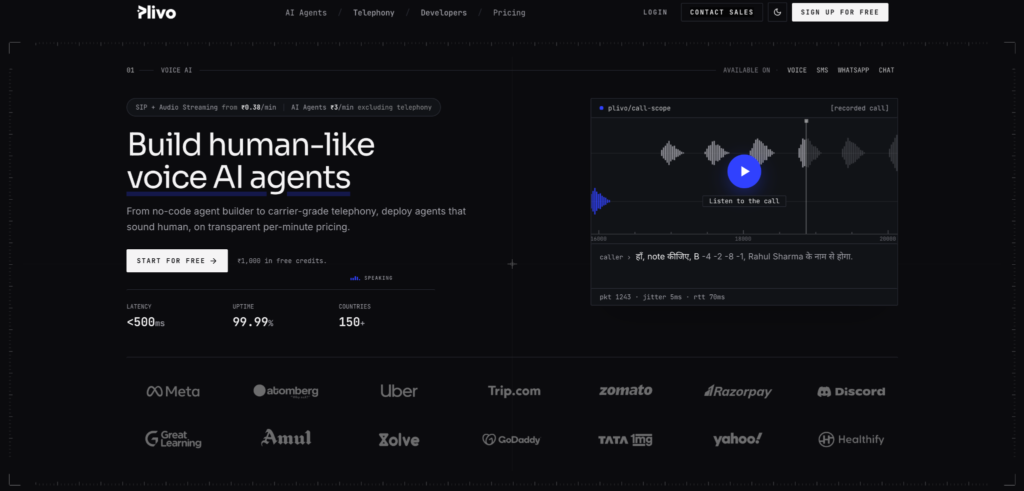
Plivo is one of the strongest all-round options in 2026 for one structural reason: it started as a communications platform and built AI agents on top of that infrastructure, rather than starting with the agent layer and adding telephony later.
That distinction matters once call volume becomes real. Plivo reports sub-500ms voice latency, 99.99% uptime, support for 50+ languages, and connectivity across 190+ countries.
There are also two ways to build. Developers get APIs and SDKs for deeper integrations and custom workflows, while product and operations teams can use AI Agent Studio to build agents visually without writing everything from scratch.
Key strengths: Plivo’s biggest advantage is how tightly the AI agent layer sits with its communications infrastructure. That means fewer external systems in the call path, which can make telephony, routing, reliability, and troubleshooting easier to manage once call volume grows.
It also has strong enterprise compliance coverage, including HIPAA, GDPR, SOC 2, PCI DSS, and CSA STAR, along with data residency options across the US, EU, and APAC. For regulated or global teams, that can make security and procurement reviews much more straightforward.
Plivo also gives teams both code and no-code paths. Operations and product teams can build and adjust agents through Agent Studio, while developers still get APIs and SDKs for more complex integrations and custom logic.
Pricing: Plivo Voice AI Agents cost $0.04 per minute, with telephony, voice models, and transcription included in that rate.
The pay-as-you-go plan includes $10 in starting credits, while Enterprise plans start at $1,000 per month and add broader global coverage, higher concurrency, volume pricing, and enterprise features.
Where it is weaker: Plivo makes the most sense if you want a more integrated stack. If your engineering team specifically wants to choose and manage separate providers for telephony, orchestration, transcription, models, and speech, a more modular platform like Vapi may give you more control over every individual layer.
2. SquadStack
Best for: high-volume outbound, sales, and collections in Indian languages.
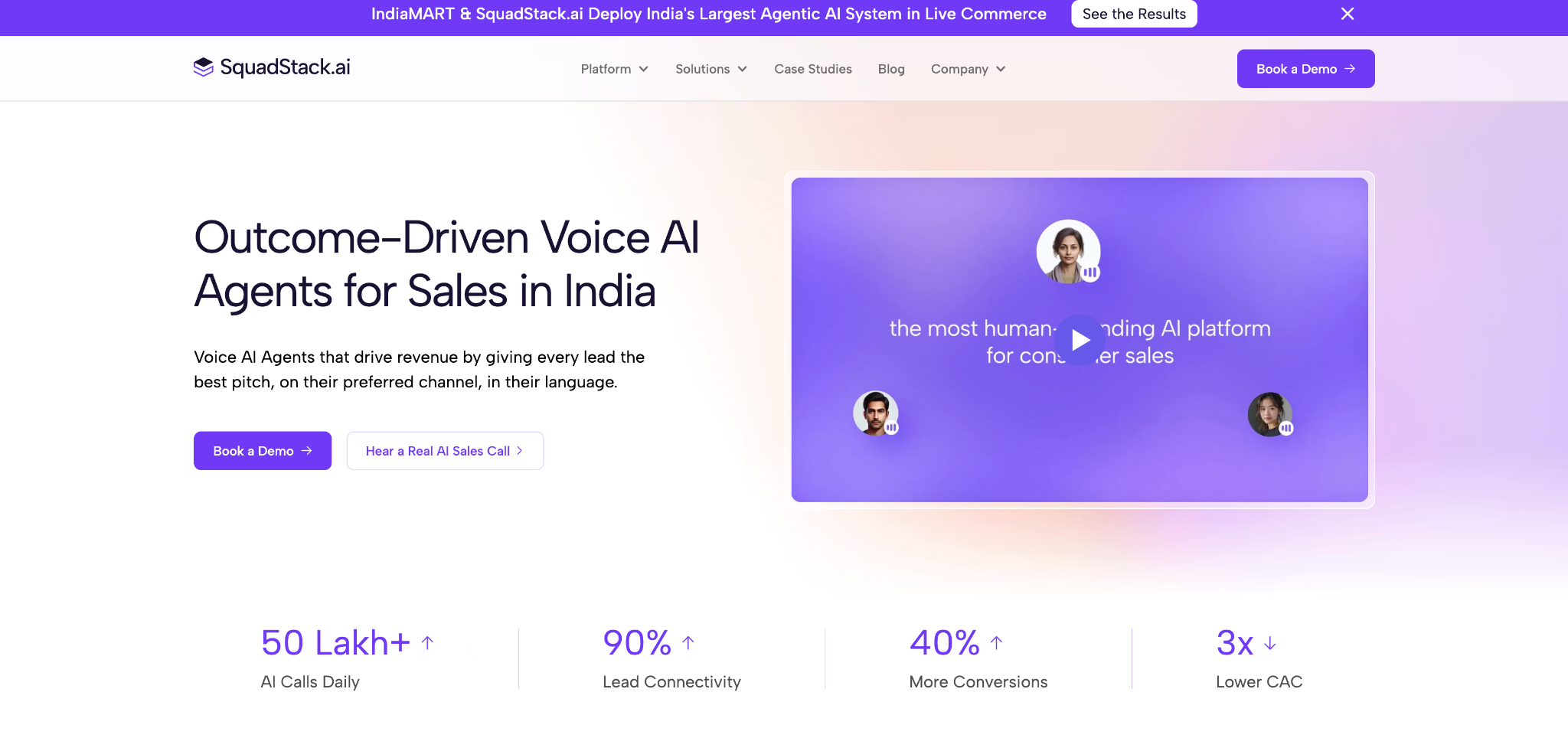
SquadStack is built specifically for Indian contact centre use cases, and that focus is its biggest advantage. Its speech models are trained on 600M+ minutes of real Indian contact centre conversations, with support for Hindi, English, Hinglish, Tamil, Telugu, Kannada, Marathi, Bengali, Gujarati, and Malayalam, including mid-sentence code-switching.
Key strengths: SquadStack reports sub-800ms latency and says it handles conversations extending beyond 30 turns without losing context. It currently runs 50 lakh+ AI calls per day, with vendor-reported results including 90% connectivity, 40% more conversions, and 3x lower CAC.
It is also well suited to regulated Indian deployments, with SOC 2 Type II, ISO 27001, ISO 27701, DPDP and TRAI compliance, India data residency, and support for on-premise or VPC deployments. Built-in A/B testing across prompts, call flows, and campaigns is another useful addition for teams optimizing large outbound programs.
Where it is weaker: Its India focus is also the limitation. If most of your call volume is in North America or Europe, the advantage of models trained specifically on Indian languages, accents, and calling patterns becomes much less relevant.
3. Retell AI
Best for: teams that want a feature-rich voice AI platform without an upfront enterprise contract.
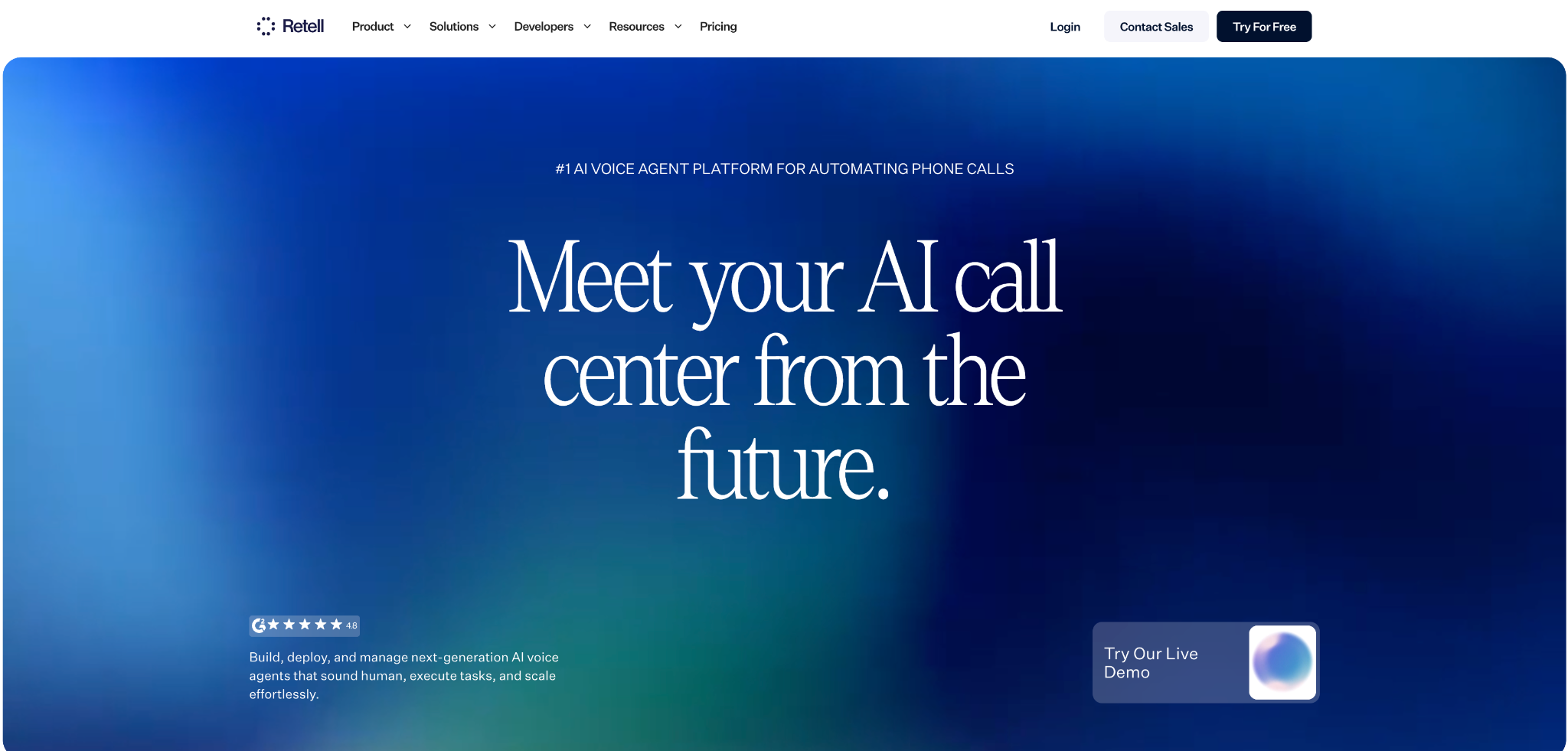
Retell AI gives pay-as-you-go customers access to most of the platform from day one, including call analytics, simulation testing, APIs, knowledge bases, batch calling, and call transfer. Enterprise is mainly where features like SSO, RBAC, dedicated infrastructure, and premium support come in.
Pricing runs from $0.07 to $0.31 per minute, depending on the stack you choose. The base voice infrastructure costs $0.055/min, TTS starts at $0.015/min, LLM costs vary by model, and Retell-managed telephony is around $0.015/min. Add-ons such as knowledge bases, PII removal, denoising, and branded calling cost extra. Billing is calculated to the nearest second, with 20 concurrent calls and $10 in starting credits included.
Where it is weaker: Retell charges for the full time the AI agent is active on a call, including silence and hold time, because the speech system continues listening. For workloads with long pauses or hold periods, that can push the real cost above what the headline per-minute rate suggests.
4. Vapi
Best for: developers who want maximum control over every layer.
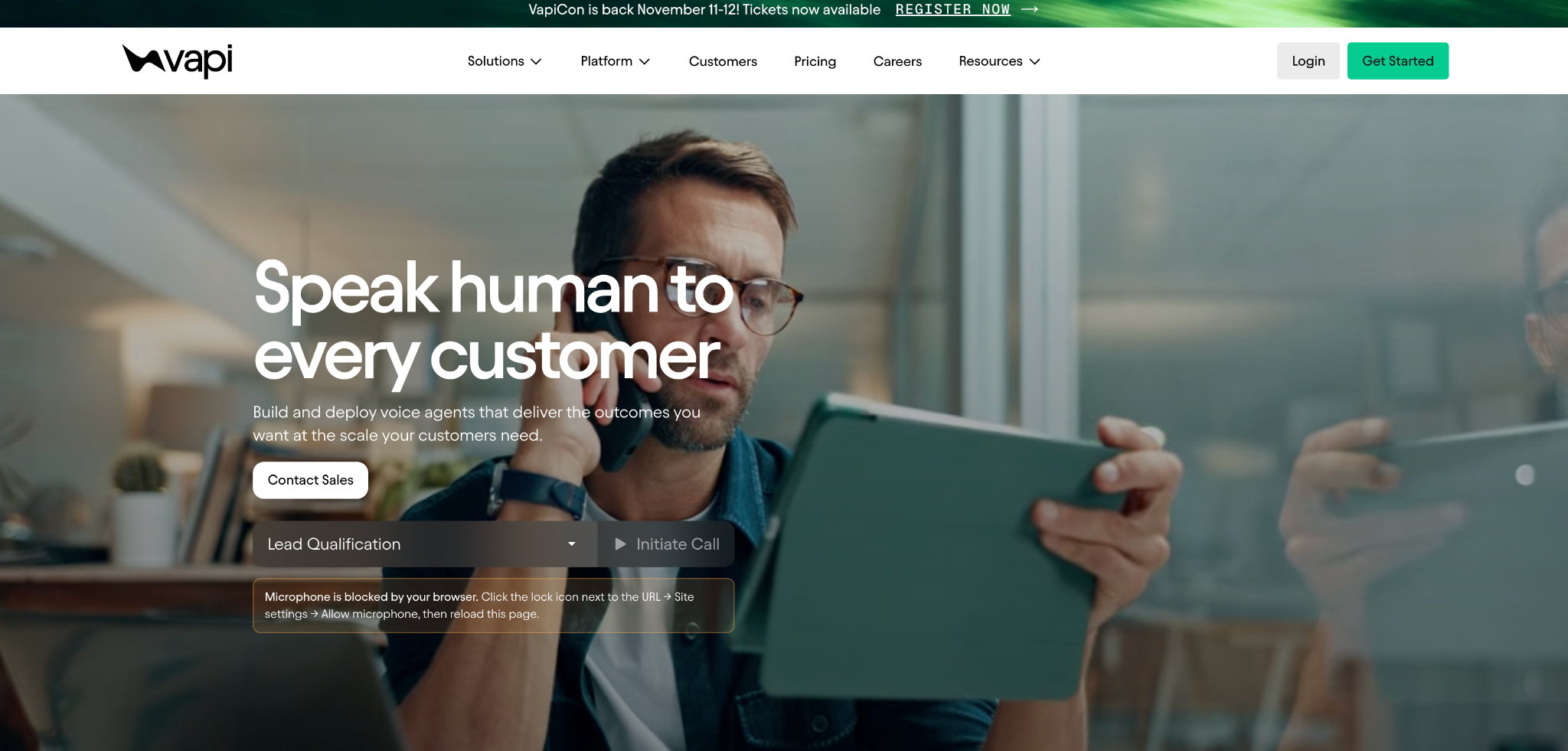
Vapi is the most composable platform on this list. The Build plan charges $0.05 per minute for orchestration, while STT, LLM and TTS costs are passed through at cost. You can also bring your own provider keys, which makes it easy to swap models and see exactly where your spend is going. Ten concurrent lines are included, with additional lines at $10 per month each.
The Scale plan is built for larger deployments, adding SOC 2, PCI, SSO, RBAC, data residency, enterprise SLAs and a dedicated account team. HIPAA costs an additional $2,000/month, while Zero Data Retention is $1,000/month.
Where it is weaker: The flexibility comes with more setup. You are choosing and managing the telephony, transcription, model and voice layers yourself, which engineering teams may love but less technical teams may not. Compliance can also make the entry price misleading: HIPAA alone adds $2,000 per month, and Build-plan call history is retained for only 14 days by default.
5. ElevenLabs Agents
Best for: multilingual deployments where voice quality is the deciding factor.
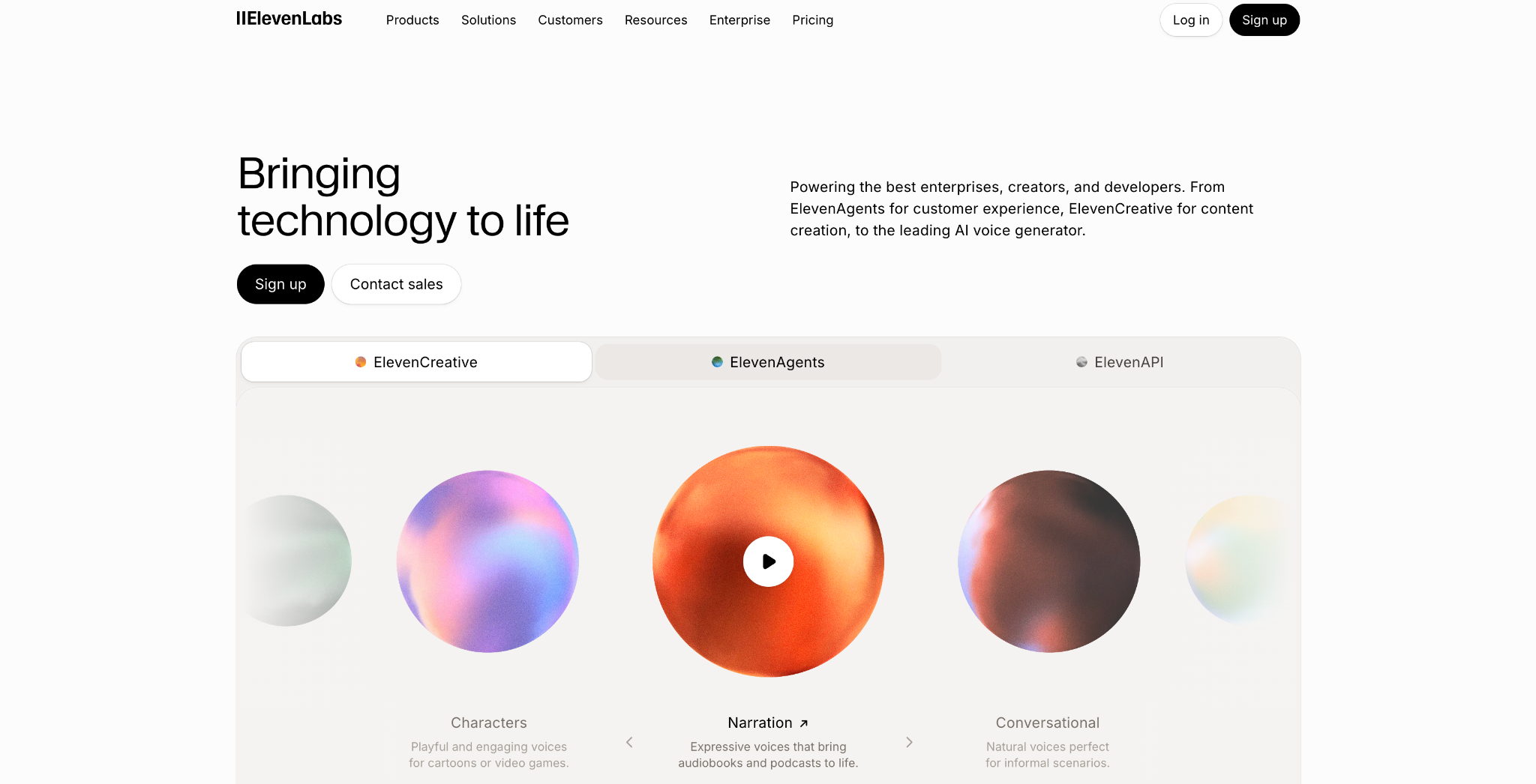
ElevenLabs is still one of the strongest options if the quality of the voice itself matters most. Its agents support 70+ languages and 11,000+ voices, including voice cloning, with sub-second response times and automatic multilingual conversations.
Telephony can be connected through providers such as Twilio, Plivo, Vonage, Telnyx, Genesys, or SIP, while integrations are available for tools like HubSpot, Zendesk, Stripe, and scheduling platforms. Enterprise deployments can add SOC 2, HIPAA, GDPR, regional data residency, Zero Retention, and PCI DSS controls.
Where it is weaker: Telephony still sits outside ElevenLabs. That gives you flexibility, but it also means another provider, another bill, and another system to troubleshoot when a specific route starts causing call-quality issues. If voice quality is the priority, ElevenLabs is hard to beat. If you want tighter control over the carrier layer as well, it is less complete.
How to choose without regretting it in six months
The best voice AI platform is not the one that sounds best in a controlled demo. It is the one that still works when the caller is on a bad mobile connection, interrupts mid-sentence, switches channels, or needs to be handed to a human halfway through the conversation.
So before you commit, test the platform on your worst traffic, calculate the full cost per conversation, check what compliance actually costs, and see what happens when the AI needs to hand off. Then run it on real traffic for two or three weeks. That will tell you more than any latency benchmark or vendor demo.
If you want AI agents and telephony handled more tightly in the same stack, Plivo is where we would start the shortlist. You can test it with $10 in free credits before moving to a larger deployment.
Get started with Plivo · Talk to sales
› no credit card › free credits › cancel anytime