Trade shows, corporate gatherings, festivals, product launches, and conferences have become increasingly competitive environments for attention. Companies often arrive with polished booths, large digital displays, promotional merchandise, and carefully rehearsed presentations. The difficulty is that most competitors are using many of the same tools. Visitors quickly learn to filter out conventional marketing messages as they move through a crowded venue. A logo displayed at eye level may earn a momentary glance, but it rarely creates a meaningful memory on its own. Businesses that want to stand apart increasingly need to give attendees something to do rather than simply something to look at.
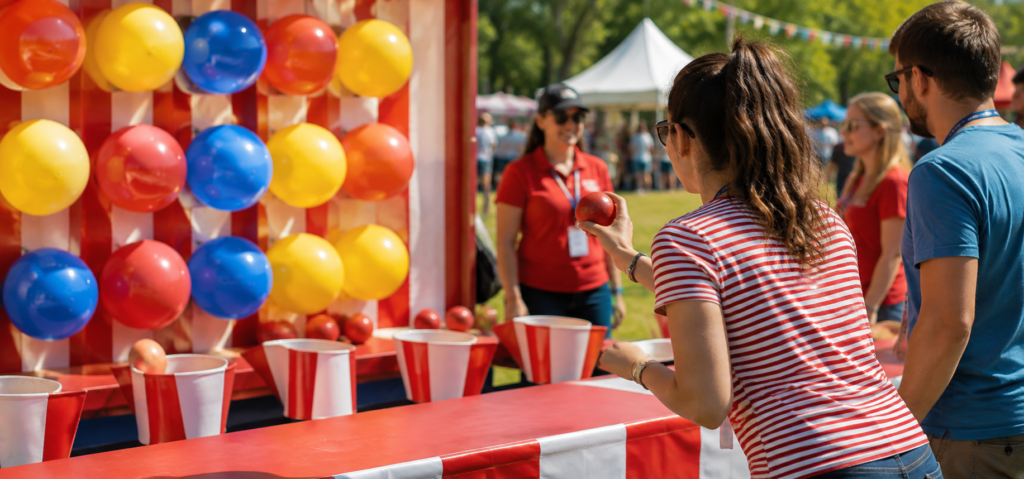
Branded carnival games address that problem by turning a passive marketing encounter into an active experience. Instead of asking visitors to stop and listen to a sales pitch, a company can invite them to test their skill, compete with colleagues, or try to win a prize. The interaction changes the emotional tone of the encounter because the visitor participates voluntarily. A successful game creates anticipation before the attempt, excitement during the activity, and a result that gives participants something to discuss afterward. Those emotional stages provide substantially more opportunities for a brand to become associated with the experience. The marketing value comes not merely from displaying the company name but from connecting that name to an enjoyable moment.
This distinction matters because event attendees are exposed to hundreds of commercial signals within a relatively short period. Signage, screens, lanyards, brochures, demonstrations, and sponsorship messages compete for the same limited attention. Interactive play interrupts that pattern because it requires physical or mental participation. It can also attract observers who initially have no intention of interacting with the company. A small crowd watching someone attempt a game can become its own form of advertising within the event. When executed well, a branded game turns a few square feet of event space into a visible social activity rather than another static promotional display.
Building a Brand Experience Around Play
The strongest branded carnival games are built around a clear experience rather than treated as standard attractions with a logo added afterward. Businesses should first decide what they want participants to feel and remember. A financial company may want to communicate precision and confidence, while a consumer brand may prefer energy, creativity, or friendly competition. The game mechanics can support those qualities through the challenge, pacing, scoring system, and visual presentation. Even simple activities can express a distinctive personality when the concept reflects the company’s identity. This makes the game feel like a natural extension of the brand instead of an unrelated form of entertainment placed inside an event space.
Reaching that level of integration often requires more than choosing an existing game and applying corporate colors. Businesses planning a larger activation may work with specialists that can bring game design, branding, staffing, and event logistics together under one concept. Something New, for example, develops custom carnival games and interactive experiences for brands and events, illustrating how these elements can work together within a broader event strategy. Its approach to brand activations reflects the same principle: interactive entertainment is most effective when it supports the wider experiential concept rather than operating as a standalone attraction. The main lesson for marketers is that the activity, environment, and staff interaction should reinforce the same creative idea. That consistency helps the entire experience feel intentional and memorable.
Brand integration should remain visible without overwhelming the entertainment value that attracted people to the game. Logos can appear on targets, scoreboards, game pieces, backdrops, prize displays, and staff apparel without turning every surface into an advertisement. Companies can also incorporate familiar product shapes, packaging details, mascots, colors, or other recognizable brand elements directly into the activity. A technology company might create a reaction challenge centered on speed, while a consumer brand could turn product features into targets or scoring elements. The strongest executions make these details feel like a natural part of the experience. Participants should feel that they briefly entered the brand’s world rather than simply played a generic carnival game beside corporate signage.
Designing Games That Naturally Attract a Crowd
Crowd appeal is one of the biggest advantages of carnival-style entertainment because participation is often visible to people nearby. An attendee throwing a ball, spinning a wheel, racing a colleague, or attempting a precision challenge can become a performer for a few moments. Other attendees frequently stop to see whether the participant succeeds. That audience creates additional exposure even when the spectators never play. The effect can expand quickly when the game is easy to understand from a distance. Businesses should therefore consider not only whether a game is enjoyable to play but also whether it is entertaining to watch.
Simplicity is particularly important in high-traffic event environments. Visitors should be able to understand the objective within seconds rather than stand through a lengthy explanation. Games with a clear beginning, challenge, and outcome tend to perform well because they maintain momentum. A participant might have three attempts to hit a target, thirty seconds to score as many points as possible, or one opportunity to complete a difficult task. Fast cycles allow more people to participate while preserving a sense of excitement. They also help prevent the attraction from developing a long queue that blocks neighboring exhibitors or discourages potential players.
Visual movement can further increase stopping power. Mechanical components, oversized props, illuminated scoring systems, moving targets, ringing bells, or visible prize displays can draw attention across a crowded room. Sound can also be useful, although businesses should carefully consider venue restrictions and neighboring exhibitors. The objective is to create a focal point without becoming disruptive. Games that produce visible reactions from players often generate the strongest social energy. Laughter, cheering, celebration, and playful frustration signal to passersby that something interesting is happening and provide an invitation to investigate.
Turning Participation Into Meaningful Brand Engagement
A game may attract a crowd, but businesses still need a strategy for converting entertainment into useful interaction. The transition should be subtle because an aggressive sales approach can undermine the goodwill created by the activity. Staff members can welcome participants, explain the challenge, and have short conversations while people wait or collect prizes. Those interactions often feel more natural than opening with a product pitch because the game has already created common ground. Employees can ask simple questions about what brought the attendee to the event or what challenges they are trying to solve. The objective is to create a conversation rather than immediately push for a transaction.
Lead capture can also be incorporated into the experience without making participation feel bureaucratic. Businesses might allow visitors to enter a digital leaderboard by providing basic contact information or send participants their scores by email or text. A QR code can connect the physical game to a contest, loyalty program, product demonstration, or follow-up offer. Some companies may choose to require registration before participation, although that approach should be used carefully. Excessive forms can weaken participation rates and make an entertaining experience feel transactional. The best systems collect only information that has a clear marketing purpose and a reasonable connection to the activity.
Companies should also consider what happens immediately after the game ends. A participant who wins may receive a prize, pose for a photograph, appear on a leaderboard, or be invited to challenge a colleague. Someone who narrowly loses might be encouraged to try again later or share the experience with another attendee. Each of these moments extends engagement beyond the original attempt. Staff can use that brief period to provide a relevant product message or direct visitors toward another part of the exhibit. Good experiential marketing creates several natural points of interaction rather than relying on one formal sales conversation.
Using Competition to Increase Repeat Visits and Dwell Time
Competition can make branded carnival games significantly more compelling because participants have a reason to care about the outcome. Even a straightforward activity becomes more interesting when scores are recorded and compared. A visible leaderboard can encourage participants to return later in the day to see whether someone has surpassed them. It may also motivate colleagues, clients, or friends to challenge one another. That social rivalry increases the number of interactions generated by a single game installation. Businesses gain additional exposure without having to repeatedly ask attendees to return.
Competitive structures can be designed for different types of events. At a conference, companies might maintain a daily leaderboard and award a premium prize to the highest scorer before the exhibition hall closes. At an employee event, departments could compete for cumulative points. A product launch might invite guests to challenge influencers, executives, or brand representatives. Large festivals could use elimination rounds that culminate in a final contest. The format should match the event schedule and audience rather than introduce unnecessary complexity.
Competition also creates valuable dwell time around a brand’s space. Participants who might otherwise spend only a minute at a booth could remain for several minutes while watching others compete or waiting for another attempt. Their colleagues may stay with them, increasing the number of people exposed to the company’s messaging. Longer visits provide more opportunities for staff to explain products, answer questions, or develop relationships. Businesses should nevertheless avoid intentionally creating slow lines simply to increase dwell time. The goal is enjoyable engagement, not manufactured congestion.
Creating Branded Moments People Want to Share
Event marketing increasingly extends beyond the physical venue because attendees document their experiences on social platforms and private messaging channels. A visually distinctive carnival game can become content when participants want photographs or videos of themselves playing. Businesses can encourage that behavior by designing installations with strong backdrops, clear branding, interesting props, and recognizable visual moments. An oversized game piece or dramatic reaction shot can be more compelling than a conventional step-and-repeat wall. The activity gives people a reason to record themselves rather than simply asking them to pose beside a logo. That distinction can make branded content feel more spontaneous.
Social sharing should be designed into the experience without becoming mandatory. Participants might receive a short video of their attempt, a digital photograph, or a personalized scorecard that can be shared online. A branded hashtag can help aggregate posts, although companies should not assume attendees will use one without a compelling reason. Instant replay screens and celebratory graphics can also create content-friendly moments. If the game produces visually satisfying wins or amusing near misses, participants may share the result naturally. Organic enthusiasm usually produces stronger advocacy than offering a small incentive solely in exchange for a post.
Businesses also need to consider how their branding will appear in photographs and videos captured from different angles. A logo positioned only on the front of a game may disappear when someone records the experience from the side. Repeating subtle branding on props, backgrounds, score displays, and game surfaces increases the likelihood that the company remains identifiable. Lighting is equally important because poorly illuminated activations rarely look appealing on mobile cameras. The visual system should support both the live experience and the images produced from it. A well-designed game can therefore operate simultaneously as entertainment, signage, and user-generated media.
Choosing Prizes That Reinforce the Experience
Prizes are closely associated with carnival games, but businesses should treat them as part of the marketing strategy rather than an afterthought. A prize gives the participant a tangible reminder of the experience and can extend brand exposure long after the event. Standard promotional items such as pens or inexpensive keychains rarely create much excitement because attendees often receive similar merchandise elsewhere. More distinctive prizes can increase participation and improve the perceived value of the activation. They do not necessarily have to be expensive. Creativity, usefulness, scarcity, and presentation can matter as much as cost.
Tiered prize structures can make a game more engaging for participants with different outcomes. Everyone might receive a small branded item, while higher scores unlock more desirable rewards. Exceptional performances could qualify for limited-edition merchandise, event tickets, premium products, or an entry into a larger drawing. This system preserves the carnival tradition of earning a reward through performance. It also makes winning feel more meaningful than simply receiving a promotional giveaway. Businesses should make the rules transparent so participants understand what they are competing for before they begin.
The prize should ideally reinforce the identity or purpose of the company. A food brand could offer product bundles or collectible packaging, while a travel company might give away useful accessories connected to exploration. A software company could provide unusual physical merchandise that references its product culture or community. Limited-edition items can be especially effective because scarcity adds perceived value. Whatever the selection, businesses should avoid prizes that overshadow the experience so completely that participants care only about obtaining the reward. The strongest activations make the game itself enjoyable while allowing the prize to provide a satisfying conclusion.
Adapting Carnival Games to Different Event Formats
Not every event provides the same amount of space, time, infrastructure, or audience attention. A large outdoor festival may support multiple games, significant signage, amplified sound, and substantial prize storage. A crowded trade show booth may offer only a small footprint and strict height restrictions. Corporate receptions may require quieter activities that can operate near conversations and dining areas. Businesses should therefore choose games based on the environment rather than assuming that a concept can be transferred unchanged between venues. Practical constraints have a direct effect on participant experience.
Indoor trade shows often benefit from compact games with short participation cycles. Tabletop challenges, precision activities, digital scoring systems, or vertical games can produce strong engagement without occupying excessive floor space. Outdoor events may allow more physical activities, larger equipment, and games that can be seen from considerable distances. Evening events may benefit from illuminated elements that become part of the atmosphere. Conferences may require a more restrained aesthetic that complements professional networking. The format should feel appropriate to the setting while still providing enough novelty to stand out.
Logistics should be considered early in the planning process. Companies need to evaluate power availability, transportation, setup times, staffing requirements, insurance, accessibility, safety procedures, weather contingencies, and venue regulations. A visually impressive concept that cannot operate reliably will quickly become a liability. Businesses should also plan for peak periods when participation may be much higher than expected. Additional staff, clear queue management, and efficient prize distribution can prevent operational problems. Strong execution often determines whether an ambitious experiential idea becomes a memorable attraction or an expensive distraction.
Measuring the Business Value of a Branded Game
Experiential marketing should be evaluated with the same discipline applied to other marketing investments. Attendance alone provides only a partial picture because a crowded game does not necessarily translate into commercial value. Businesses should determine their objectives before the event and choose metrics that reflect those goals. Relevant measures might include number of participants, qualified leads, average dwell time, social mentions, QR code scans, newsletter registrations, product demonstrations, or meetings booked. Companies may also track how many attendees return for a second attempt. Clear objectives make it easier to evaluate whether the activation justified its cost.
Data collection should not interfere with the experience itself. Digital scoring systems can automatically track participation volume and repeat plays. Lead-capture tools can associate players with scores or prize entries when participants have provided permission. Social monitoring can show whether the activation generated meaningful online attention. Staff can also record qualitative observations, such as common questions or unexpectedly popular aspects of the game. Combining numerical data with employee feedback provides a more complete picture than focusing on a single metric.
Post-event analysis should connect engagement to downstream business outcomes whenever possible. Leads generated through the game can be compared with leads gathered through traditional booth interactions. Sales teams can track whether participants respond differently to follow-up messages or show stronger recall of the company. Businesses might also compare results across several events to determine which games, prizes, or messaging approaches consistently perform best. Over time, these findings can turn experiential marketing from a novelty into a repeatable acquisition and brand-building channel. Measurement also helps companies justify further investment by showing exactly what the experience contributed.
Making Play Part of a Broader Event Strategy
Branded carnival games work best when they support an organization’s wider event objectives rather than operate as isolated entertainment. The activity should connect visually and strategically with the rest of the company’s presence. Messaging used by staff, signage surrounding the game, digital follow-up, prize selection, and post-event communications should reinforce the same central idea. When those components align, attendees experience a coherent campaign rather than several unrelated marketing tactics. The game becomes an entry point into the brand story. That gives the entertainment a business purpose while preserving the pleasure of participation.
Companies should also consider how a successful concept can evolve across multiple events. A recognizable game might become a recurring element of the brand’s conference presence, with new challenges or prizes introduced throughout the year. Alternatively, businesses can create a broader family of games built around the same visual system and strategic idea. Repeatability can improve efficiency because equipment, training materials, creative assets, and operating procedures can be reused. Familiarity may also help customers recognize the company at future events. The challenge is preserving enough novelty to keep the experience from becoming predictable.
Ultimately, the strategic advantage of branded carnival games comes from their ability to transform commercial attention into voluntary participation. People rarely attend events hoping to collect more brochures or listen to more sales pitches. They do, however, respond to opportunities to play, compete, laugh, and share experiences with others. Businesses that understand this behavior can create event environments where marketing becomes something attendees actively choose to engage with. The strongest concepts respect the participant’s desire for entertainment while carefully integrating branding and commercial objectives. In a crowded event landscape, creating an experience people genuinely want to join can be more powerful than simply trying to be seen.