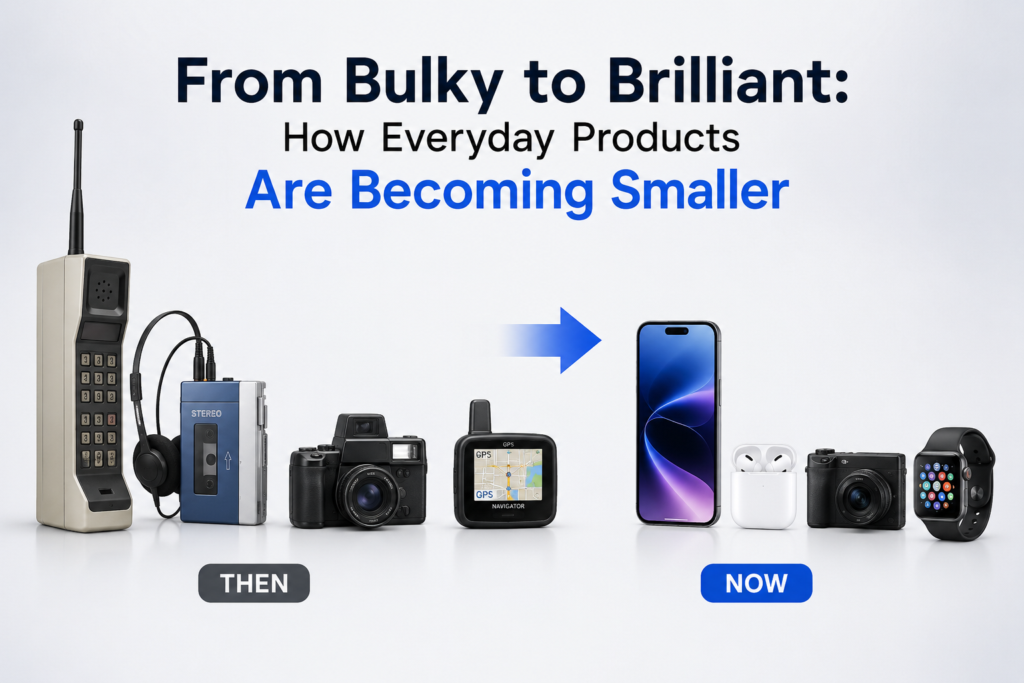
and SmarterSome of the most interesting innovations are not the products that completely change our lives overnight.They are the products that quietly become smaller, lighter, faster, and easier to use. Flying horse Consider how much everyday technology has changed in the last twenty years.Phones became computers.Cameras became pocket-sized.Music collections moved from shelves to streaming services.Headphones lost their wires.Batteries became smaller while powering increasingly sophisticated devices.This transformation is driven by a simple idea: better technology allows manufacturers to do more withless.
Why Smaller Products Are Winning
Portability has become one of the most valuable characteristics of modern products.People carry their technology everywhere.That creates demand for devices that can fit into pockets, bags, cars, desks, and small living spaces.But shrinking a product is not as simple as making every component smaller.Engineers must rethink how batteries, processors, sensors, motors, heating systems, and othercomponents work together.Miniaturization requires creativity.
Battery Technology Is Changing Everything
Battery technology is one of the biggest factors behind smaller consumer electronics.1As batteries become more efficient, manufacturers can create products that deliver useful performancewithout requiring large power sources.This has opened the door to smaller wireless devices, wearable technology, portable medical equipment,compact cameras, and countless other products.Battery technology also presents challenges.Manufacturers have to consider charging time, operating temperature, safety, capacity, durability, anddisposal.As consumers purchase more battery-powered products, responsible battery management will becomeincreasingly important.
Smart Design Beats Unnecessary Complexity
Innovation is sometimes misunderstood as adding more features.But the best product designers often remove unnecessary complexity.A well-designed product can feel almost effortless.The user does not need to understand everything happening internally.They simply interact with the product and get the desired result.This philosophy can be seen throughout modern technology.Touchscreens replaced physical buttons in many devices.Automatic sensors replaced manual controls.Wireless connectivity eliminated cables.Voice interfaces reduced the need to navigate complicated menus.Good design hides complexity instead of forcing consumers to manage it.
Materials Are Part of Innovation
Product innovation is not limited to electronics.New materials are changing how everyday objects are designed.2Manufacturers are experimenting with lighter composites, recycled materials, biodegradable packaging,advanced polymers, and stronger metals.The goal is often to create products that are simultaneously lighter, stronger, cheaper, or more sustainable.Packaging is another major area of innovation.Companies are under increasing pressure to reduce unnecessary plastic, excessive boxes, and difficult-torecycle materials.Better packaging can reduce shipping costs while also improving the environmental footprint of a product.
Personalization Is Becoming the New Standard
Consumers increasingly expect products to fit their individual preferences.Streaming services personalize recommendations.Smartphones allow users to customize interfaces.Fitness devices track individual activity.Online shopping platforms remember preferences.This expectation is spreading into physical products as well.Consumers want choices in colors, sizes, accessories, configurations, and features.Manufacturers can respond by creating modular products that allow customers to select the componentsthey actually need.
Innovation and Sustainability
There is an important relationship between innovation and sustainability.A smaller product may require fewer materials.A rechargeable product may reduce the frequency of replacement.Repairable products can remain useful for longer.Recyclable packaging can reduce waste.However, innovation should not automatically be confused with sustainability.3A product can be technologically advanced while still creating significant environmental problems.Manufacturers therefore need to consider the entire product lifecycle.How is it manufactured?How much material does it require?How long will it last?Can it be repaired?What happens when it reaches the end of its useful life?These questions are becoming increasingly important.
Consumers Are Driving Innovation
Technology companies often receive credit for innovation, but consumers play a major role in determiningwhich innovations survive.When people consistently choose products that are portable, convenient, durable, and easy to use,manufacturers respond.Consumer behavior creates market signals.A successful product can inspire competitors to develop similar technologies, eventually making newfeatures standard across an entire industry.This process is one reason consumer technology can evolve so quickly.
What Comes Next?
The next generation of everyday products will likely become even more integrated into our routines.Artificial intelligence will personalize experiences.Sensors will make products more responsive.Batteries will continue improving.Materials will become more specialized.Manufacturing will become increasingly automated.4At the same time, consumers will demand something that technology alone cannot provide: trust.People want to know that products are safe, accurately represented, responsibly manufactured, and worththe money they spend.
The Real Meaning of Innovation
Innovation is not simply about creating something new.It is about creating something better.Sometimes that means adding a new capability.Sometimes it means removing unnecessary steps. Ghost carts Sometimes it means using fewer materials or making a product last longer.And sometimes the biggest innovation is simply making a complicated technology feel completely ordinary.The most successful products of the future will likely combine all of these ideas.They will be smaller, smarter, easier to use, more transparent, and more thoughtfully designed.That is the direction consumer technology has been moving for years—and there is little indication that thetrend is slowing down.