Hardware products can change quickly during development. A shielding cover may need another opening, a contact spring may need a wider tab, or a sensor plate may require a revised pattern after testing. When each change depends on a new hard tool, cost and schedule risks can rise before the design is ready. For thin, detailed metal parts, photochemical etching offers another path from early prototypes to repeat production.
Why Tooling Becomes a Risk Too Early
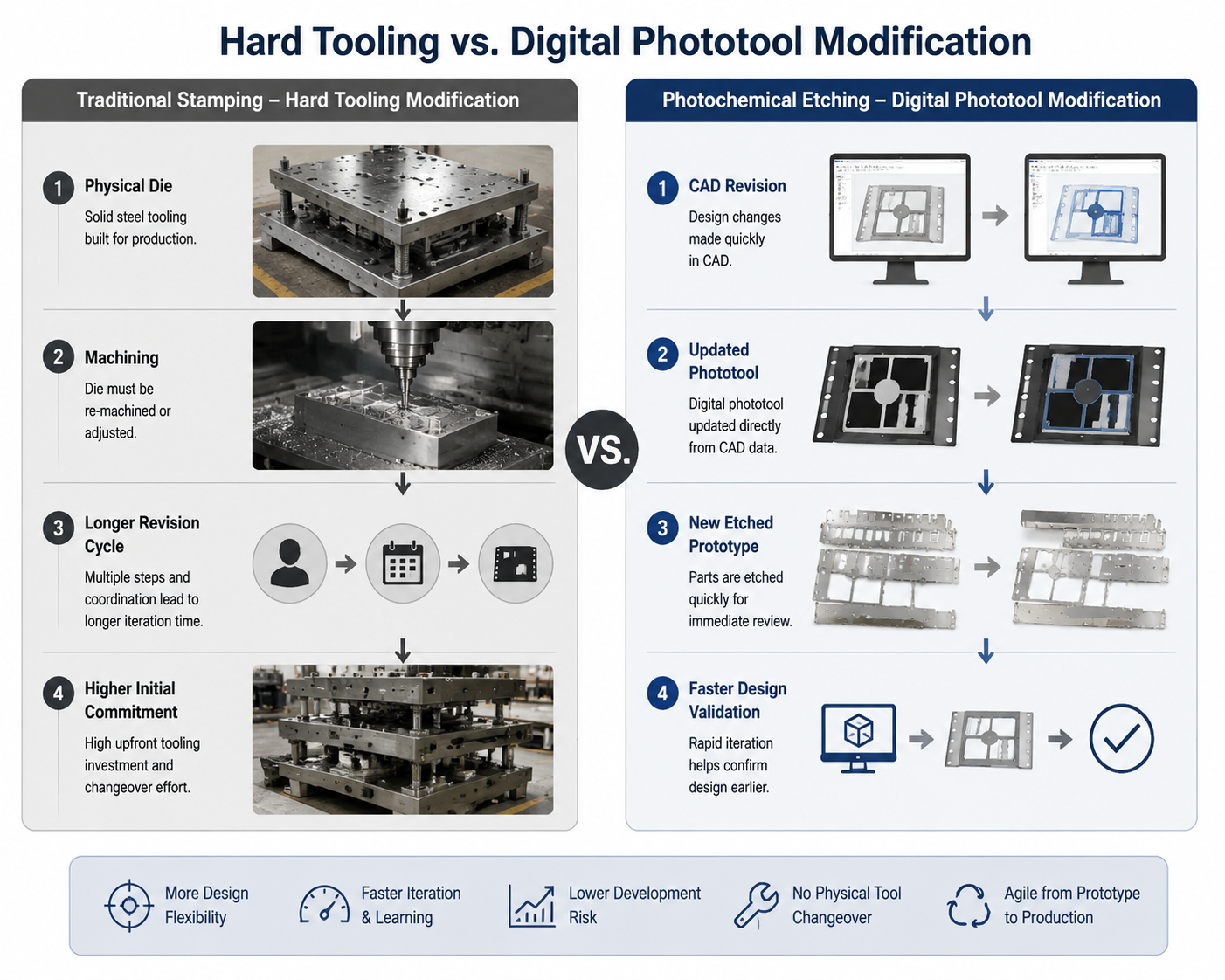
Stamping dies can deliver excellent productivity when a design is stable and annual volume is high. The risk appears when a team commits to hard tooling before it has finished testing geometry, material, assembly, or product performance.
A late design change may require a tool modification or replacement. The project can absorb more cost, lose time, or continue with a design that is not fully optimized.
The development method should therefore provide useful parts for testing without forcing the team to lock every feature too early.
How Photochemical Etching Uses Digital Tooling
Photochemical etching, also called photo etching or photochemical machining, produces flat metal components through controlled imaging and chemical removal.
A cleaned metal sheet is coated with a light-sensitive photoresist. A digital pattern is transferred through ultraviolet exposure. After development, selected areas remain protected while an etchant removes the exposed metal. The parts are then stripped, cleaned, and inspected.
Unlike a stamping die, the phototool is based on digital artwork. Updating a hole, slot, tab, identification mark, or outer profile generally begins with revising that artwork.
Digital phototooling can therefore reduce the cost and delay associated with physical tool changes during early development.
Why It Supports Faster Design Iteration
Product validation rarely follows a straight line. A prototype may fit the assembly but fail an airflow test. A shield may need a different ventilation pattern. A connector may require a revised contact area.
Photochemical etching allows teams to test these changes without rebuilding a complex hard die for every version. Multiple design variants can also be arranged on one sheet when their material and process requirements are compatible.
The process does not use a cutting tool that presses directly against the part. This makes it useful for thin metals and intricate flat geometries that could be affected by mechanical force.
It can also produce clean edges without the raised burrs commonly associated with mechanical blanking.
Where It Fits in the Hardware Lifecycle
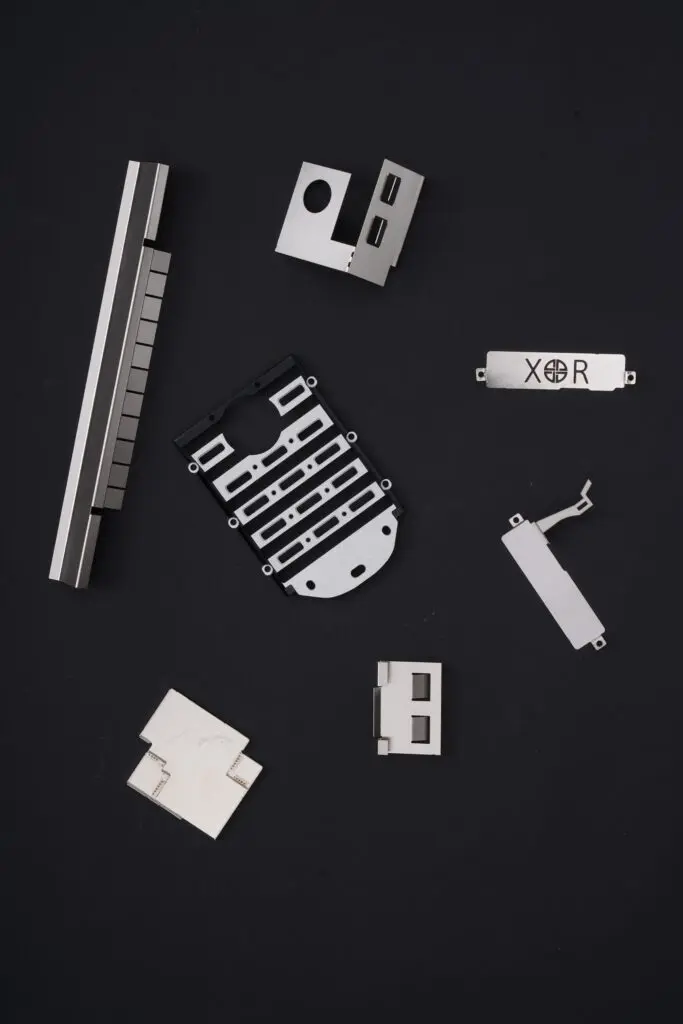
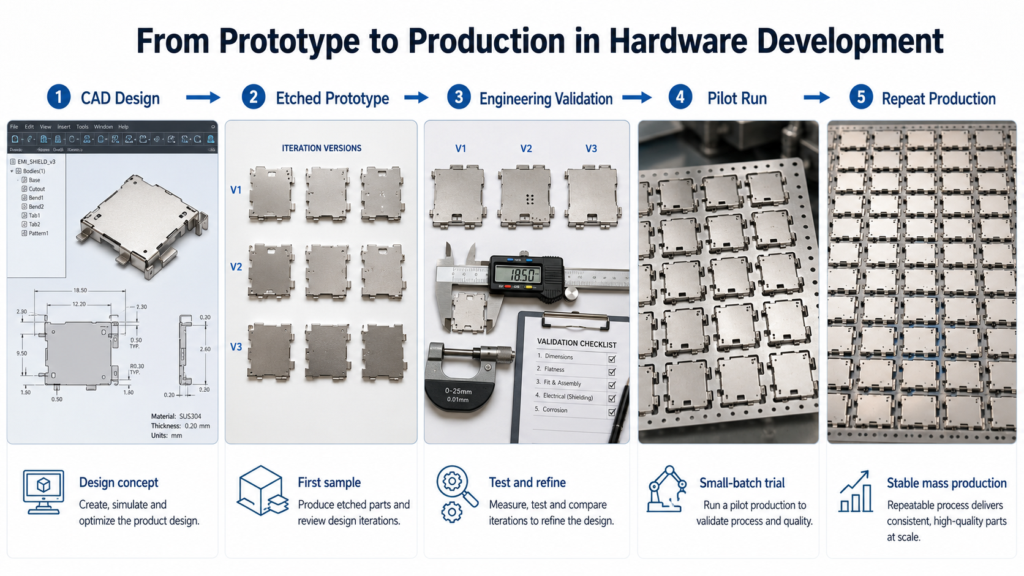
During concept development, etched samples can help teams evaluate size, shape, material, and assembly. These parts may reveal issues that are difficult to identify in a CAD model alone.
During engineering validation, the same process can support refined parts for dimensional checks, functional testing, and integration with other components.
Pilot production can reveal handling, inspection, packaging, forming, plating, and supplier coordination requirements before demand increases.
Photochemical etching may also continue into repeat production when parts remain thin and complex, order volumes do not justify a stamping die, or several product variants must be supported.
The best path depends on geometry, tolerance, material, production volume, and total cost.
Components That Often Benefit
The process is commonly considered for thin metal parts with detailed two-dimensional patterns. Examples include EMI shielding, electrical contacts, lead frames, encoder disks, precision shims, fine metal screens, flat springs, apertures, and thin flow plates.
These components appear in electronics, medical devices, automotive systems, aerospace equipment, sensors, and industrial automation.
Their functions differ, but their manufacturing challenges are often similar. They may require limited installation space, fine features, clean edges, precise openings, and flexibility for future design changes.
When a project also requires forming, plating, polishing, cleaning, or specialized packaging, buyers should examine how these steps connect with etching.
Reducing the number of supplier handoffs can make revision control, inspection, and delivery planning easier to manage.
When Hard Tooling Still Makes Sense
Photochemical etching should not replace stamping, laser cutting, or CNC machining in every project.
Stamping may provide the best unit economics when a simple design is stable and production volume is very high. CNC machining is often more suitable for thick parts or complex three-dimensional shapes. Laser cutting can be effective for many thicker flat components and lower-volume requirements.
The right question is which process matches the product’s maturity and final production requirements.
Some projects may begin with etching and later move to stamping. Others may remain with etching because their geometry, product mix, or order pattern continues to favor flexible tooling.
What Hardware Teams Should Ask Suppliers
Before requesting a quote, teams should provide the material grade, thickness, drawing, critical dimensions, tolerances, quantities, and secondary-operation requirements.
They should also ask how revisions are recorded, how prototypes are inspected, whether different variants can be processed together, and how process controls change as volume grows.
Material traceability, inspection reports, packaging, lead times, and communication procedures can be as important as the etching step itself.
A supplier should also discuss design for manufacturing. Small adjustments to corner geometry, web width, hole spacing, or part layout may improve manufacturability without changing the intended function.
Reducing Risk Before Scaling
Hardware development always carries uncertainty. The goal is not to remove every design change, but to prevent each revision from creating unnecessary tooling costs and schedule disruption.
Professional metal etching provides a flexible option for producing custom components while designs are still evolving. By connecting digital artwork with a repeatable metal-removal process, it can support prototypes, validation builds, pilot runs, and selected production programs.
For hardware teams, this flexibility can make the path to production more controlled. The result is not only a faster prototype, but also better information for deciding when to revise, when to scale, and when another manufacturing process becomes the smarter choice.