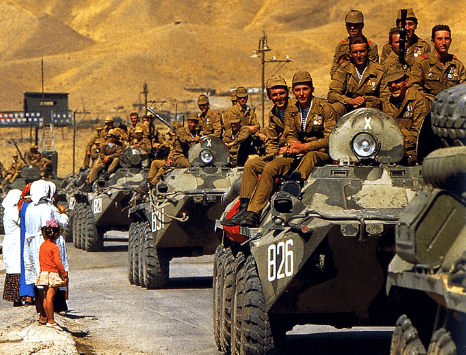
The Soviet-Afghan War was a conflict that lasted from 1979 to 1989, with the Soviet Union invading Afghanistan to support the communist government in Kabul. The war was a significant event in the Cold War, as it marked the first time the Soviet Union had directly intervened in the affairs of a neighboring state outside the Soviet bloc.
The Soviet Union had long-standing ties with Afghanistan and had provided the country with economic and military aid since the 1950s. However, by the late 1970s, the country was facing increasing instability, with a communist government coming to power in a coup in 1978.
The Soviet Union saw the new government as an ally and sent troops to Afghanistan in December 1979 to support it. The Soviet Army was initially met with little resistance, but soon found itself fighting against a growing insurgency of Afghan mujahideen, who were supported by the United States, Pakistan, and other countries.
Books about the Soviet-Afghan war
- “The Bear Went Over the Mountain: Soviet Combat Tactics in Afghanistan” by Lester W. Grau – This book provides a detailed analysis of the Soviet Army’s tactics and strategy in Afghanistan, based on interviews with Soviet veterans and other sources.
- “The Other Side of the Mountain: Mujahideen Tactics in the Soviet-Afghan War” by Ali Ahmad Jalali and Lester W. Grau – This book provides a detailed analysis of the tactics and strategy used by the Afghan mujahideen, based on interviews with former mujahideen fighters.
- “The Hidden War: A Russian Journalist’s Account of the Soviet War in Afghanistan” by Artyom Borovik – This book provides an inside look at the Soviet Army’s experience in Afghanistan, as seen through the eyes of a Russian journalist who covered the war.
- “Uniforms and history of the Soviet Airborne – the 345th Regiment in Afghanistan” by Vladyslav Besedovskyy – this book concentrates on one exact Soviet Airborne regiment and takes you through the whole journey through the soldiers’ perspective.
- “The Afghan Trap” by Brigadier Mohammed Yousaf and Mark Adkin – This book provides a detailed account of the war from the perspective of the Pakistani intelligence officer who helped to organize and support the Afghan resistance.
- “Charlie Wilson’s War: The Extraordinary Story of the Largest Covert Operation in History” by George Crile – This book provides an overview of the U.S. covert operation to support the Afghan mujahideen during the war, as well as the political and diplomatic maneuvering that took place behind the scenes.
These books offer different perspectives on the Soviet-Afghan War, from the tactics and strategy of the combatants to the political and diplomatic context of the conflict.
The end of the Soviet-Afghan war
The war quickly became a quagmire for the Soviet Union. The Afghan resistance was highly effective at using guerrilla tactics to target Soviet troops, and the Soviet Army was ill-prepared for the harsh mountain terrain of Afghanistan.
The Soviet Army suffered heavy losses during the war, with estimates of Soviet casualties ranging from 15,000 to 50,000 troops killed. The war also took a toll on Afghanistan, with an estimated 1 million Afghan civilians killed and many more displaced or injured.
The Soviet Union eventually withdrew its troops from Afghanistan in 1989, after a decade of fighting. The war was a significant defeat for the Soviet Union and is widely seen as contributing to the country’s eventual collapse in 1991.
In conclusion, the Soviet-Afghan War was a significant event in the Cold War, with the Soviet Union invading Afghanistan to support a communist government in Kabul. The war became a quagmire for the Soviet Union, with heavy losses suffered by both Soviet troops and Afghan civilians. The war is seen as contributing to the eventual collapse of the Soviet Union.