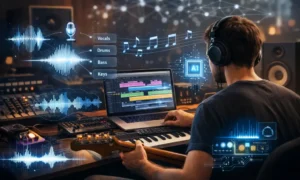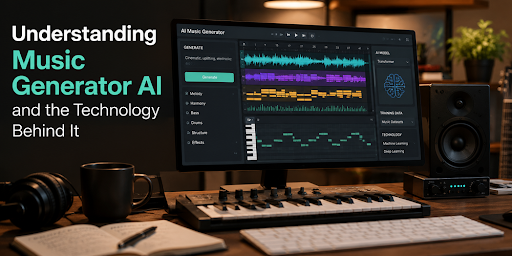
The concept of composing music with artificial intelligence used to feel like science fiction. It is now a viable option for producers, corporations, and music fans all around the world. Written prompts may be transformed into creative songs, instrumentals, and background tracks in minutes using platforms such as Music Generator AI. While the results appear nearly mystical, the technology underlying these systems is based on advanced machine learning algorithms that analyze musical patterns and produce totally new songs.
What Is Music Generator AI?
Music Generator AI utilizes artificial intelligence to create creative music. These systems create creative tunes based on user input rather than pre-recorded recordings. A genre, ambiance, or musical arrangement might all serve as triggers. melodic piano ballad.
These algorithms vary from regular music libraries in that they always generate something new. Instead of choosing from current music, the technology generates new audio that corresponds to the user’s desire. This potential has piqued the interest of content makers, marketers, educators, and independent developers seeking bespoke music without the need for a long production process.
The Technology Behind AI-Generated Music
Machine learning serves as the foundation of current music-generating systems. This is a general-purpose model designed for music AI—trained on huge amounts of music data and able to recognize musical patterns across multiple styles and genres of music: to connect chord progressions, notes, rhythm, harmony, and song structure in the context of musical education; to be able to predict what other musical experience will go well with it as part of an entirely new creative work. Given a prompt from the user, it analyzes and composes the music that embodies certain characteristics. While the consumer perceives the process as rapid, various computations are performed behind the scenes to establish how the final song should sound.
The quality of music composition has significantly improved as a result of recent developments in AI. Current models may produce more complex arrangements with better musical coherence, whereas earlier algorithms occasionally produced repetitive or unrealistic outcomes.
Why Creators Are Using These Tools
The simplicity of use of AI-powered music composition is one of the main factors contributing to its rising popularity. Sometimes specialized expertise, recording equipment, instruments, and software are needed for traditional music creation. Many people have unique ideas but lack the technical abilities required to transform them into full songs.
Artificial intelligence contributes to the closing of this gap. Someone with no professional musical experience can express a notion and get a playable piece in minutes. This reduces the entrance hurdle and allows more individuals to get involved in music making.
The technology is also attractive because of its speed. Before settling on the best music for a video production, a creative may need to explore several options. Instead of searching through stock libraries for hours, they may produce many versions that are appropriate for the project’s tone and design. This ability to explore ideas quickly has become one of the technology’s most practical benefits.
Common Applications Across Industries
Beyond the area of traditional music creation, AI-generated music is widely used. These technologies are being incorporated into the operations of several industries. Custom background music is used by filmmakers to enhance the story and grab viewers’ attention. Podcasters compose music that embodies their brand identity for introductions and transitions. Game designers build soundtracks for certain situations or locales.
Customized audio content may also help marketing teams. Music that is appropriate for a brand’s message and target demographic is frequently required for promotional campaigns. Instead of depending on generic stock tracks, businesses may produce music that is more personalized to their purposes.
Educational material makers have also found usefulness in technology. These days, instructional videos, lectures, and online courses can employ audio produced by AI. It can optimize teaching processes and will not incur high production costs. We cannot help but ask:
Can artificial intelligence replace human musicians?
This is a frequently debated question that has emerged since AI entered creative fields. Even as technology continues to advance, we must clearly recognize AI’s limitations—music is far more than just properly arranged notes. It also carries human individuals’ experiences, emotions, cultural imprints, and original ideas.
Artificial intelligence is extremely adept at spotting patterns and generating variants depending on what it has learned. It does not, however, reveal a person’s life experiences. As a result, many artists view these tools as improvements rather than replacements. Although they can help produce ideas, speed up procedures, and give inspiration, human artists are the only ones capable of making creative judgments.
The interaction between artists and technology has always changed throughout time. Artificial intelligence may ultimately become a tool that assists the creative process, much as digital recording software has.
What the Future Could Hold
The progression of advancement in artificial intelligence predicts that music-generation systems will continue to improve. Future versions may provide greater flexibility over song structure, instrumentation, voice styles, and emotional tone. Users may be able to work with these systems in more engaging and customized ways than existing tools enable.
As the technology advances, it is likely to be incorporated into larger creative workflows rather than being a stand-alone solution. Producers, composers, marketers, and content producers can utilize it in addition to typical production methods to save time and experiment with new ideas.
Simultaneously, concerns regarding copyright, ownership, and ethical usage will continue to shape the business. The long-term effectiveness of these tools will be determined not only by technological innovation, but also by how responsibly they are designed and implemented.
Conclusion
Music Generator AI is a significant advancement in the evolution of music composition. These technologies, which combine machine learning with musical knowledge, allow users to create creative sounds from basic instructions. Producers may use technology to solve technical challenges, analyze ideas more quickly, and make original music for a range of uses.
Though it is unlikely to take the place of human creativity, artificial intelligence is already having an impact on how many individuals approach music creation. Technology will surely become a more crucial instrument for musicians looking for new ways to realize their ideas as it develops.