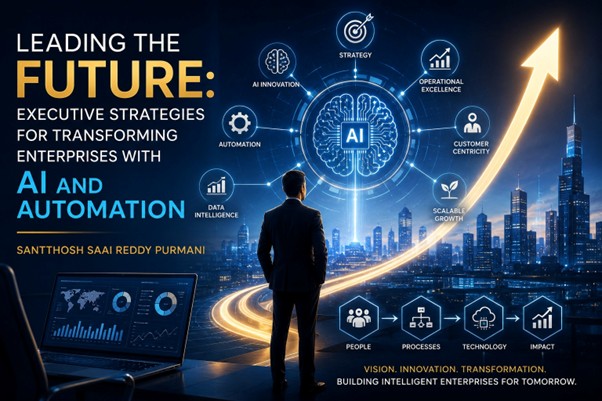
The current, fast-paced business world finds artificial intelligence (AI) and automation essential in maintaining competitive advantage. The role of executive leadership plays a central role in leading organizations to undergo a technological transformation. The leaders must align AI efforts with strategic goals, create an organizational culture that is open to innovation, and empower the use of data to make decisions. Making intelligent systems work together enables the executives to optimize the operations, increase efficiency and performance of the organization. The research paper of Santthosh Saai Reddy Purmani examines the role of leadership strategies, AI adoption and automation on overall efficiency of operations, decision-making, revenue growth and customer satisfaction.
AI in the Executive Leadership of Transformation
Transforming to adopt AI needs visionary leadership to achieve successful transformation. In order to innovate and excel, executives should establish specific AI goals, explain their strategic importance and create a culture of innovation. The roles of a leader extend beyond technical management and control to include change management, ethical leadership and cooperation between the technical and business teams. The ability to empower employees by training and providing resources guarantees that AI power initiatives enhance organizations abilities without needing to interrupt the workflow. The leaders need to balance the chances and possible threats of AI implementation, such as threats to privacy and algorithm bias.
Business Strategy and AI Initiative Alignment
The need to support organizational strategy to achieve effective AI initiatives. AI projects are supposed to be aimed at efficiency in their operations, customer experience, as well as the generation of revenue. The translation of technical innovation to business deliverables becomes assured by aligning business AI efforts. The task of executives is to align. Better alignment to its business strategies, improved performance of the business operations and generation of new business opportunities are realized by using AI. This type of alignment places organizations in a position to gain a competitive advantage and success in the long term.
Implications of change in organizations and culture
Use of AI demands significant culture and organizational transformations. Automation is disruptive to workflows and roles, and requires a good change management process. The resistance may be observed in case the employees are afraid to be displaced or are not aware of novel technologies. Strong leadership is able to convey the advantages of AI, spearheaded by its application in enhancing human abilities, and not eliminating them. Training and skill development investments, as well as the innovation culture, are essential to keep engagement. To guarantee that solutions serve a diverse workforce, leaders should adjust the organizational structures to AI-enabled workflows and help foster inclusiveness. Cultural adaptation contributes to the successful integration of AI and prevents threats related to bias or misalignment.
Execution of decision and performance influence
AI can improve decision-making through up-to-date analytics and predictive suggestions. There is reduced operational risk and fast-tracked strategic execution as the executives are able to make informed, objective and efficient decisions. AI tools enable leaders to predict market changes and trends, predict customer behavior and always identify possible disruptions. The efficiency of the decision-making process will lead to a quicker strategy implementation, a greater level of precision, and increment of ROI. Companies that apply AI make verifiable gains in their performance measures, such as time savings in decision-making, operational efficiency, and alignment with the business objectives.
Analytical Intelligence and Analyzing
AI evaluation is a key area of visual analytics. Radar charts, heatmaps, pie charts, and box plots provide the data visualization that indicates the correlation between AI adoption and implementation strategy, ROI, and efficiency of decision making. Following the trends of AI adoption and the results of its performance, the executives will have the liberty to make quality choices concerning investments and resource allocation, as well as optimizing processes. These analytical tools allow explorers to monitor the progress, evaluate the success of projects and make sure that AI projects contribute to the strategic goals and the overall performance of the business.
Future Implications in the Deployment of AI
Future and inclusiveness should be considered when adopting AI in a responsible manner. Anonymization of all data in studies and simulations is provided, and informed consent is taken. Organizations need to reduce prejudices in the AI systems and make the decisions clear, open to criticism and based on the organizational values. Ethical governance helps foster a sustainable AI integration environment by creating trust to the employees and stakeholders. Leaders are a key player in encouraging ethical application of AI and protecting organizational integrity in achieving performance advantages.
Conclusion
Santthosh Saai Reddy Purmani illustrates that AI and automation dramatically enhance executive decision-making, operational efficiency, and strategic goal alignment. Companies that welcome the use of AI transformation realize better ROI, customer satisfaction, and workflows. Leadership in a corporate environment plays the leading role in handling of cultural changes, the process of staff guidance on change and ethical application. Further studies can be conducted in the field of AI implementation in small and medium organizations and in sector-specific issues to give knowledge on the transformation of large corporations.