The blockchain market currently holds close to $400 billion in circulation. Out of that, only $20 billion are active in trading — a small fraction when compared to the amount of idle capital in the industry. The outstanding $380 billion are held by investors who retain conservative positions due to lack of knowledge, time, or general insecurity about the market. Blockchain expert Nick Evdokimov believes these holdings have an incredible potential for profit if put in the hands of experienced traders.
Most blockchain trading markets can be intimidating for the average user. Private investors who participate in these exchanges often lose money to volatility and, in the worst cases, to scammers who prey on the inexperienced. They arrive to platforms such as Huobi, Binance, and Bittrex, knowing little about the mechanics of these markets, the ICOs that participate, and the underlying token economies that constitute them.
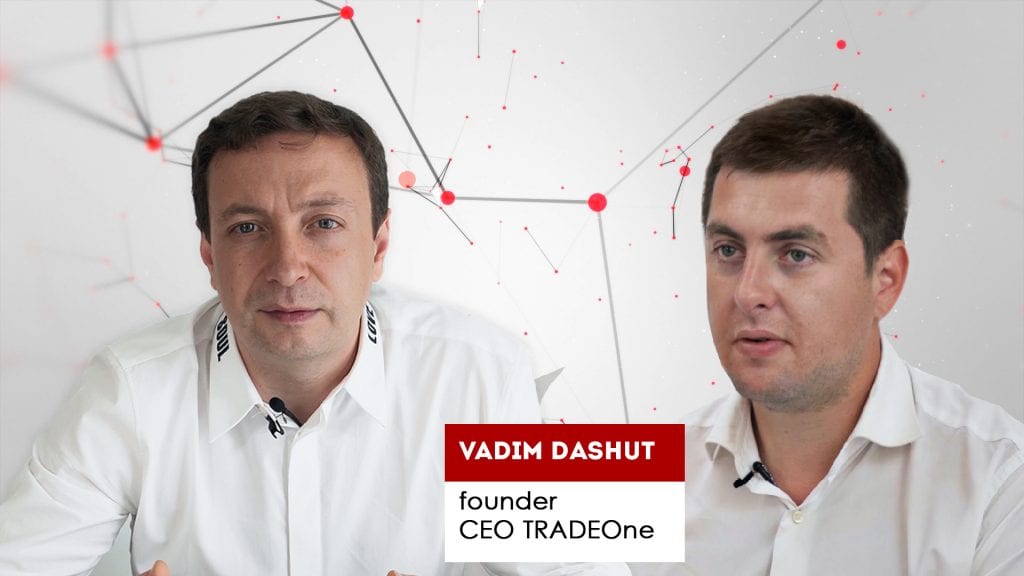
Vadim Dashut is a seasoned blockchain investor and entrepreneur who saw the need that blockchain markets had for the right expertise to handle the excess of $380 billion in idle capital that floats around the ecosystem. He was recently interviewed in Nick’s ongoing video course, where he shared important details on TradeOne, an innovative project that seeks to provide a solution to this market segment.
TradeOne is a platform that connects blockchain investors with vetted trade professionals. These traders bring experience from traditional markets into the blockchain ecosystem, producing profits that sometimes reach up to 20 times their original investments. In essence, TradeOne bridges the gap between two parties: those who have idle capital but lack the knowledge to invest it properly, and those who have the ability to trade professionally but lack the necessary funds.
On this new trading market, any investor is able to choose from a group of experienced traders to allocate the amount of capital they are ready to invest. They have access to well rounded knowledge beforehand, given that TradeOne maintains a verified record of every trader’s statistics and how they perform on major exchanges. All fund transfers and investments are easily tracked and every action taken is logged on the blockchain, affording investors peace of mind and ease of use.
As a blockchain platform, tokens are at the center of the trading market’s business model, ensuring their integration and importance. In fact, TradeOne uses two separate tokens within its token economy. The BITT ERC20 utility token is used to pay commissions and a separate BITZ security token allows token holders to receive dividends from the overall profits made by the platform. The introduction of this security token is a new concept within trading markets that places their holders on equal terms with the project’s founders and team.
As Nick explains in his video lecture, TradeOne becomes even more profitable thanks to the implementation of an important tool in its token economy. It is set to allocate a percentage of its profits to buy back BITT tokens and remove them from circulation. By doing this, the platform reduces supply and creates a healthy, mathematically transparent jump in the value of the token — especially if there is a high demand.
A two-token model is one Nick believes holds exciting potential, even if the new trading market takes over a conservative estimate of 1% of the $380 billion idle capital segment. Together, they guarantee investors receive good returns via both the dividends paid to their security tokens and the selling price of the utility tokens that they hold.
“This balanced model with two tokens: one being of token equity and the other of token utility, allows the investor to be in both components of the business. As an investor, you are constantly in redemption of tokens on the utility component and the participant in dividends just as the start-up inner team. Giving you the absolute balance of your relationship with the start-up. This is a very good thing.”
To find out more about TradeOne visit the website and join the community.
Disclaimer:
This information is the opinion of the provider and is for informational purposes only. It is not intended as and does not constitute investment advice or legal or tax advice or an offer to sell any securities to any person or a solicitation of any person of any offer to purchase any securities. This information should not be construed as any endorsement, recommendation or sponsorship of any company or security. There are inherent risks in relying on, using or retrieving this information. Seek the advice of professionals, as appropriate, to evaluate any opinion, advice, product, service or other information provided.