Customer acquisition cost optimization technology has become a strategic imperative for marketing organizations navigating the complex intersection of rising media costs, increasing privacy restrictions, and intensifying investor scrutiny of marketing efficiency metrics. As digital advertising costs have increased by an average of 15-20% annually across major platforms while third-party targeting capabilities diminish, the ability to systematically reduce acquisition costs while maintaining or improving customer quality has emerged as a defining capability that separates sustainable growth companies from those burning cash on inefficient customer acquisition strategies.
Understanding the Full Cost of Customer Acquisition
Comprehensive acquisition cost measurement extends far beyond dividing advertising spend by the number of new customers to encompass the complete investment required to convert prospects into paying customers. True CAC calculation includes direct advertising expenditure across all paid channels, marketing technology costs allocated per acquisition, content creation and distribution expenses, sales team compensation and overhead for sales-assisted conversions, onboarding and activation costs required to bring new customers to their first value realization, and promotional discounts or incentives offered to drive initial conversion. Research from ProfitWell indicates that the average SaaS company underestimates its true CAC by 40-60% when using simplified calculation methods that exclude indirect acquisition costs. Understanding fully-loaded CAC is essential for accurate unit economics analysis, as organizations that optimize apparent CAC by shifting costs to categories excluded from their measurement may achieve misleading efficiency improvements while actual acquisition economics deteriorate. Organizations implementing comprehensive CAC measurement report 25% improvements in acquisition strategy decisions through more accurate understanding of true cost structures across channels and customer segments.
Channel-Level CAC Analysis and Optimization
Channel-level CAC analysis disaggregates acquisition costs across every marketing channel and tactic to identify efficiency variations that inform budget reallocation and channel-specific optimization strategies. Advanced analytics platforms track acquisition costs from initial awareness impression through final conversion for each channel, accounting for multi-touch contribution where multiple channels participate in conversion journeys. Marginal CAC analysis evaluates how acquisition costs change at different spending levels within each channel, identifying the optimal investment point where increasing spend begins generating diminishing returns. Cohort-based channel analysis tracks the long-term value of customers acquired through different channels, recognizing that the cheapest acquisition channel may not produce the most valuable customers when lifetime value is considered. Incrementality testing isolates the true causal contribution of each channel to customer acquisition by comparing conversion rates between exposed and unexposed audiences, revealing channels that receive attribution credit for customers who would have converted organically. Organizations implementing channel-level CAC optimization report 30-40% reductions in blended acquisition costs through systematic reallocation from high-CAC channels with low incrementality to efficient channels with demonstrated causal impact on customer conversion.
Audience Quality and Targeting Optimization
Audience targeting optimization represents the highest-leverage approach to CAC reduction by ensuring marketing investment reaches prospects with the highest conversion probability and expected lifetime value. Predictive audience models analyze historical customer data to identify the demographic, behavioral, and contextual characteristics most strongly associated with conversion and long-term value, enabling precise targeting that eliminates waste spending on low-probability prospects. Look-alike modeling extends successful customer profiles to identify prospect audiences that share key characteristics with an organization’s most valuable existing customers, typically achieving 2-3 times higher conversion rates compared to broad demographic targeting. Exclusion modeling identifies audience segments with consistently low conversion rates or poor lifetime value outcomes, systematically removing these audiences from targeting to prevent investment in prospects unlikely to generate acceptable returns. Real-time bidding optimization adjusts impression-level targeting decisions based on predicted conversion probability for each individual ad opportunity, ensuring that higher bids are placed only for prospects with sufficient expected value to justify the investment. Organizations implementing advanced audience optimization report 35-50% improvements in conversion rates from paid advertising and 25-35% reductions in cost per acquisition through elimination of waste targeting.
Conversion Rate Optimization for CAC Reduction
Conversion rate optimization directly reduces CAC by increasing the percentage of marketing-generated traffic that converts to customers without requiring additional acquisition spending. Systematic CRO programs continuously test and improve landing pages, website experiences, checkout flows, and conversion funnels to remove friction and increase conversion probability at every stage. AI-powered personalization adapts website experiences for individual visitors based on their behavior patterns, traffic source, device type, and predicted preferences, increasing relevance and conversion probability compared to static experiences. Form optimization reduces abandonment by minimizing required fields, implementing progressive profiling, and providing real-time validation that prevents frustrating error states. Page speed optimization addresses the significant conversion impact of load time, with research showing that each additional second of load time reduces conversion rates by 4.4%. Organizations with mature CRO programs typically achieve 20-40% improvements in conversion rates over 12 months through systematic testing and optimization, directly reducing CAC by the same proportion without requiring any changes to media spending or audience targeting strategies.
Organic Acquisition Channel Development
Strategic investment in organic acquisition channels including SEO, content marketing, social media, referral programs, and community building creates sustainable low-CAC customer acquisition that reduces dependence on increasingly expensive paid media. Content marketing and SEO investments generate compounding returns over time as published content continues attracting organic traffic long after creation costs are incurred, with mature content programs typically achieving CAC levels 60-70% lower than paid advertising channels. Referral program optimization leverages existing customer satisfaction to generate new customers at a fraction of paid acquisition costs, with well-designed referral programs achieving CAC reduction of 40-60% compared to paid channels while typically producing customers with higher retention rates. Community-driven acquisition through branded communities, user groups, and social media communities creates organic awareness and trust that converts prospects without paid media intervention. Product-led growth strategies that allow prospects to experience product value before purchase commitment generate self-serve acquisition that dramatically reduces sales-assisted conversion costs. Organizations that systematically develop organic acquisition channels report 35-50% reductions in blended CAC over 2-3 year investment periods as organic channels mature and capture increasing share of total acquisition volume.
CAC Payback Period Optimization
CAC payback period measurement evaluates how quickly the revenue generated by acquired customers recovers their acquisition investment, providing critical insight into the cash flow implications and sustainability of acquisition strategies. Optimizing payback periods requires balancing acquisition cost reduction with revenue acceleration strategies that speed the time between customer acquisition and full cost recovery. Onboarding optimization reduces the time between customer acquisition and first revenue-generating activity by streamlining activation processes, providing guided setup experiences, and proactively addressing common barriers to initial product usage. Early lifecycle revenue optimization ensures new customers quickly discover and adopt the features and services that drive revenue, through personalized engagement sequences, proactive cross-sell recommendations, and usage-triggered upgrade offers. Pricing and packaging optimization evaluates whether acquisition economics can be improved through pricing structures that accelerate early revenue recognition, such as annual prepayment incentives that reduce payback periods even if nominal pricing remains constant. Organizations focusing on payback period optimization report 25% faster cost recovery on customer acquisition investments and improved cash flow predictability that enables more aggressive growth investment with reduced financial risk.
Unit Economics Dashboard and Intelligence
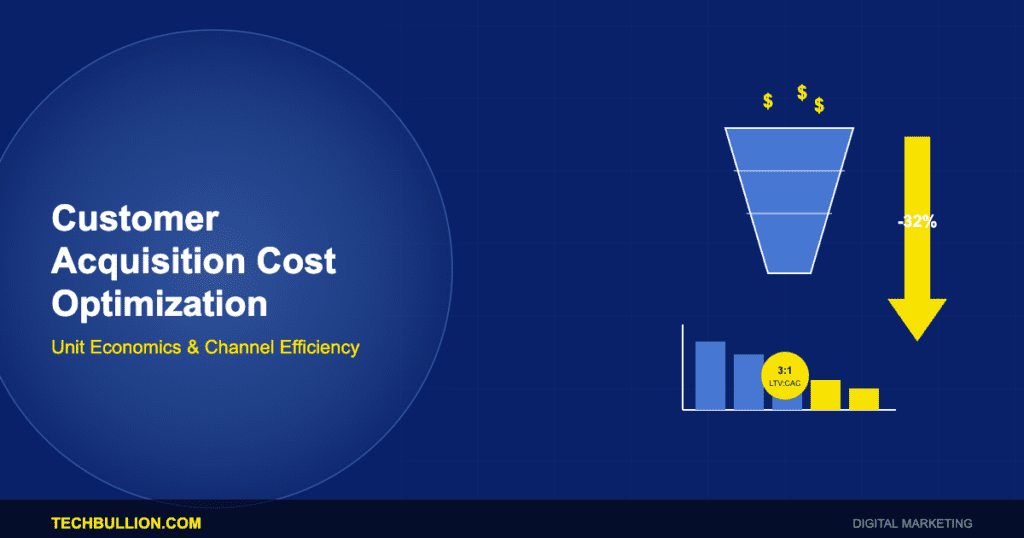
Unit economics platforms provide integrated views of CAC, lifetime value, payback period, and contribution margin metrics across customer segments, channels, and time periods, enabling comprehensive profitability analysis of customer acquisition programs. Real-time unit economics dashboards monitor the relationship between acquisition costs and customer value at granular levels, alerting teams when acquisition economics deteriorate beyond acceptable thresholds for any segment or channel. Cohort analysis tracks how customer economics evolve over time for groups acquired during specific periods or through specific channels, revealing whether efficiency improvements in CAC are generating proportional improvements in overall customer profitability. LTV-to-CAC ratio monitoring ensures that acquisition investments are justified by proportional expected customer value, with industry benchmarks suggesting healthy ratios of 3:1 or higher for sustainable growth. Scenario modeling capabilities project how changes in acquisition strategy, pricing, retention, or expansion revenue would impact unit economics, enabling marketing leaders to evaluate strategic options against profitability constraints. Organizations implementing comprehensive unit economics intelligence report 30% improvements in acquisition investment decisions and 25% better alignment between marketing spending and business profitability objectives.
Privacy-Era Acquisition Strategies
The deprecation of third-party cookies, mobile identifier restrictions, and expanding privacy regulations have fundamentally disrupted acquisition strategies that relied on individual-level tracking and targeting across the open web. Privacy-preserving acquisition technologies enable effective customer acquisition within new data limitations through contextual targeting that matches advertisements to relevant content environments rather than individual user profiles. First-party data activation strategies leverage organizations’ own customer data for acquisition targeting through platform-specific audience matching, customer data platform-powered look-alike modeling, and server-side data connections that maintain targeting capability within privacy-compliant frameworks. Aggregated measurement methodologies including marketing mix modeling and geo-based experimentation provide acquisition performance insights without requiring individual-level tracking, enabling optimization decisions based on population-level patterns rather than user-level attribution. Privacy-preserving collaboration technologies including data clean rooms enable organizations to combine their first-party data with publisher audience data for improved targeting without exposing individual customer records. Organizations that have proactively adapted acquisition strategies for privacy restrictions report maintaining acquisition efficiency within 10-15% of pre-privacy performance levels while competitors relying on deprecated targeting methods experience 30-50% CAC increases.
The Future of Acquisition Cost Optimization
Customer acquisition cost optimization is evolving toward increasingly automated, intelligent, and holistic approaches to maximizing the efficiency and effectiveness of customer acquisition investment. AI-powered acquisition engines will autonomously identify optimal combinations of channels, audiences, creative, and timing to minimize CAC while maintaining customer quality, continuously learning from outcomes to improve efficiency over time. Full-funnel acquisition optimization will integrate awareness, consideration, and conversion investments into unified optimization frameworks that recognize the interdependencies between funnel stages rather than optimizing each in isolation. Predictive acquisition economics will forecast CAC trends based on competitive dynamics, platform pricing trajectories, and audience saturation indicators, enabling proactive strategy adjustments before efficiency deterioration occurs. As acquisition costs continue rising across paid digital channels, organizations that combine sophisticated optimization technology with strategic investment in owned acquisition assets will maintain sustainable growth economics while competitors face progressively challenging acquisition economics that constrain growth and profitability.
According to Deloitte’s industry outlook, more than 60 percent of large enterprises now allocate dedicated budgets to digital transformation initiatives, up from 35 percent in 2020.
Market analysis from Grand View Research projects that technology-driven market segments will continue expanding at compound annual growth rates between 15 and 25 percent through the end of the decade.
For more coverage on related topics, explore our dedicated section on technology news.
Readers interested in this space may also find value in our reporting on fintech updates.
Stay informed with TechBullion’s latest coverage of startup news.