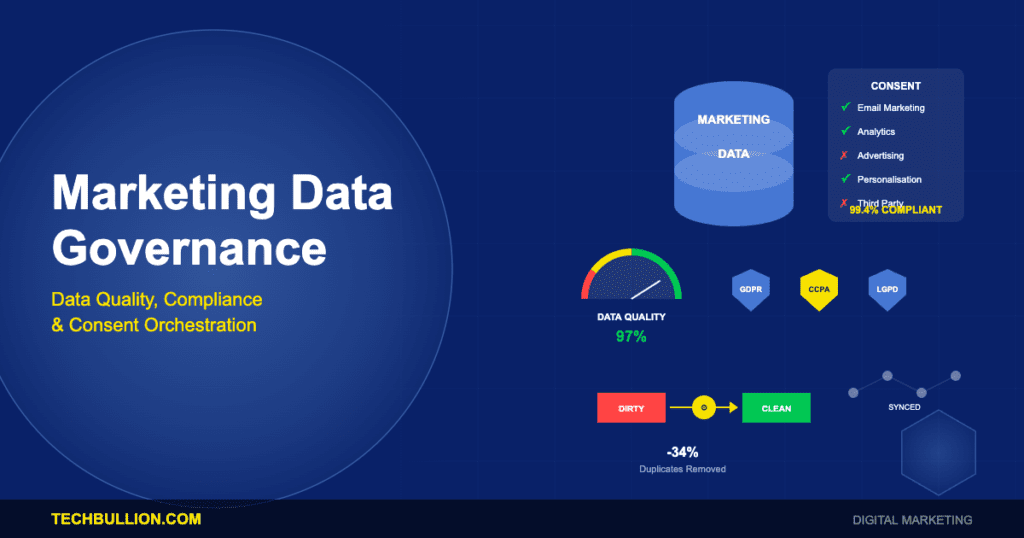
A global consumer goods company operating across 42 markets discovers during a data governance audit that 34 percent of its marketing database contains duplicate records, 28 percent of email addresses are invalid or outdated, and 19 percent of customer profiles lack the consent documentation required under GDPR, CCPA, and other applicable privacy regulations. The company’s marketing campaigns are simultaneously wasting budget on unreachable contacts, risking regulatory penalties for non-compliant data processing, and delivering fragmented customer experiences due to inconsistent data across its 14 marketing technology platforms. After implementing a marketing data governance framework supported by automated data quality monitoring, consent management orchestration, and cross-platform data synchronisation, the company reduces invalid contact rates to under 3 percent, achieves 99.4 percent consent documentation compliance, and improves marketing campaign performance by 41 percent through more accurate targeting and personalisation enabled by clean, compliant, and consistent customer data.
The Data Quality Crisis in Marketing Technology
Data quality degradation is a persistent challenge that compounds over time, with research indicating that marketing databases experience an average annual decay rate of 22 to 30 percent as contacts change jobs, switch email providers, move addresses, and update phone numbers. This natural decay, combined with data entry errors, integration inconsistencies, and the accumulation of duplicate records from multiple acquisition channels, means that without active governance, the majority of marketing databases contain enough inaccurate data to significantly impair campaign effectiveness and analytical reliability. A B2B company analysing its marketing database discovers that 16 percent of its leads list company names that no longer exist due to acquisitions, closures, or rebranding, and 23 percent of contacts hold job titles that differ from their current roles, rendering firmographic and role-based segmentation unreliable.
Marketing data governance establishes the policies, processes, and technologies that ensure data remains accurate, complete, consistent, and compliant throughout its lifecycle. Unlike traditional IT data governance focused on data warehousing and business intelligence, marketing data governance must address the unique challenges of marketing technology ecosystems where data flows through dozens of interconnected platforms, each with its own data model, validation rules, and synchronisation schedules. The marketing data governance stack includes data quality platforms that continuously monitor and cleanse customer records, master data management systems that maintain authoritative customer profiles across platforms, and data observability tools that detect anomalies in data pipelines before they corrupt downstream marketing activities.
Automated Data Quality Management
Modern data quality platforms employ machine learning algorithms that continuously evaluate customer records against multiple quality dimensions including accuracy, completeness, consistency, timeliness, and validity. These platforms operate at the point of data entry, validating and standardising information as it enters the marketing ecosystem, and on existing databases through batch processing that identifies and resolves quality issues across millions of records. A marketing technology company implementing real-time data validation reduces form abandonment by 12 percent by providing immediate feedback when users enter invalid email formats, while simultaneously improving data quality by catching errors before they propagate through downstream systems.
Deduplication technology represents one of the most impactful data quality capabilities, using fuzzy matching algorithms that identify duplicate records even when they contain variations in spelling, formatting, or completeness. A financial services company’s deduplication process identifies 340,000 duplicate pairs in a database of 2.1 million records, consolidating them into unified profiles that immediately improve email marketing deliverability by eliminating duplicate sends and enhance segmentation accuracy by combining previously fragmented interaction histories into complete customer views. The deduplication algorithms evaluate name similarity, address proximity, email pattern matching, and phone number variations to achieve 97.8 percent accuracy in identifying true duplicates while minimising false positive merges that would incorrectly combine records belonging to different individuals.
Consent Management and Compliance Orchestration
The regulatory landscape governing marketing data has grown increasingly complex, with GDPR, CCPA, LGPD, POPIA, and dozens of other privacy regulations imposing distinct requirements for consent collection, documentation, and enforcement across different jurisdictions. Marketing teams must navigate these overlapping regulations while maintaining the ability to execute effective campaigns, requiring consent management systems that track individual consent preferences at granular levels and automatically enforce those preferences across every marketing platform and communication channel.
Consent orchestration platforms maintain comprehensive consent records that document when consent was given, what specific processing purposes were authorised, through which channel the consent was collected, and the exact language presented to the individual at the time of consent. These records must be immutable and auditable, providing defensible documentation in the event of regulatory inquiry. A healthcare company’s consent orchestration platform manages 2.8 million individual consent records across 12 processing purposes, automatically enforcing consent preferences across email marketing, SMS communications, programmatic advertising, and analytics platforms. When a customer withdraws consent for email marketing but maintains consent for transactional communications, the platform propagates this preference change to all downstream systems within 15 minutes, ensuring consistent compliance without manual intervention.
Cross-Platform Data Synchronisation and Lineage
The average enterprise marketing technology stack comprises 12 to 24 distinct platforms, each maintaining its own customer data store with varying data models, update frequencies, and quality standards. Without governance, these platforms inevitably develop conflicting versions of customer records, leading to situations where the email platform shows a customer as opted in while the CRM shows them as opted out, or the analytics platform attributes a customer to segment A while the personalisation engine classifies them in segment B. Data synchronisation governance establishes the rules, hierarchies, and processes that maintain consistency across platforms.
Data lineage tracking provides visibility into how data flows through the marketing technology ecosystem, documenting the origin of each data element, the transformations it undergoes, and the systems that consume it. When a data quality issue is detected in a downstream platform, lineage tracking enables rapid root cause identification by tracing the data back to its source and identifying where the corruption occurred. A retail company implementing data lineage discovers that 40 percent of its customer segmentation errors originate from a single integration point where data type mismatches cause geographic fields to be incorrectly mapped, a systematic error that had been generating inaccurate targeting for months without detection.
Data Governance Metrics and Continuous Improvement
Effective marketing data governance requires ongoing measurement through data quality scorecards that track key metrics across accuracy, completeness, consistency, and compliance dimensions. These scorecards provide executive visibility into data health trends, enable benchmarking against industry standards, and create accountability for data stewards responsible for maintaining quality within their domains. A technology company implementing monthly data quality scoring discovers that its customer address accuracy drops below 90 percent every January due to holiday-season relocations, enabling proactive address verification campaigns that prevent the seasonal quality degradation from impacting spring marketing campaigns.
The financial impact of data governance investments is measured through both cost avoidance metrics including reduced regulatory penalty risk, eliminated wasted spend on unreachable contacts, and decreased campaign error rates, and revenue enhancement metrics including improved targeting accuracy, increased personalisation effectiveness, and higher customer lifetime value enabled by complete, accurate customer profiles. Organisations implementing comprehensive marketing data governance programmes typically report 15 to 25 percent improvements in campaign performance metrics within the first year, with compounding benefits as data quality improvements cascade through analytics, segmentation, and personalisation systems that all depend on the accuracy and completeness of the underlying customer data to deliver reliable insights and effective marketing experiences.
Research from McKinsey’s 2024 analysis indicates that organisations deploying AI at scale report efficiency improvements of 15 to 25 percent within the first 18 months of production implementation.
According to Mordor Intelligence, the AI in fintech market is projected to grow at a compound annual growth rate exceeding 20 percent through 2029, driven by demand for automated fraud detection, credit scoring, and customer service applications.
For more coverage on related topics, explore our dedicated section on artificial intelligence.
Readers interested in this space may also find value in our reporting on technology news.
Stay informed with TechBullion’s latest coverage of startup ecosystem.