A venture-backed fintech company offering automated investment management to millennials and Gen Z consumers allocates $3.4 million quarterly to customer acquisition across paid social, display, and search channels, but finds that its cost per account opening has risen 47 percent over 18 months as traditional digital advertising formats face increasing ad fatigue, banner blindness, and competitive bidding pressure in the financial services vertical. The company redirects 35 percent of its acquisition budget to native advertising through content discovery platforms and sponsored content partnerships with financial education publishers. The native strategy deploys a library of 28 educational articles covering topics from compound interest fundamentals to tax-loss harvesting strategies, each containing soft calls to action that guide readers toward the company’s investment platform. Over two quarters, the native advertising programme delivers 4.2 million content engagements at an average cost of $0.38 per engaged reader, generates 18,400 new account openings at a cost per acquisition 34 percent lower than the company’s display advertising channels, and produces average customer lifetime values 22 percent higher than display-acquired customers because the educational content pre-qualifies readers who demonstrate genuine interest in investment management. The programme also creates lasting organic search value as the sponsored content generates backlinks and social shares that improve the company’s domain authority across financial planning keywords. That evolution from interruptive advertising to value-first content distribution illustrates the strategic advantage of native advertising technology in building customer relationships through relevant, contextually integrated content experiences.
Market Scale and Format Evolution
Global native advertising spend reached $98.6 billion in 2024, according to eMarketer, representing approximately 65 percent of total display advertising expenditure as advertisers continue shifting budget from standard banner formats to content-integrated placements that match the visual design and user experience of the surrounding editorial environment. The native advertising category encompasses multiple format types including in-feed sponsored content on social platforms, content recommendation widgets on publisher websites, sponsored search results, promoted listings on e-commerce marketplaces, and custom branded content created in collaboration with publishers.
The growth of native advertising is driven by the widening performance gap between native and traditional display formats. Native advertisements generate 53 percent higher viewability rates than standard display banners, achieve click-through rates four to eight times higher than banner advertisements, and produce brand recall scores 18 percent above equivalent display placements, according to research from Sharethrough and IPG Media Lab. These performance advantages reflect the fundamental user experience insight that advertisements integrated within the content consumption flow generate more attention and engagement than advertisements that interrupt or compete with the content experience.
The integration of native advertising with programmatic advertising infrastructure has transformed native from a predominantly direct-sold, IO-based format into a scalable programmatic channel where native inventory is traded through real-time auctions with the same targeting, measurement, and optimisation capabilities available in standard display.
| Metric | Value | Source |
|---|---|---|
| Global Native Ad Spend (2024) | $98.6 billion | eMarketer |
| Share of Display Advertising | ~65% | eMarketer |
| Native CTR vs Banner CTR | 4-8x higher | Sharethrough / IPG |
| Native Viewability Advantage | 53% higher | Sharethrough |
| Brand Recall Lift (Native vs Display) | +18% | IPG Media Lab |
| Content Discovery Platform Reach | 2B+ users/month | Taboola |
Content Discovery and Recommendation Platforms
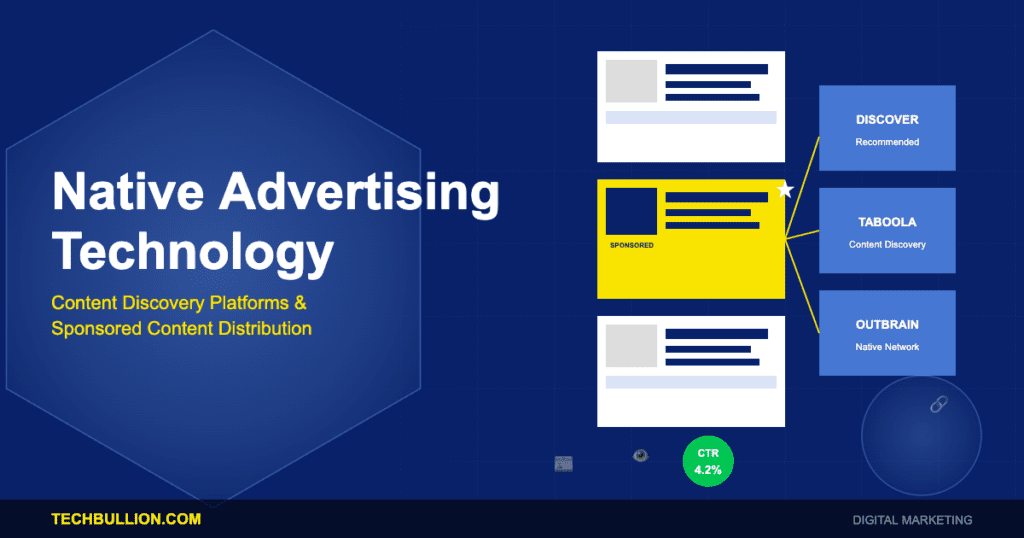
Content discovery platforms represent the largest segment of the native advertising ecosystem, placing sponsored content recommendations alongside editorial content on premium publisher websites. These platforms analyse the content of each page, the behaviour patterns of each visitor, and the performance history of each sponsored asset to select which content recommendations to display in widget placements that typically appear below articles, within content feeds, or in sidebar positions.
The recommendation algorithms powering content discovery platforms operate through a combination of contextual relevance matching, collaborative filtering based on user engagement patterns, and real-time performance optimisation that continuously adjusts which creative assets and landing pages are shown to which audience segments. Advertisers provide headline, thumbnail image, and landing page combinations that the platform’s algorithm tests across its publisher network, automatically identifying the combinations that generate the highest engagement rates within each audience segment and content context.
The integration with ad fraud detection technology is essential in native advertising where the content engagement model creates unique fraud vectors including fake content consumption that generates fraudulent engagement metrics and bot traffic that mimics the reading behaviour patterns that native platforms use to measure content quality.
Leading Native Advertising Platforms
| Platform | Primary Format | Key Differentiator |
|---|---|---|
| Taboola | Content discovery | Largest content discovery platform reaching 500M+ daily active users |
| Outbrain | Content discovery | Premium publisher network with interest-based targeting and Smartfeed technology |
| TripleLift | Programmatic native | Computer vision-powered native ad formatting that adapts to publisher design |
| Nativo | Branded content | True in-feed native with content hosted directly on publisher domains |
| Sharethrough | Enhanced native exchange | Headline and creative optimisation with real-time bidding native marketplace |
| MGID | Global content discovery | Performance-focused native with strong reach across emerging markets |
Creative Optimisation and Content Strategy
The creative dimension of native advertising requires fundamentally different approaches than traditional display advertising because native success depends on providing genuine content value rather than delivering a promotional message within an attention-grabbing visual format. Effective native creative combines compelling headlines that generate curiosity without resorting to clickbait tactics, thumbnail images that convey credibility and relevance, and landing page content that delivers on the promise established by the headline while naturally integrating the advertiser’s value proposition.
AI-powered headline optimisation analyses linguistic patterns, emotional triggers, and structural elements across millions of headline-performance data points to predict which headline formulations will generate the highest engagement within specific audience segments and content contexts. Dynamic creative optimisation extends this capability by automatically testing multiple headline, image, and description combinations across the publisher network, identifying winning combinations that are promoted while underperforming variants are suppressed. The most sophisticated native advertisers develop content libraries spanning multiple stages of the customer journey, using content discovery platforms to distribute awareness-stage educational content, consideration-stage comparison and evaluation content, and decision-stage content that drives direct conversion actions.
Measurement and Attribution in Native
Native advertising measurement requires metrics that go beyond the click-based attribution models designed for direct-response display advertising, capturing the content engagement and brand impact that represent the primary value of native formats. Attention metrics including average reading time, scroll depth, content completion rate, and interaction events provide granular insight into how deeply users engage with sponsored content, distinguishing between superficial clicks and meaningful content consumption that builds brand awareness and purchase consideration.
Brand lift measurement quantifies the impact of native advertising on upper-funnel metrics including aided and unaided brand awareness, brand favourability, message association, and purchase intent. These studies compare survey responses between exposed and control audiences to isolate the incremental impact of native content exposure on brand perceptions, providing the evidence that connects content engagement to downstream business outcomes. View-through attribution tracks conversions that occur within a defined window after native content exposure without requiring a direct click, acknowledging that native content often influences purchase decisions through brand building and education rather than direct response.
Multi-touch attribution models that incorporate native touchpoints alongside display, search, social, and email interactions enable advertisers to understand native advertising’s contribution within the broader customer journey. These models consistently show that native content touchpoints occurring early in the customer journey have disproportionate influence on eventual conversion, supporting the strategic value of content-driven awareness and consideration building that native advertising delivers most effectively.
The Future of Native Advertising
The trajectory of native advertising technology through 2029 will be shaped by the integration of generative AI that enables rapid creation of high-quality sponsored content at scale, the evolution of native formats into immersive experiences including interactive articles, embedded video narratives, and augmented reality content previews. The convergence of native advertising with generative AI content creation will enable personalised content experiences where article narratives, product comparisons, and educational content adapt dynamically to individual reader interests, knowledge levels, and purchase journey stages. Privacy-compliant contextual targeting will become the dominant signal for native ad placement as cookie deprecation shifts the ecosystem toward content-based rather than audience-based targeting strategies. Organisations that invest in native advertising capabilities today are building the content-driven acquisition channels that perform increasingly well as consumer tolerance for interruptive advertising formats continues declining across digital platforms.
Data from Statista’s digital market outlook shows that global digital spending continues to grow at double-digit rates, with mobile channels accounting for an increasingly dominant share of total transactions.
PwC’s analysis of financial services trends through 2025 highlights the convergence of technology and media as a defining dynamic, with data-driven personalisation becoming the primary competitive differentiator.