A European airline operating 240 routes across 45 countries processes approximately 38 million customer interactions annually across post-flight surveys, social media mentions, contact centre transcripts, online reviews, mobile app feedback, and airport kiosk responses. The customer experience team manually reviews a sample of fewer than 2 percent of these interactions, producing quarterly reports that arrive too late to address emerging service issues and too aggregated to identify specific operational problems. When a catering quality decline at a specific hub airport triggers a 340 percent increase in negative meal-related feedback over three weeks, the issue remains undetected until the quarterly review because the manual sampling process did not capture sufficient volume from that route cluster. The airline implements an AI-powered customer feedback analytics platform that ingests all 38 million annual interactions, applies natural language processing to extract topics, sentiment, emotion, and intent from unstructured text, and delivers real-time dashboards that surface emerging issues within hours rather than months. Within its first quarter of operation, the platform identifies the catering issue within 48 hours of its onset, detects a crew training gap on specific route types through sentiment pattern analysis, and quantifies the revenue impact of service improvements by correlating feedback trends with rebooking rates and loyalty programme engagement. That transformation from sampled hindsight to comprehensive real-time intelligence represents the operational advantage that modern customer feedback analytics delivers.
Market Growth and Strategic Context
The global voice of customer analytics market reached $12.2 billion in 2024 and is projected to grow to $27.1 billion by 2029, according to MarketsandMarkets, reflecting a compound annual growth rate of 17.3 percent. This growth is driven by the recognition that customer feedback contains actionable intelligence that directly impacts revenue, retention, and competitive positioning when organisations can process it at scale and speed.
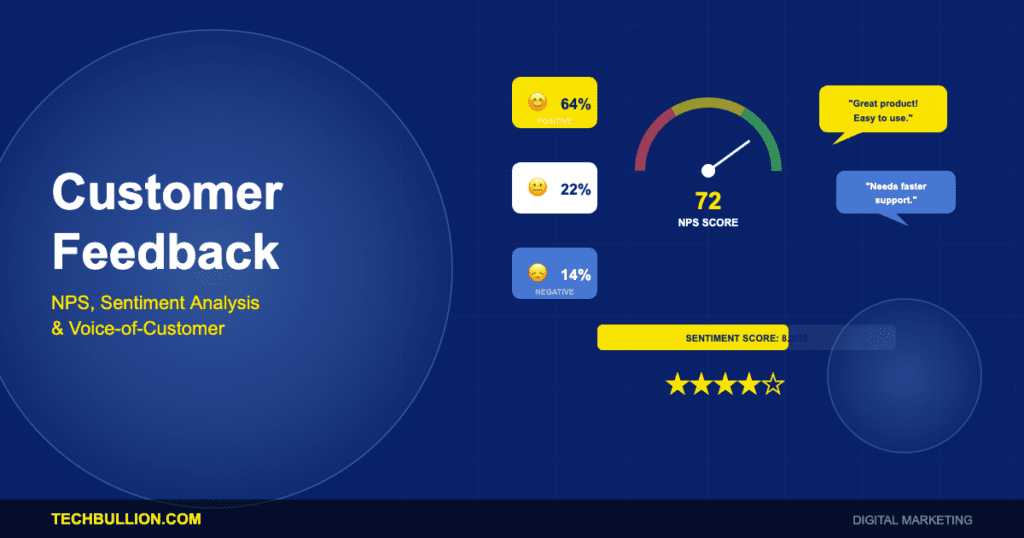
Net Promoter Score remains the most widely adopted customer feedback metric, with over 65 percent of Fortune 1000 companies using NPS as a primary measure of customer loyalty. However, the limitations of single-metric approaches have driven adoption of comprehensive feedback analytics platforms that combine NPS with sentiment analysis, topic extraction, emotion detection, and predictive modelling to provide multidimensional understanding of customer experience.
The integration of feedback analytics with customer retention technology enables organisations to connect feedback signals directly to retention actions, triggering automated response workflows when feedback indicates churn risk or service recovery opportunities.
| Metric | Value | Source |
|---|---|---|
| VoC Analytics Market (2024) | $12.2 billion | MarketsandMarkets |
| Projected Market (2029) | $27.1 billion | MarketsandMarkets |
| CAGR | 17.3% | MarketsandMarkets |
| Companies Using NPS | 65%+ of Fortune 1000 | Bain & Company |
| Unstructured Data in Customer Feedback | 80%+ | Gartner |
| Revenue Impact of CX Leaders vs. Laggards | 5.7x revenue growth | Forrester |
NLP and Sentiment Analysis Technology
Modern customer feedback analytics platforms apply natural language processing models that go far beyond simple positive/negative sentiment classification. Aspect-based sentiment analysis identifies the specific topics within each piece of feedback and assigns sentiment scores to each topic independently, enabling organisations to understand that a customer who is highly satisfied with product quality may simultaneously be frustrated with delivery speed. This granular topic-level analysis transforms vague satisfaction scores into specific, actionable insights that operational teams can address.
Emotion detection algorithms analyse linguistic patterns to identify specific emotional states including frustration, delight, confusion, urgency, and disappointment, providing deeper insight into customer experience than sentiment polarity alone. A customer expressing calm dissatisfaction requires a different response than one expressing urgent frustration, and emotion detection enables organisations to prioritise and route responses based on emotional intensity rather than treating all negative feedback equally.
Intent classification identifies what customers are trying to accomplish through their feedback, distinguishing between customers seeking resolution to a specific problem, expressing general satisfaction or dissatisfaction, making suggestions for improvement, or signalling potential churn through disengagement language. This classification enables automated routing of feedback to the appropriate team or workflow based on the action required.
Leading Customer Feedback Platforms
| Platform | Primary Focus | Key Differentiator |
|---|---|---|
| Qualtrics XM | Enterprise experience management | Comprehensive XM platform with AI-powered text analytics and predictive intelligence |
| Medallia | Customer experience intelligence | Real-time signal capture with AI-driven action recommendations |
| InMoment | Experience improvement | Award-winning NLP with integrated case management for closed-loop feedback |
| Sprinklr | Unified CXM | Social listening integrated with customer care and feedback analytics |
| SurveyMonkey (Momentive) | Survey and feedback collection | Accessible survey platform with AI-powered insights and benchmarking |
| Birdeye | Reputation and feedback | Review management combined with survey analytics and competitive benchmarking |
Closed-Loop Feedback and Operational Integration
The most mature implementations of customer feedback analytics operate closed-loop systems where feedback triggers automated workflows that ensure every actionable piece of feedback receives an appropriate organisational response. When a high-value customer submits feedback indicating dissatisfaction with a recent interaction, the system automatically creates a case in the CRM, assigns it to the appropriate account manager, and tracks resolution through to customer follow-up.
Operational integration connects feedback analytics to the business systems where improvements are actually implemented. When feedback analysis identifies a recurring product quality issue, the insight is automatically routed to product development. When service delivery patterns generate consistent negative feedback at specific touchpoints, operations teams receive targeted alerts with supporting data. The connection to marketing automation platforms enables feedback-driven segmentation where customer communication is personalised based on recent experience signals.
Predictive analytics models built on historical feedback data identify customers at risk of churn before they explicitly signal dissatisfaction, enabling proactive retention interventions. These models analyse patterns of declining satisfaction scores, reduced engagement frequency, and sentiment trajectory to generate churn probability scores that enable prioritised outreach to the customers most likely to leave.
Multi-Channel Feedback Aggregation
Modern feedback analytics platforms aggregate customer signals from diverse sources that each provide different perspectives on the customer experience. Survey responses deliver structured quantitative data through NPS, CSAT, and CES scores alongside open-ended qualitative commentary. Social media monitoring captures unsolicited public feedback that often reflects more extreme positive and negative experiences than survey responses, which tend toward moderate ratings. Contact centre transcripts and chat logs contain rich operational detail about specific issues customers encounter, while online reviews on platforms like Trustpilot, Google, and industry-specific review sites provide competitive context that internal surveys cannot capture.
The technical challenge of multi-channel aggregation lies in normalising feedback from sources with fundamentally different characteristics. A five-star review on Google carries different semantic weight than a 5-out-of-10 NPS response, and a frustrated tweet about delayed delivery contains different actionable information than a detailed complaint submitted through a web form. Advanced analytics platforms apply source-specific NLP models trained on the linguistic patterns characteristic of each channel, then normalise the extracted insights into a unified taxonomy that enables cross-channel analysis. This normalisation enables organisations to identify themes that appear consistently across multiple feedback channels, which typically represent the highest-priority improvement opportunities because they affect customers regardless of how they choose to communicate their experience.
Text analytics applied to contact centre interactions has proven particularly valuable because customer service conversations contain detailed problem descriptions, resolution attempts, and outcome information that structured surveys rarely capture. Speech-to-text processing of phone calls combined with NLP analysis of the transcripts enables organisations to identify systemic issues at scale, measure agent effectiveness in resolving specific problem types, and detect escalation patterns that indicate procedural gaps in first-contact resolution.
The Future of Customer Feedback Analytics
The trajectory of customer feedback analytics through 2029 will be defined by the integration of generative AI that enables conversational analysis of feedback data through natural language queries, the expansion of feedback sources to include behavioural signals, biometric data, and ambient sensing alongside traditional survey and text inputs, and the evolution toward predictive experience management where organisations anticipate and address customer needs before feedback is even submitted. The convergence of feedback analytics with generative AI will enable automated insight generation that produces narrative summaries, executive briefings, and recommended actions from complex feedback datasets without requiring analyst intervention. Organisations that invest in comprehensive feedback analytics today are building the customer intelligence infrastructure that enables them to continuously improve experiences, reduce churn, and identify the specific operational improvements that generate the greatest impact on customer satisfaction and business performance.
According to Deloitte’s industry outlook, more than 60 percent of large enterprises now allocate dedicated budgets to digital transformation initiatives, up from 35 percent in 2020.
Market analysis from Grand View Research projects that technology-driven market segments will continue expanding at compound annual growth rates between 15 and 25 percent through the end of the decade.