A B2B software company selling enterprise resource planning solutions notices something unusual in its analytics dashboard on a Monday morning: a mid-market manufacturing firm with 2,200 employees has visited the ERP comparison page four times in three days, downloaded a migration guide whitepaper, read three blog posts about implementation timelines, and searched for “ERP replacement costs” on two industry review sites. No one from that company has filled out a contact form or requested a demo. Without intent data, this account would remain invisible to the sales team until a buyer eventually raised their hand, likely after evaluating three competitors and forming strong vendor preferences. With an intent data platform monitoring these research signals, the account is flagged with a surge score of 92 out of 100, routed to the assigned account executive within minutes, and entered into a targeted advertising campaign featuring customer case studies from the manufacturing vertical. The sales rep reaches out with a personalised email referencing ERP migration challenges specific to mid-market manufacturers, and within two weeks the account enters the pipeline as a qualified opportunity worth $340,000 in annual contract value. That ability to detect buying intent before prospects self-identify represents the foundational value proposition of B2B intent data platforms, and it is reshaping how organisations approach demand generation, account-based marketing, and sales prioritisation.
Market Growth and Strategic Context
The global B2B intent data market reached $1.2 billion in 2024 and is projected to grow to $3.6 billion by 2028, according to Verified Market Research, reflecting a compound annual growth rate of 31.5 percent. This growth is driven by the increasing sophistication of buyer research behaviour, the rising cost of outbound prospecting, and the strategic adoption of account-based marketing programmes that depend on intent signals to identify and prioritise target accounts.
B2B purchasing behaviour has undergone a fundamental transformation. Gartner research shows that B2B buyers spend only 17 percent of their total purchase journey in meetings with potential suppliers, with 27 percent of that time dedicated to independent online research. By the time a buyer contacts a vendor, they have typically completed 70 percent of their evaluation process. This means that organisations relying exclusively on inbound leads and form fills are missing the majority of active buying journeys happening in their addressable market. Intent data closes this visibility gap by detecting the digital research signals that indicate an organisation is actively evaluating solutions in a specific category.
The connection between intent data and first-party data strategies has become increasingly important as third-party tracking diminishes. While intent data platforms aggregate signals from across the open web, the most effective implementations combine these third-party intent signals with first-party engagement data from owned properties to create comprehensive views of account-level buying activity.
| Metric | Value | Source |
|---|---|---|
| B2B Intent Data Market (2024) | $1.2 billion | Verified Market Research |
| Projected Market (2028) | $3.6 billion | Verified Market Research |
| CAGR | 31.5% | Verified Market Research |
| Buyer Time in Vendor Meetings | 17% | Gartner |
| Journey Completed Before First Contact | 70% | Gartner |
| ABM Programmes Using Intent Data | 73% | Demand Gen Report |
How Intent Data Works
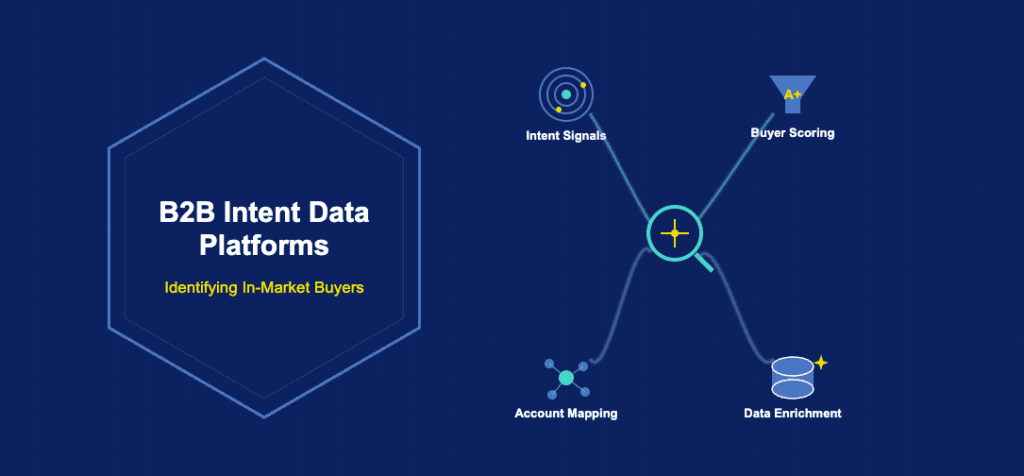
Intent data platforms aggregate and analyse digital signals that indicate organisational interest in specific topics, products, or solution categories. These signals come from multiple sources, each providing different levels of granularity and reliability.
First-party intent data captures engagement signals from an organisation’s own digital properties, including website visits, content downloads, webinar registrations, email engagement, and product page views. This data provides the highest accuracy because it reflects direct interaction with a brand’s content, but it captures only a fraction of total research activity since buyers spend the majority of their evaluation time on third-party sites, review platforms, and industry publications.
Third-party intent data aggregates research signals from across the broader web. Providers like Bombora operate cooperative data networks where participating publishers share anonymised content consumption data. When employees at a specific company consume significantly more content about a particular topic than their baseline behaviour, the platform identifies this as an intent surge. The data is typically resolved to the account level rather than the individual level, associating research patterns with organisations based on IP address mapping, cookie data, and deterministic matching through publisher registration data.
Second-party intent data comes from direct partnerships with specific publishers, review platforms, or industry sites. G2 buyer intent, for example, captures research signals from one of the largest B2B software review platforms, providing highly specific signals about which companies are actively evaluating products in specific categories. TrustRadius and Capterra offer similar capabilities, each contributing unique buyer research signals based on their platform engagement.
Bidstream data extracts intent signals from the programmatic advertising ecosystem, using the metadata embedded in ad bid requests to identify which organisations are consuming content on specific topics. While bidstream data provides broad coverage, its accuracy is lower than cooperative network or publisher-direct data, and privacy regulations have increasingly restricted its availability.
Leading Intent Data Platforms
| Platform | Data Source Type | Key Differentiator |
|---|---|---|
| Bombora | Cooperative data network | Largest B2B publisher co-op with 5,000+ sites and topic taxonomy |
| 6sense | Multi-source AI platform | AI-driven buying stage prediction with account identification |
| Demandbase | Multi-source ABM platform | Integrated intent with account-based advertising and sales intelligence |
| G2 Buyer Intent | Review platform signals | Category-specific research signals from software review activity |
| ZoomInfo Intent | Bidstream and partnerships | Intent data combined with contact database for direct outreach |
| TechTarget Priority Engine | Owned media network | Purchase intent from enterprise technology research on owned sites |
Activation Strategies and Use Cases
The value of intent data is realised through activation, the process of translating intent signals into marketing and sales actions that engage target accounts at the right moment with relevant messaging. The most effective activation strategies coordinate across multiple channels and teams to create cohesive account experiences.
Account-based advertising uses intent signals to trigger targeted display, social, and connected TV campaigns to accounts showing elevated research activity. When an account surges on topics related to a company’s solution category, programmatic campaigns automatically activate to serve relevant ads to employees at that organisation. This approach dramatically improves advertising efficiency, with Demandbase reporting that intent-driven account-based advertising delivers 2.5 times higher click-through rates and 40 percent lower cost per qualified opportunity compared to non-intent-targeted campaigns.
Sales prioritisation represents one of the highest-impact applications of intent data. Rather than working accounts alphabetically or based on firmographic scoring alone, sales teams prioritise outreach to accounts showing active buying signals. 6sense research indicates that accounts identified as being in active buying stages convert at 3 times the rate of accounts without detected intent signals. Sales development representatives who focus their outreach on high-intent accounts achieve 42 percent higher meeting booking rates compared to those working standard prospecting lists.
Content personalisation powered by intent data enables marketing teams to deliver relevant content experiences based on the topics accounts are researching. When intent data reveals that an account is researching data security compliance, the website experience, email nurture sequences, and advertising creative can all adapt to emphasise security-related messaging and content. The integration of intent data with customer data platforms enables this level of personalisation at scale by feeding intent signals into the unified customer profiles that orchestration engines use to determine content selection.
Pipeline acceleration uses intent data to identify opportunities that are actively re-engaging in research, which may indicate competitive evaluation or internal expansion of requirements. When accounts already in the sales pipeline show increased intent activity, sales teams can proactively address potential concerns and reinforce their value proposition before competitors gain traction.
Integration with Marketing and Sales Technology
Intent data platforms derive significant value from their integration with the broader marketing and sales technology ecosystem. CRM integration pushes intent signals directly into Salesforce, HubSpot, and Microsoft Dynamics, enabling sales teams to view account-level intent scores alongside traditional pipeline data without switching between tools.
Marketing automation integration enables intent-triggered nurture workflows that activate when accounts reach specific intent thresholds. A marketing automation platform can automatically enrol high-intent accounts into accelerated nurture sequences featuring bottom-of-funnel content, demo invitations, and personalised case studies relevant to the account’s industry and the topics they are researching.
The connection between intent data and predictive analytics creates particularly powerful demand generation capabilities. Predictive models that incorporate intent signals alongside firmographic, technographic, and engagement data produce significantly more accurate predictions of purchase likelihood than models based on static attributes alone. These combined models enable marketing teams to focus resources on accounts with both the right profile characteristics and active buying signals.
Advertising platform integration enables real-time activation of intent signals across LinkedIn, programmatic display networks, and connected TV platforms. When account intent scores change, advertising campaigns automatically adjust targeting, budgets, and creative to match the intensity and specificity of detected buying signals.
Measurement and Data Quality
Measuring the impact of intent data requires attribution frameworks that connect intent-driven actions to pipeline and revenue outcomes. The most common measurement approach compares conversion rates, pipeline velocity, and deal sizes for intent-identified accounts against baseline accounts without detected intent signals. Organisations typically see 30 to 50 percent improvements in conversion rates from marketing qualified account to sales qualified opportunity when intent data is used to prioritise and personalise engagement.
Data quality varies significantly across intent data providers and signal types. Key quality dimensions include account identification accuracy (the percentage of intent signals correctly matched to the right organisation), topic relevance (whether detected research activity genuinely relates to the vendor’s solution category), signal freshness (how quickly intent signals are detected and delivered), and surge accuracy (whether elevated activity truly represents buying behaviour versus routine content consumption). Organisations should evaluate providers across these dimensions using controlled tests that compare intent-flagged accounts against actual pipeline outcomes.
The integration of intent data with marketing attribution technology enables organisations to quantify the incremental revenue impact of intent-driven programmes and optimise their investment in intent data accordingly.
The Future of B2B Intent Data
The trajectory of B2B intent data through 2028 will be defined by increasing signal sophistication, AI-driven buying stage prediction, and deeper integration into autonomous go-to-market systems. Next-generation intent platforms will move beyond topic-level signals to detect specific buying stages, competitive evaluation patterns, and decision committee composition based on the combination and sequence of research activities observed across an account. The integration of generative AI will enable automated, hyper-personalised outreach that responds to specific intent signals with contextually relevant messaging at scale. Organisations that build intent data into the foundation of their demand generation and account-based marketing programmes today are establishing the early-warning systems that will define competitive advantage in B2B markets where the ability to reach buyers before competitors increasingly determines which vendors earn a place on the shortlist and ultimately win the deal.
According to Deloitte’s industry outlook, more than 60 percent of large enterprises now allocate dedicated budgets to digital transformation initiatives, up from 35 percent in 2020.
Market analysis from Grand View Research projects that technology-driven market segments will continue expanding at compound annual growth rates between 15 and 25 percent through the end of the decade.