
Marketing Automation Platform Comparison: HubSpot, Marketo, Pardot and Emerging Challengers

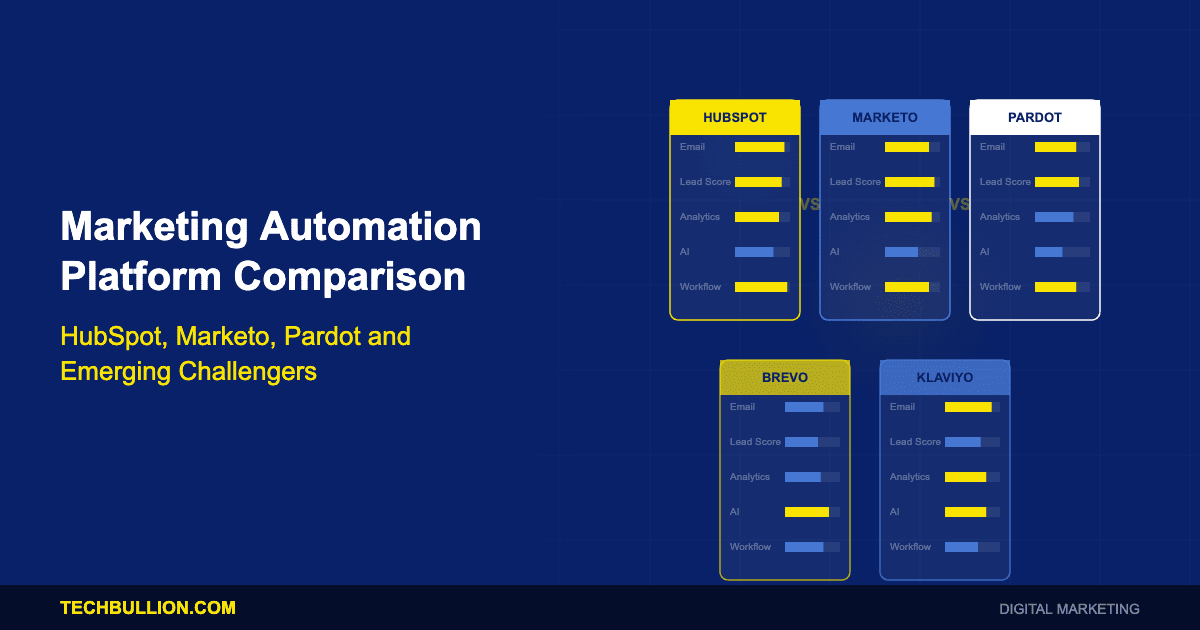
The marketing automation platform a company selects shapes every aspect of its customer communication strategy, from the sophistication of its segmentation to the complexity of its multi-channel orchestration capabilities. A mid-market SaaS company evaluating platforms faces a landscape of more than 400 marketing automation solutions, each claiming to deliver the intelligence and efficiency needed to compete in an increasingly personalised digital environment. The wrong choice creates years of technical debt, migration costs, and capability gaps that constrain marketing effectiveness. The right choice becomes the operational backbone that enables everything from lead nurturing and customer onboarding to retention campaigns and revenue expansion. In 2026, the marketing automation landscape has matured into distinct tiers and categories that serve different organisational needs, and understanding the architecture, strengths, and limitations of each platform is essential for making an informed investment decision.
Market Overview and Growth
The global marketing automation market reached $6.6 billion in 2024 and is projected to grow to $13.7 billion by 2030, according to Grand View Research. This growth is driven by the increasing complexity of customer journeys, the proliferation of communication channels, and the demand for personalised experiences at scale. Nucleus Research reports that marketing automation delivers an average return of $5.44 for every dollar spent, making it one of the highest-ROI technology investments available to marketing teams.
The market has consolidated around several major platforms while simultaneously fragmenting into specialised solutions for specific industries, company sizes, and use cases. Enterprise platforms like Adobe Marketo Engage, Salesforce Marketing Cloud, and Oracle Eloqua serve large organisations with complex requirements, while platforms like HubSpot, ActiveCampaign, and Brevo have captured the small and mid-market segments with more accessible pricing and faster implementation timelines.
| Metric | Value | Source |
|---|---|---|
| Global Marketing Automation Market (2024) | $6.6 billion | Grand View Research |
| Projected Market Size (2030) | $13.7 billion | Grand View Research |
| Average ROI per $1 Spent | $5.44 | Nucleus Research |
| Companies Using Marketing Automation | 76% | HubSpot |
| Total Marketing Automation Solutions | 400+ | G2 |
| Average Implementation Time (Enterprise) | 3-6 months | Gartner |
Enterprise Platform Comparison
Enterprise marketing automation platforms serve organisations with large databases, complex sales cycles, and multi-brand or multi-region requirements. These platforms offer the deepest functionality but demand significant implementation investment and ongoing technical expertise.
Adobe Marketo Engage remains the market leader for B2B enterprise marketing automation. Its strengths include sophisticated lead scoring models, deep Salesforce CRM integration, robust A/B testing capabilities, and a mature ecosystem of integrations. Marketo excels at managing complex nurture programmes with branching logic that adapts based on prospect behaviour, and its revenue attribution reporting connects marketing activity to pipeline and closed revenue. The platform typically requires dedicated administrators and costs $50,000 to $200,000 or more annually depending on database size and feature tier.
Salesforce Marketing Cloud serves enterprise B2C organisations with its Journey Builder visual workflow engine, Einstein AI-powered personalisation, and native integration with the broader Salesforce ecosystem. The platform handles massive contact volumes and supports email, SMS, push notifications, social advertising, and web personalisation from a unified interface. Its strength lies in customer journey orchestration across channels, though the learning curve and implementation complexity are substantial.
Oracle Eloqua targets enterprise B2B organisations with complex buying cycles and strict data governance requirements. Its campaign canvas provides granular control over multi-step nurture programmes, and its lead scoring and routing capabilities integrate deeply with Oracle CX and third-party CRM systems. Eloqua is particularly strong in industries with regulatory compliance requirements where data residency and audit trails are essential.
Mid-Market and Growth-Stage Platforms
The mid-market tier has seen the most innovation and competitive activity, with platforms competing on ease of use, AI capabilities, and value-for-money positioning.
| Platform | Best For | Key Differentiator |
|---|---|---|
| HubSpot | Inbound-focused B2B teams | Unified CRM, marketing, sales, service platform |
| Klaviyo | E-commerce brands | Deep Shopify integration, predictive analytics |
| Braze | Mobile-first brands | Real-time event streaming, cross-channel Canvas |
| Iterable | Growth-stage companies | Workflow flexibility, AI send-time optimisation |
| ActiveCampaign | SMBs needing CRM + automation | Combined email automation and sales CRM |
| Customer.io | SaaS and product-led growth | Event-driven messaging, developer-friendly APIs |
HubSpot has become the default platform for mid-market B2B organisations, particularly those practising inbound marketing methodologies. Its unified platform spanning CRM, marketing automation, sales engagement, customer service, and content management creates a single source of truth that eliminates the integration challenges plaguing multi-vendor stacks. HubSpot\’s AI-powered features including content generation, predictive lead scoring, and adaptive testing have narrowed the capability gap with enterprise platforms while maintaining the usability that drives adoption.
Klaviyo dominates the e-commerce marketing automation segment with native integrations across Shopify, BigCommerce, and WooCommerce. Its predictive analytics engine forecasts customer lifetime value, churn risk, and next purchase date at the individual level, enabling email marketing automation workflows that adapt to each customer\’s predicted behaviour. The platform\’s revenue attribution model provides clear visibility into the direct revenue contribution of every automated flow and campaign.
Braze serves mobile-first brands with real-time event processing that triggers messages within milliseconds of user actions. Its Canvas visual workflow builder supports complex multi-channel journeys across push notifications, in-app messages, email, SMS, and webhooks. The platform\’s strength in handling high-volume, real-time interactions makes it the preferred choice for media, fintech, and consumer app companies.
AI and Predictive Capabilities Across Platforms
AI capabilities have become the primary competitive differentiator in the marketing automation landscape. Every major platform has integrated machine learning models for send-time optimisation, content recommendations, predictive scoring, and audience segmentation. The depth and maturity of these AI features varies significantly.
Predictive analytics for lead and customer scoring represent the most widely adopted AI application. Platforms analyse historical conversion patterns to score new leads by their likelihood to convert, enabling automated routing of high-probability leads to sales while directing lower-scoring leads into nurture sequences. Klaviyo, HubSpot, and 6sense have particularly mature predictive scoring implementations that continuously improve as more data flows through their systems.
Generative AI for content creation has been integrated across most platforms, enabling marketers to generate subject lines, email body copy, and ad variations directly within their automation workflows. These AI assistants accelerate campaign production while maintaining brand voice consistency through customisable tone and style parameters.
Integration Architecture and Data Connectivity
The value of a marketing automation platform depends heavily on its ability to connect with the broader technology stack. Customer data platforms feed enriched customer profiles into automation engines, CRM systems provide sales context, analytics platforms measure downstream impact, and advertising platforms extend reach beyond owned channels.
Native CRM integration remains the most critical connector. HubSpot\’s advantage here is its built-in CRM, while Marketo\’s deep Salesforce integration and Braze\’s flexible API architecture each serve different integration philosophies. The quality of CRM synchronisation, including bidirectional data flow, custom field mapping, and real-time updates, directly impacts the accuracy of segmentation and the relevance of automated communications.
API quality and webhook support differentiate platforms for technically sophisticated teams. Customer.io and Braze offer developer-friendly APIs that enable custom integrations with any data source, while platforms like ActiveCampaign provide no-code integration through Zapier and native connectors that serve teams without engineering resources.
The rise of composable architecture has introduced a new integration paradigm where organisations assemble best-of-breed components rather than relying on a single monolithic platform. A company might use Braze for cross-channel messaging, Segment for data collection, Snowflake for data warehousing, and dbt for transformation, connecting these components through APIs and reverse ETL tools. This approach offers maximum flexibility but requires significant technical investment in integration maintenance and data pipeline management. First-party data strategy considerations further influence platform selection, as organisations increasingly need their automation platforms to operate effectively within privacy-compliant data architectures.
Selection Framework and Decision Criteria
Selecting the right marketing automation platform requires evaluating technical capabilities against organisational readiness, budget constraints, and strategic priorities. The most sophisticated platform is the wrong choice for a team that lacks the technical resources to implement and maintain it. Conversely, a platform chosen purely for ease of use may create capability ceilings that constrain growth within 18 to 24 months.
The selection process should begin with a clear assessment of current and anticipated use cases, integration requirements, database size and growth trajectory, team technical proficiency, and total budget including implementation, training, and ongoing management costs. Platforms should be evaluated through structured proof-of-concept exercises rather than vendor demonstrations alone, testing actual workflows against real data to verify that promised capabilities function as expected in the specific context of the organisation\’s requirements. The investment in thorough evaluation pays dividends through avoided migration costs and accelerated time to value from the selected platform.
The Future of Marketing Automation Platforms
The marketing automation landscape through 2027 will be shaped by the continued integration of AI capabilities that move platforms from execution tools to strategic advisors. Autonomous campaign optimisation, where AI systems continuously adjust audience targeting, content selection, channel mix, and send timing without human intervention, will become standard across enterprise and mid-market platforms alike. The distinction between marketing automation and customer journey orchestration will continue to blur as platforms expand their cross-channel capabilities and real-time decisioning engines. Platform consolidation through acquisition will reduce the number of standalone solutions, while the composable architecture movement will ensure that organisations always have the option to assemble custom stacks from specialised components. The organisations that approach platform selection as a strategic capability investment rather than a procurement exercise will build the marketing infrastructure needed to compete effectively in an increasingly automated and personalised digital landscape.
Research from McKinsey’s 2024 analysis indicates that organisations deploying AI at scale report efficiency improvements of 15 to 25 percent within the first 18 months of production implementation.
According to Mordor Intelligence, the AI in fintech market is projected to grow at a compound annual growth rate exceeding 20 percent through 2029, driven by demand for automated fraud detection, credit scoring, and customer service applications.






Comment