
Programmatic Advertising in 2026: Supply Path Optimisation and Header Bidding Evolution

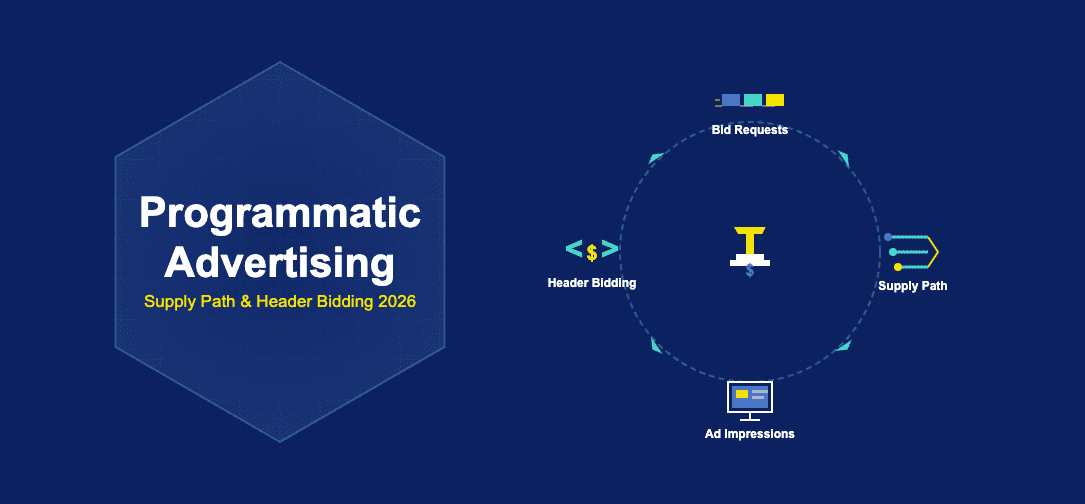
Programmatic advertising has matured from an experimental buying method into the dominant mechanism through which digital media is traded globally. In 2026, programmatic channels account for more than 91 percent of all digital display ad spending in the United States alone, according to eMarketer. Yet beneath this scale lies an industry grappling with fundamental questions about transparency, efficiency, and value distribution. Supply path optimisation and the continued evolution of header bidding represent two of the most consequential technical developments reshaping how advertisers and publishers transact. Understanding these shifts is no longer optional for marketing technology professionals; it is essential for anyone responsible for allocating digital media budgets.
Market Scale and Spending Trends
Global programmatic advertising spending reached $595 billion in 2024 and is projected to exceed $779 billion by 2028, according to Statista. The growth is driven by expanding inventory pools across connected television, digital audio, digital out-of-home, and in-game advertising, all of which have adopted programmatic transaction methods originally developed for web display. North America and Europe remain the largest markets, but Asia-Pacific is growing at the fastest rate, fuelled by rapid mobile adoption and the maturation of regional ad exchanges.
The composition of programmatic spending has shifted meaningfully. Open auction transactions, which once dominated the ecosystem, now represent less than 40 percent of total programmatic spend. Private marketplace deals and programmatic guaranteed transactions have gained share as advertisers seek greater control over where their ads appear and publishers pursue revenue certainty. This structural shift reflects growing sophistication on both sides of the market and a collective movement toward quality over volume.
| Metric | Value | Source |
|---|---|---|
| Global Programmatic Spend (2024) | $595 billion | Statista |
| Projected Spend (2028) | $779 billion | Statista |
| US Programmatic Display Share | 91%+ | eMarketer |
| Open Auction Share of Spend | <40% | Index Exchange |
| Ad Tech Fee Share of Spend | 30-50% | ISBA / PwC |
| CTV Programmatic Growth (YoY) | 38% | IAB |
Supply Path Optimisation: Cutting Through the Complexity
Supply path optimisation, commonly abbreviated as SPO, addresses one of the most persistent problems in programmatic advertising: the excessive number of intermediaries between an advertiser\’s dollar and a publisher\’s ad impression. Research by the ISBA and PwC found that between 30 and 50 percent of advertiser spending is consumed by ad tech fees before reaching the publisher. SPO aims to reduce this tax by identifying and prioritising the most efficient, transparent paths to inventory.
The practice works by analysing the multiple routes through which a demand-side platform can access the same publisher impression. A single ad opportunity on a premium news site might be available through five or more supply-side platforms, each adding their own fee and latency. SPO algorithms evaluate these paths based on win rates, fees, auction dynamics, and historical performance to select the route that delivers the best combination of cost efficiency and inventory quality.
Major demand-side platforms have embedded SPO capabilities directly into their bidding infrastructure. The Trade Desk, DV360, and Amazon DSP all offer SPO features that automatically deprioritise or exclude supply paths that fail transparency standards. On the sell side, supply-side platforms like Magnite, Index Exchange, and PubMatic have responded by investing in direct publisher integrations, reduced auction mechanics, and transparent fee reporting to position themselves as preferred paths.
Header Bidding: From Revolution to Refinement
Header bidding transformed programmatic advertising by enabling publishers to offer their inventory to multiple demand sources simultaneously, rather than relying on the sequential waterfall model that historically favoured a single ad exchange. In 2026, header bidding has evolved from a disruptive innovation into standard infrastructure, but its technical implementation continues to advance.
Server-side header bidding has largely replaced client-side implementations for premium publishers. The original client-side approach required JavaScript tags from multiple demand partners to execute in the user\’s browser, creating page load latency and user experience degradation. Server-side solutions from Prebid Server, Amazon TAM, and Google\’s Open Bidding move the auction to a server environment where multiple demand sources compete without impacting page performance.
Prebid.js remains the dominant open-source header bidding wrapper, powering more than 70 percent of publishers that use header bidding. The Prebid community has expanded the framework beyond web display into connected television, mobile app, and digital out-of-home environments. Prebid Server has become the standard for video and CTV header bidding, where the latency constraints of client-side execution make server-side approaches essential.
Connected Television and Programmatic Video
Connected television represents the fastest-growing segment of programmatic advertising, with CTV programmatic spending increasing 38 percent year over year according to the IAB. The convergence of linear television viewing habits with digital targeting and measurement capabilities has created an advertising channel that combines the brand impact of television with the precision of digital.
The programmatic CTV ecosystem, however, faces unique challenges. Inventory fragmentation across streaming platforms, smart TV manufacturers, and free ad-supported streaming television services creates complexity that does not exist in web display. Frequency management across platforms remains difficult because most CTV environments lack cross-platform identity solutions. A viewer who watches content on Roku, Hulu, and Samsung TV Plus might see the same advertiser\’s creative eight times across those platforms without any of them recognising the duplication.
VAST 4.2 and newer specifications have improved ad serving standards for CTV, enabling interactive ad formats, better measurement, and enhanced creative capabilities. Server-side ad insertion has become the default delivery method, eliminating the buffering and quality issues that plagued early CTV ad implementations.
Privacy-Preserving Targeting in Programmatic
The deprecation of third-party cookies and mobile advertising identifiers has forced programmatic advertising to develop alternative targeting mechanisms. The industry has coalesced around several approaches that attempt to maintain targeting effectiveness while respecting user privacy.
Contextual targeting has experienced a renaissance, powered by natural language processing and computer vision models that analyse page content, sentiment, and imagery to determine advertising relevance. Modern contextual solutions from vendors like Oracle Advertising, DoubleVerify, and Seedtag achieve performance that approaches behavioural targeting for many campaign objectives, particularly in upper-funnel awareness and consideration campaigns.
Seller-defined audiences represent a publisher-centric alternative to third-party data. Publishers use their first-party data to create audience segments that are exposed to buyers through bid request signals without revealing individual user identities. The IAB Tech Lab\’s seller-defined audiences specification provides a standardised framework for this approach, enabling buyers to target publisher-defined segments such as auto intenders or frequent travellers without relying on cross-site tracking.
Data clean rooms have emerged as a privacy-preserving collaboration layer between advertisers and publishers. Platforms from LiveRamp, InfoSum, Habu, and the walled garden clean rooms of Google, Meta, and Amazon enable audience matching, measurement, and attribution without exposing individual-level data. These environments allow an advertiser to determine how many of their CRM customers were exposed to a publisher\’s inventory and what actions those customers subsequently took, all without either party sharing raw customer records.
Measurement and Attribution in Programmatic
Programmatic measurement has evolved beyond simple click-through rates and last-touch attribution into multi-dimensional frameworks that evaluate brand impact, attention, and incrementality. Attention metrics, pioneered by companies like Adelaide, Lumen Research, and Playground xyz, measure the actual human attention an ad receives rather than simply confirming it was served. These metrics correlate more strongly with business outcomes than viewability alone and are increasingly used as optimization signals in programmatic campaigns.
Multi-touch attribution models continue to evolve, incorporating impression-level data from programmatic campaigns alongside search, social, and offline touchpoints. The shift toward incrementality testing, where controlled experiments isolate the specific contribution of programmatic advertising to business outcomes, provides the most rigorous measurement framework available. Platforms like Measured, Geo Experiments by Google, and Meta\’s Conversion Lift studies enable advertisers to measure true incremental impact rather than correlative attribution.
Key Technology Platforms and Their Roles
The programmatic ecosystem comprises distinct technology layers, each serving specific functions.
| Platform Category | Function | Leading Providers |
|---|---|---|
| Demand-Side Platform | Automated ad buying and optimisation | The Trade Desk, DV360, Amazon DSP |
| Supply-Side Platform | Publisher inventory monetisation | Magnite, Index Exchange, PubMatic |
| Ad Exchange | Real-time auction marketplace | Google Ad Manager, OpenX, Xandr |
| Data Platform | Audience data and identity | LiveRamp, Lotame, Eyeota |
| Verification | Brand safety and viewability | DoubleVerify, IAS, MOAT |
| Header Bidding | Unified auction management | Prebid.js, Amazon TAM, Index Wrapper |
What Comes Next for Programmatic
The programmatic landscape through 2027 will be shaped by continued convergence across media types. The lines between digital display, video, audio, CTV, and out-of-home will blur as unified programmatic platforms enable omnichannel campaign planning and execution from a single interface. AI-powered creative optimisation will generate and test thousands of ad variations in real time, matching creative elements to audience signals and contextual environments automatically.
Supply chain transparency will improve as initiatives like ads.txt, sellers.json, and the IAB Tech Lab\’s supply chain object gain broader adoption. Blockchain-based verification pilots are providing immutable records of ad transactions, though widespread adoption remains several years away. The organisations that thrive in this environment will be those that invest in understanding the technical infrastructure underpinning their media investments, treating programmatic not as a commodity buying channel but as a strategic capability that requires continuous optimisation and oversight.
Related reading: The Future of MarTech: Key Trends Shaping Marketing Technology Through 2030
Data from Statista’s digital market outlook shows that global digital spending continues to grow at double-digit rates, with mobile channels accounting for an increasingly dominant share of total transactions.
PwC’s analysis of financial services trends through 2025 highlights the convergence of technology and media as a defining dynamic, with data-driven personalisation becoming the primary competitive differentiator.






Comment