
AI-Powered Content Personalisation Platforms: Scaling Relevance Across Millions of Users

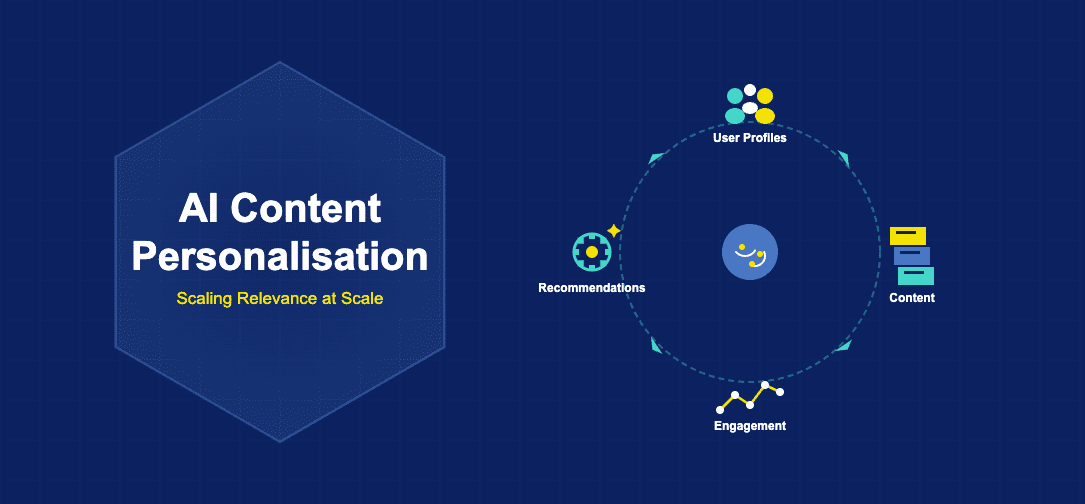
AI-powered content personalisation platforms are rewriting the rules of digital engagement at a velocity that most marketing departments still have not fully grasped. Consider what happens every time a returning visitor lands on a major e-commerce homepage in 2026. Within 140 milliseconds, a machine learning model has already ingested that visitor’s browsing history, purchase patterns, device type, geographic location, time of day, weather conditions in their city, and dozens of behavioural micro-signals captured across previous sessions. The homepage they see is fundamentally different from the one shown to the visitor who arrived three seconds later from a different referral source. Neither visitor is aware that the other’s experience exists. This is not aspirational technology sitting in a vendor roadmap. It is the operational reality at companies like Amazon, Netflix, Spotify, and an expanding cohort of mid-market brands that have recognised personalisation as the single highest-leverage investment in their digital stack.
The Scale of the Content Personalisation Market
The global website personalisation AI market was valued at $2.02 billion in 2024 and is projected to reach $2.57 billion in 2025, growing at a compound annual growth rate of 27 percent, according to The Business Research Company. By 2029, the market is expected to hit $6.62 billion as enterprises accelerate investment in AI-driven customer experiences. The broader content intelligence market, which encompasses the data infrastructure that powers personalisation engines, is projected to grow from $3.53 billion in 2026 to approximately $28.86 billion by 2034, expanding at a CAGR of 30.34 percent according to Precedence Research.
These numbers reflect a fundamental shift in how organisations think about content. The era of creating a single piece of content and publishing it identically for every visitor is ending. In its place, brands are building content systems that generate, assemble, and serve thousands of variations automatically, each tailored to the individual context of the person viewing it. Research by Evergage found that 88 percent of marketers report measurable improvements from personalisation efforts, and McKinsey estimates that companies excelling at personalisation generate 40 percent more revenue from those activities than average performers.
| Metric | Value | Source |
|---|---|---|
| Website Personalisation AI Market (2024) | $2.02 billion | Business Research Company |
| Projected Market Size (2029) | $6.62 billion | Business Research Company |
| Content Intelligence Market (2026) | $3.53 billion | Precedence Research |
| Content Intelligence Market (2034) | $28.86 billion | Precedence Research |
| Content Intelligence CAGR (2025-2034) | 30.34% | Precedence Research |
| Revenue Uplift from Personalisation Leaders | 40% more than average | McKinsey |
| Marketers Reporting Measurable Improvement | 88% | Evergage |
How AI Personalisation Engines Process Decisions in Real Time
Modern content personalisation platforms operate through a layered architecture that combines data ingestion, identity resolution, decisioning, and content assembly in a continuous loop. The process begins with a customer data platform that unifies first-party behavioural data, transactional records, CRM attributes, and increasingly, zero-party data that customers have voluntarily shared through preference centres and interactive content.
Identity resolution stitches together fragmented user interactions across devices and sessions. A visitor who browses products on a mobile phone during their commute, reads a blog post on a desktop at work, and later opens a promotional email on a tablet must be recognised as a single individual for personalisation to be effective. Probabilistic and deterministic matching algorithms work together to build unified customer profiles that serve as the foundation for all downstream personalisation decisions.
The decisioning layer is where machine learning models evaluate which content variant will maximise a specific business objective for each visitor. These models typically employ a combination of collaborative filtering, which analyses patterns across similar users, and contextual bandits, which continuously test and learn from each interaction to improve recommendations over time. Unlike static A/B testing, contextual bandit algorithms can dynamically allocate more traffic to winning variants while still exploring new options, compressing optimisation cycles from weeks to hours.
Content assembly is the final stage. Rather than storing thousands of pre-built page variations, modern platforms use modular content components that can be dynamically arranged. A homepage might have twelve personalisation zones, each capable of displaying different hero images, product carousels, editorial content blocks, or promotional banners depending on the visitor’s profile and the model’s predictions. This modular approach means the number of possible page variations scales exponentially without requiring proportional content creation effort.
Leading Personalisation Platforms and Their Capabilities
The personalisation technology landscape in 2026 ranges from testing-focused tools designed for conversion rate optimisation to enterprise platforms that orchestrate personalised experiences across web, mobile, email, and in-store channels. Many of these platforms integrate directly with the marketing automation stacks that enterprises already rely on for campaign execution and audience management.
| Platform | Core Capability | Best For | Pricing Tier |
|---|---|---|---|
| Adobe Target | AI-driven testing and personalisation | Enterprise omnichannel orchestration | $100,000+/year |
| Optimizely | Experimentation and feature management | Product-led growth teams | $50,000+/year |
| Dynamic Yield | Cross-channel personalisation | E-commerce and retail | $35,000+/year |
| Bloomreach | Commerce-specific AI search and merchandising | Online retailers and marketplaces | $30,000+/year |
| Algolia | AI-powered search and recommendations | Media and content platforms | $10,000+/year |
| Insider | Predictive segmentation and journey orchestration | Growth marketing teams | $20,000+/year |
| Evergage (Salesforce) | Real-time behavioural personalisation | B2B and B2C enterprises | $60,000+/year |
The Role of Generative AI in Content Personalisation
Generative AI has introduced an entirely new dimension to content personalisation by enabling platforms to create original content variants rather than simply selecting from pre-built options. The AI-powered content creation market was valued at approximately $2.15 billion in 2024 and is projected to reach $10.59 billion by 2033, growing at a CAGR of 19.4 percent according to Grand View Research.
In practical terms, this means a personalisation engine can now generate unique product descriptions, email subject lines, push notification copy, and even blog introductions tailored to individual user segments without requiring a human copywriter to create each variation. Publicis Groupe and Adobe expanded their global partnership in 2025 to integrate Adobe Firefly generative AI into Publicis’ CoreAI platform, combining creative AI tools with proprietary data to scale personalised content production across campaigns.
The implications for customer journey orchestration are significant. Instead of mapping out a fixed number of journey paths with predetermined content at each stage, organisations can now build adaptive journeys where the content itself evolves based on how each individual customer responds. A welcome email sequence that previously offered three variations can now produce hundreds, each reflecting the recipient’s demonstrated interests, browsing behaviour, and engagement patterns.
Privacy-First Personalisation: Adapting to a Cookieless World
The deprecation of third-party cookies and tightening privacy regulations have forced personalisation platforms to fundamentally rethink their data strategies. Platforms that relied heavily on third-party audience data for visitor identification and segmentation have had to pivot toward first-party and zero-party data collection frameworks that operate within consent boundaries.
Server-side personalisation has emerged as a critical architectural pattern. By processing personalisation decisions on the server before the page renders, organisations can deliver tailored experiences without relying on client-side JavaScript that can be blocked by ad blockers and privacy extensions. This approach also improves page load performance, as the personalised content arrives in the initial HTML response rather than being injected after the page loads.
Edge computing is amplifying this trend. Personalisation decisions that previously required round trips to centralised servers can now be processed at CDN edge nodes located physically closer to the end user. Platforms like Cloudflare Workers and AWS Lambda@Edge enable sub-50-millisecond personalisation decisions that are invisible to the visitor, eliminating the content flicker that plagued early client-side personalisation implementations.
Measuring Personalisation ROI: Beyond Click-Through Rates
Sophisticated personalisation programmes have moved well beyond simple engagement metrics to measure true incremental business impact. The standard approach involves continuous holdout testing, where a small percentage of traffic, typically 5 to 10 percent, sees the unpersonalised default experience. Comparing conversion rates, average order values, and customer lifetime value between the personalised and holdout groups reveals the actual revenue generated by the personalisation programme.
Leading platforms now provide automated incrementality measurement that quantifies the dollar impact of each personalisation decision. Adobe Target’s Auto-Allocate feature, for example, automatically shifts traffic toward the best-performing experience while maintaining a statistically valid control group. This approach has shown that personalised experiences typically deliver 10 to 30 percent higher conversion rates compared to static alternatives, with the strongest gains appearing in product recommendations, search results ranking, and homepage content selection.
The compounding effect of personalisation across the full customer lifecycle is where the real value emerges. Personalised acquisition experiences improve conversion rates, which feed richer data into the personalisation models, which in turn improve retention and cross-sell recommendations. This virtuous cycle explains why McKinsey found that personalisation leaders generate disproportionately more revenue: the advantage compounds over time as the models become more accurate with each interaction.
Implementation Challenges and How Enterprises Are Overcoming Them
Despite the clear business case, implementing enterprise-grade content personalisation remains challenging. The most common obstacle is data fragmentation. Personalisation engines are only as effective as the data that feeds them, and most organisations have customer data scattered across dozens of disconnected systems. Building a unified data layer through a customer data platform or a composable data architecture is typically the first and most expensive phase of any personalisation initiative.
Content velocity is the second major bottleneck. Personalisation at scale requires significantly more content than a one-size-fits-all approach. Organisations that attempt to hand-craft every content variant quickly hit resource constraints. The solution increasingly involves a combination of modular content design, where atomic content components can be recombined in multiple configurations, and generative AI for producing variant copy at scale.
Organisational alignment is often the most underestimated challenge. Effective personalisation requires close collaboration between marketing, product, engineering, and data science teams. Companies that treat personalisation as a technology initiative owned by a single department consistently underperform those that establish cross-functional personalisation centres of excellence with shared KPIs and governance frameworks.
The Future: Predictive and Anticipatory Personalisation
The next frontier in content personalisation is the shift from reactive to anticipatory. Current platforms primarily personalise based on what a visitor has already done. Emerging approaches use predictive models to personalise based on what a visitor is likely to do next, serving content that addresses needs the customer has not yet explicitly expressed.
Predictive personalisation leverages the same predictive analytics capabilities that are transforming demand forecasting and churn prediction to anticipate individual content preferences. A financial services company, for example, might detect early signals that a checking account customer is researching mortgage options and proactively personalise their banking app experience with mortgage content, calculators, and pre-qualification offers before the customer ever searches for them.
For marketing leaders evaluating personalisation investments, the strategic imperative is clear: organisations that build robust first-party data foundations, invest in modular content architectures, and deploy AI-driven decisioning engines will create customer experiences that are measurably more relevant, more engaging, and ultimately more profitable than those still relying on static, one-size-fits-all content delivery. The market data suggests this is not a question of whether to invest in personalisation technology, but how quickly an organisation can reach the maturity required to compete.
Research from McKinsey’s 2024 analysis indicates that organisations deploying AI at scale report efficiency improvements of 15 to 25 percent within the first 18 months of production implementation.
According to Mordor Intelligence, the AI in fintech market is projected to grow at a compound annual growth rate exceeding 20 percent through 2029, driven by demand for automated fraud detection, credit scoring, and customer service applications.






Comment