Engagement has become one of the most pursued yet elusive metrics in marketing. Whilst companies invest millions in campaigns designed to capture customer attention, engagement rates continue to decline across most channels. The root cause is often not creative quality or targeting precision but rather the fundamental challenge of sustaining motivation and interest over time. Gamification represents a sophisticated approach to this challenge, applying principles from game design and behavioural psychology to marketing programmes to drive deeper customer engagement and sustained participation. The gamification in marketing market is valued at approximately $3.2 billion in 2025, and organisations implementing gamified experiences report engagement increases of approximately 48 percent compared to non-gamified alternatives. Gamification is not simply adding points and badges to a programme. Rather, it represents a systematic application of game mechanics and psychological triggers to create engaging experiences that feel rewarding and motivate sustained behaviour change and participation.
Games are extraordinarily effective at maintaining engagement and motivation. Decades of research in psychology and game design have identified the core mechanics and triggers that make games engaging: they provide clear goals and feedback, they offer incremental progress toward mastery, they create a sense of status or social comparison, they provide meaningful rewards, and they implement systems of challenges that scale in difficulty to maintain engagement at the edge of a player’s current skill level. These elements exist in games ranging from simple mobile puzzle games to complex multiplayer online role-playing games. Gamification in marketing applies these same principles to customer engagement programmes, loyalty schemes, educational experiences, and advocacy initiatives. Rather than treating engagement as something that happens once during an advertising impression or a website visit, gamification creates multi-step experiences where customers engage repeatedly, progress is tracked and visualised, rewards are earned and celebrated, and social elements create community and status differentiation.
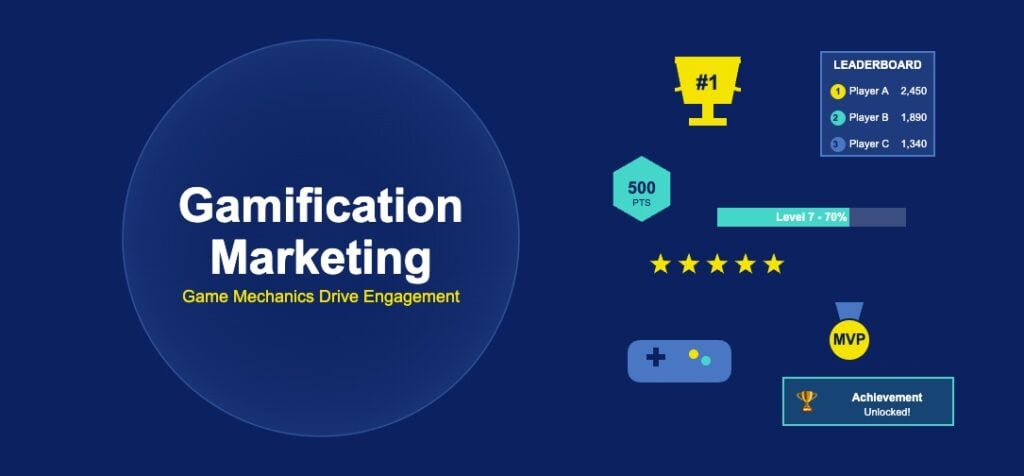
The primary game mechanics employed in marketing gamification are relatively straightforward, though their psychological impact is substantial. Points represent the most fundamental mechanic: customers earn points for desired behaviours, whether those are purchases, referrals, social shares, content consumption, or account completion activities. Points are attractive because they provide immediate quantifiable feedback, allow players to compare their progress against others, and can be redeemed for tangible or status-based rewards. Badges and achievements represent symbolic recognition of accomplishments. Unlike points which accumulate quantitatively, badges are typically one-time unlocks for accomplishing specific milestones or challenges. They serve a psychological function beyond their face value, providing recognition and status. Leaderboards introduce social comparison elements: ranking customers based on points or achievements creates both motivation to climb the ranks and a sense of community. Progress bars and visualisation make abstract progress visible and concrete, which psychological research shows increases motivation to complete activities. Challenges and quests structure gamified experiences into narrative arcs, giving customers specific objectives to complete within time periods, creating urgency and focus.
Gamification Platforms and Implementation Approaches
Purpose-built gamification platforms have emerged to manage the operational complexity of running gamified programmes at scale. Bunchball, now owned by Nitro, provides a comprehensive gamification platform used by consumer brands to create gamified loyalty and engagement programmes. Badgeville similarly offers gamification capabilities, particularly for B2B and enterprise customer engagement. Influitive specialises in community-based gamification for B2B customer advocacy programmes, creating branded communities where customer advocates earn points and badges for activities that benefit the company, such as sharing case studies or referring prospective customers. These platforms provide visual designers for creating gamified experiences, rules engines for defining how points and badges are earned, analytics dashboards for measuring engagement and programme performance, and integration capabilities with email, web, mobile, and CRM systems.
Gamification has found particular traction in B2B customer advocacy and partner programmes. In these contexts, the goal is often to motivate customers or partners to take actions that benefit the company: providing testimonials or case studies, referring prospective customers, providing product feedback, or participating in user conferences. Unlike consumer gamification programmes where intrinsic motivation is typically weaker, B2B advocate programmes benefit from advocates who already have motivation to support the company. Gamification amplifies this intrinsic motivation by making activities feel more rewarding and creating status recognition. A customer who might otherwise write a single case study might, in a gamified programme, become a highly engaged advocate continuously contributing content and referrals in pursuit of status and recognition. Gamification creates a multiplier effect on advocate engagement.
Educational Gamification and Onboarding
Educational gamification has emerged as particularly effective for customer onboarding and training. When customers purchase complex software products or services, a critical success factor is effective customer training and adoption. Traditional training approaches, such as documentation, webinars, and instructor-led training, often struggle to maintain engagement. Gamified onboarding experiences, by contrast, break training into bite-sized lessons that award badges and points for completion, provide challenges that require applying learned concepts, and rank users on leaderboards based on progress. This transforms what might otherwise be a tedious compliance activity into an engaging experience. Duolingo exemplifies this approach in language learning: the application uses a progression system with challenges of increasing difficulty, streak-based engagement mechanics where missing a day breaks a user’s streak, and daily goal mechanics to drive consistent engagement. Educational gamification works because it applies game design principles to maintain motivation through the initial learning phase when mastery is still distant.
Gamification Analytics and Ethical Considerations
Measuring gamification impact requires attention to metrics beyond simple engagement. Activity metrics track how frequently users engage with gamified experiences and whether engagement is sustained over time. Progression metrics measure whether users are advancing through challenges and milestones, indicating that difficulty is well-calibrated and the experience feels achievable. Behavioural metrics measure whether gamification actually drives the desired business behaviours: do customers who engage with the gamified experience ultimately purchase more, refer more, or advocate more than non-engaged customers. Retention metrics measure whether gamification sustains long-term engagement or whether engagement spikes and then declines. Sophisticated gamification programmes track all of these dimensions to ensure that the programme is actually driving business impact rather than simply creating the appearance of engagement.
As gamification has become more prevalent, questions about ethics and psychological manipulation have become increasingly important. Gamification mechanics, particularly those involving social comparison and status, leverage psychological triggers that are powerful specifically because they tap into deep motivational drives. When poorly designed, gamification can feel manipulative, creating artificial urgency or pressure to engage. When targeted at vulnerable populations, gamification mechanics can create problematic behaviour patterns, as demonstrated by concerns about gambling-like mechanics in mobile games. Responsible gamification design involves transparency about mechanics and rewards, fair systems where advancement is based on genuine effort rather than spending, and careful consideration of whether the behaviours being motivated are actually beneficial for customers. The most successful gamification programmes create genuine value for customers: learning outcomes from educational gamification, community and status from social gamification, and meaningful rewards from loyalty gamification.
| Mechanic | Psychological Trigger | Marketing Application | Example |
|---|---|---|---|
| Points | Progress toward quantifiable goals and reward | Loyalty programmes, referral programmes, contest mechanics | Customers earn points for purchases redeemable for rewards |
| Badges and Achievements | Recognition and status within community | Advocacy programmes, certification, milestone recognition | Customers earn “Expert” badge after completing certification course |
| Leaderboards | Social comparison and competitive motivation | Sales team competitions, customer advocacy rankings | Advocates ranked by contribution points visible on community site |
| Progress Bars | Concrete visualisation of progress toward goals | Customer onboarding, profile completion, programme progression | Profile completion bar shows 60 percent complete, motivating final steps |
| Challenges and Quests | Clear goals, urgency, and sense of narrative progress | Limited-time campaigns, content engagement, educational learning | Weekly challenge to complete five lessons before deadline |
| Streaks | Loss aversion and consistency motivation | Daily engagement apps, consistent behaviour building | Users earn streak badges for consecutive days of engagement |
| Sector | Application | Outcome Measured | Technology |
|---|---|---|---|
| Ecommerce | Loyalty programmes with tiered benefits and challenges | Repeat purchase rate, customer lifetime value, engagement frequency | Bunchball, Badgeville, custom platform integrations |
| B2B SaaS | Customer onboarding, certification, and user adoption | Time to value, feature adoption, training completion rate | Duolingo methodology applied to product onboarding |
| Financial Services | Savings goals, investment education, behaviour change challenges | Savings rate, product cross-sell, user engagement duration | Custom gamification within mobile banking platforms |
| B2B Communities | Customer advocacy, referral programmes, community contribution | Advocacy activity, referred pipeline, case study generation | Influitive, community platforms with gamification modules |
Gamification has matured from experimental novelty to mainstream marketing practice, with sophisticated platforms and proven methodologies now available. The organisations gaining the greatest value from gamification are those that apply it strategically to genuine business challenges where engagement and behaviour change drive real outcomes. Rather than gamification for its own sake, the most effective programmes carefully design mechanics and reward systems around the actual behaviours that deliver business value. As customer attention becomes increasingly fragmented and competition for engagement intensifies, gamification represents a powerful psychological toolkit for creating experiences that customers find genuinely rewarding to participate in, resulting in sustained engagement and business impact that extends far beyond what traditional marketing approaches alone can achieve.
Related reading: The Future of Marketing Technology: Emerging Trends, Convergence Platforms, and the Next Decade of Digital Marketing Innovation
Data from Statista’s digital market outlook shows that global digital spending continues to grow at double-digit rates, with mobile channels accounting for an increasingly dominant share of total transactions.
PwC’s analysis of financial services trends through 2025 highlights the convergence of technology and media as a defining dynamic, with data-driven personalisation becoming the primary competitive differentiator.
For more coverage on related topics, explore our dedicated section on technology insights.