Programmatic advertising technology has fundamentally transformed how organisations plan, purchase and optimise digital media. With programmatic ad spend forecast to reach $25 billion in 2025, representing approximately 88% of all digital display advertising, the automation of media buying has moved from a niche capability to the default approach for sophisticated digital advertisers. The technology underpinning this transformation encompasses demand-side platforms, supply-side platforms, ad exchanges, data management platforms and a constellation of supporting infrastructure that enables advertisers to reach specific audiences at scale, in real-time, with measurable precision. Understanding how these components work together is essential for any organisation seeking to compete effectively in modern digital advertising.
The Mechanics of Real-Time Bidding
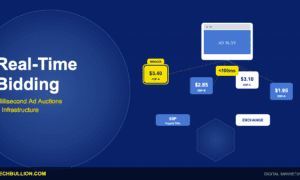
Real-time bidding forms the transactional foundation of programmatic advertising. When a user loads a webpage containing a programmatic ad placement, an auction occurs within milliseconds. The publisher’s supply-side platform sends a bid request containing information about the ad slot and, where available, audience signals. Demand-side platforms evaluate this request against advertiser campaign parameters, calculate a bid value and respond. The winning bidder’s creative is served to the user before the page finishes loading. This entire process typically completes within 100 milliseconds, invisible to the user but representing a sophisticated computational exchange that matches advertising demand with available supply based on audience relevance, contextual signals and advertiser-defined bidding logic.
The precision of RTB bidding depends on the quality of data signals available at auction time. Where rich audience data exists, advertisers can bid with confidence that impressions will reach relevant audiences. In contexts with limited signals, such as environments where cookie-based tracking is restricted, bidding logic must rely on contextual, geographic and device-level signals. The transition towards cookieless advertising environments has prompted significant investment in alternative identity solutions and contextual targeting capabilities that maintain bidding precision without individual-level tracking.
| Component | Role in Ecosystem | Example Vendors |
|---|---|---|
| Demand-Side Platform (DSP) | Enables advertisers to bid for and purchase ad inventory across multiple exchanges | The Trade Desk, DV360, Amazon DSP |
| Supply-Side Platform (SSP) | Enables publishers to manage and sell their ad inventory programmatically | Magnite, Pubmatic, OpenX |
| Ad Exchange | Marketplace where DSPs and SSPs connect to execute real-time auctions | Google Ad Exchange, Xandr |
| Data Management Platform (DMP) | Aggregates and segments audience data for targeting activation | Adobe Audience Manager, Salesforce DMP |
| Ad Server | Manages creative delivery, frequency capping and campaign measurement | Campaign Manager 360, Sizmek |
| Verification Platform | Measures viewability, brand safety and invalid traffic | DoubleVerify, Integral Ad Science |
Demand-Side Platforms: The Advertiser’s Control Centre
Demand-side platforms serve as the primary interface through which advertisers access programmatic inventory. Modern DSPs like The Trade Desk, Google’s Display and Video 360 and Amazon DSP provide unified environments for campaign planning, audience targeting, bid management and performance measurement across display, video, mobile, audio and connected television inventory. The sophistication of DSP bidding algorithms has advanced considerably, with machine learning now automating bid adjustments based on predicted conversion probability, audience recency, competitive auction dynamics and budget pacing requirements.
DSP selection represents a strategic decision for advertisers. Walled garden DSPs, such as those operated by Google and Meta, provide access to proprietary inventory and first-party audience data within closed ecosystems. Independent DSPs like The Trade Desk offer access to the open programmatic ecosystem with greater transparency into auction mechanics, data usage and supply path. Many sophisticated advertisers operate across both environments, using walled garden platforms for their unique inventory access whilst leveraging independent DSPs for cross-channel reach and measurement consistency.
Header Bidding and the Evolution of Inventory Access
Header bidding transformed the supply side of programmatic advertising by enabling publishers to offer inventory to multiple demand sources simultaneously rather than through a sequential waterfall process. In traditional waterfall setups, publishers offered unsold inventory to demand partners in priority order, leaving significant yield on the table. Header bidding allows simultaneous auctions across multiple SSPs, dramatically increasing competition for premium inventory and improving publisher revenue. For advertisers, header bidding environments mean greater access to quality inventory that previously sat behind restricted supply paths, though the complexity of evaluating supply path quality has increased accordingly.
Private Marketplaces and Premium Inventory Access
The programmatic ecosystem encompasses deal structures beyond open auction environments. Private marketplaces and programmatic direct deals allow advertisers to transact with specific publishers at negotiated rates whilst retaining the targeting and measurement capabilities of programmatic buying.
| Deal Type | Description | Typical Use Case |
|---|---|---|
| Open Auction (RTB) | Any buyer can bid; highest bid wins each impression | Broad reach, prospecting, performance campaigns |
| Private Marketplace (PMP) | Invitation-only auction with select buyers and publisher floor prices | Brand safety, premium publisher access, audience targeting |
| Preferred Deal | Buyer gets first look at inventory at fixed CPM before open auction | Securing premium placements with pricing predictability |
| Programmatic Guaranteed | Reserved inventory transacted programmatically at agreed price and volume | High-impact campaigns, seasonal periods, brand moments |
Fraud Prevention and Brand Safety Technology
The programmatic ecosystem’s scale and automation create significant exposure to advertising fraud and brand safety risks. Invalid traffic, including bot-generated impressions and click fraud, costs advertisers billions annually. Verification platforms such as DoubleVerify and Integral Ad Science address this through pre-bid filtering that prevents bids on fraudulent inventory, post-bid measurement that identifies invalid traffic after delivery and brand safety controls that block ad serving adjacent to problematic content.
Brand safety technology has evolved considerably in response to high-profile advertiser incidents where programmatic placements appeared alongside extremist content, misinformation or other damaging material. Context-aware filtering using natural language processing and computer vision now analyses page content at a granular level, enabling advertisers to define acceptable adjacency standards whilst minimising over-blocking that reduces reach unnecessarily. Advertisers increasingly adopt tiered brand safety approaches, with conservative standards applied to brand-building campaigns and more permissive settings for performance-focused activity.
Identity Solutions in the Post-Cookie Era
The deprecation of third-party cookies across major browsers has created significant challenges for audience targeting and measurement in programmatic advertising. Deterministic identifiers based on hashed email addresses, such as those underpinning Unified ID 2.0 and LiveRamp’s RampID, offer persistence in addressable environments where users provide consent. Contextual targeting solutions that infer audience relevance from content signals rather than individual tracking have regained prominence, with advances in natural language processing enabling more sophisticated contextual categorisation than was previously possible.
First-party data activation through clean room technology allows advertisers to match their customer data against publisher audiences without direct data transfer, preserving privacy whilst enabling precise targeting in cookieless environments. The sophistication of these solutions continues advancing rapidly, with major platform providers investing in privacy-preserving architectures that maintain targeting capability within evolving regulatory frameworks. Organisations that invest in robust first-party data strategies and clean room partnerships are best positioned to maintain targeting precision as the programmatic ecosystem adapts to a cookieless future.
Measurement and Optimisation Across Programmatic Channels
Programmatic advertising technology excels at generating data, but extracting actionable insight from this data requires sophisticated measurement frameworks. Attribution models that accurately credit programmatic touchpoints within multi-channel customer journeys remain challenging, particularly as identity fragmentation increases. Marketing mix modelling, incrementality testing and multi-touch attribution approaches each offer different perspectives on programmatic contribution to business outcomes, and the most sophisticated advertisers triangulate across multiple methodologies rather than relying on a single measurement approach.
The organisations deriving greatest value from programmatic technology are those that combine sophisticated bidding infrastructure with disciplined audience strategy, robust brand safety controls and rigorous measurement frameworks. Programmatic technology provides the machinery; the strategic judgment applied to audience selection, creative execution and optimisation decisions determines whether that machinery delivers competitive returns. As the ecosystem continues evolving, the ability to adapt to new identity frameworks, inventory environments and measurement methodologies will increasingly distinguish effective programmatic advertisers from those struggling to maintain performance in a more complex landscape.
Related reading: Connected TV Advertising: The AdTech Growth Driver
Data from Statista’s digital market outlook shows that global digital spending continues to grow at double-digit rates, with mobile channels accounting for an increasingly dominant share of total transactions.
PwC’s analysis of financial services trends through 2025 highlights the convergence of technology and media as a defining dynamic, with data-driven personalisation becoming the primary competitive differentiator.
For more coverage on related topics, explore our dedicated section on technology insights.