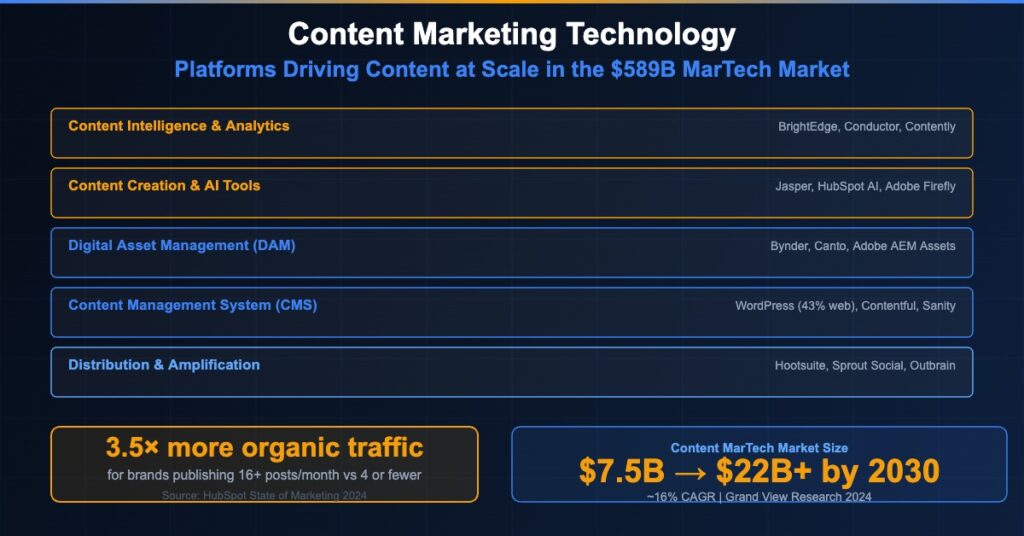
Content has become the currency of digital marketing, and the technology platforms that help organisations create, manage, distribute, and measure content have grown into one of the most expansive categories within the MarTech ecosystem. The global content marketing technology market was valued at approximately $7.5 billion in 2023 and is projected to grow at a CAGR of around 16 percent through 2030, according to Grand View Research. Within the context of the broader 15,000-plus tool MarTech ecosystem, content technology platforms represent some of the most widely deployed tools across organisations of all sizes.
The Content Technology Stack
The content marketing technology stack spans several distinct layers. At the foundational layer sits the content management system — WordPress powers approximately 43 percent of all websites globally according to W3Techs data. For enterprise marketing operations, headless CMS platforms including Contentful, Contentstack, and Sanity have grown significantly, enabling organisations to separate content creation from presentation and distribute content across multiple channels from a single source of truth.
Above the CMS sits the digital asset management layer — platforms such as Bynder, Canto, and Adobe Experience Manager Assets that organise, store, and distribute brand-approved creative assets. Content creation and optimisation tools represent a fast-growing sub-category, including AI writing assistants (Jasper, Copy.ai, Writer), video production platforms (Vidyard, Wistia), graphic design tools (Canva, Adobe Express), and content optimisation platforms that score content for SEO quality before publication.
The Scale of Content Production Requirements
The volume of content that modern digital marketing requires is substantial and growing. According to HubSpot’s State of Marketing report, companies that publish 16 or more blog posts per month generate 3.5 times more organic traffic than those publishing four or fewer posts. Enterprise brands with global operations may produce thousands of content pieces per month across multiple languages, formats, and channels — a scale that requires technology platforms rather than purely manual processes.
The growth in MarTech budgets is directly connected to this content volume challenge. As digital channels requiring content continue to expand — from websites and email to social media, connected television, and AI-generated search summaries — the technology investment required to produce, manage, and distribute content at scale grows proportionally. The Content Marketing Institute’s 2024 B2B benchmarks report found that 71 percent of content marketers say content marketing has become more important to their organisation over the last year.
Generative AI and the Content Production Revolution
The most significant recent development in content marketing technology is the integration of generative artificial intelligence into content creation workflows. Jasper reported that brands using its platform could produce content five times faster than traditional methods. HubSpot’s AI content assistant, launched in 2023, is now used by over 200,000 companies to accelerate email, blog, and social content creation. Adobe’s Firefly generative image model is integrated into Creative Cloud, enabling marketing teams to generate brand-compliant imagery without stock photo licensing costs.
This development connects directly to the broader AI-driven MarTech transformation and is changing the economics of content production for organisations of all sizes. The ability to generate first drafts, create content variations for A/B testing, and localise content across languages at minimal marginal cost is reshaping how content teams operate within the broader MarTech investment landscape.
Content Intelligence and Performance Measurement
Beyond creation and distribution, content marketing technology increasingly includes intelligence layers that connect SEO data, engagement metrics, and conversion data to understand which content is driving commercial outcomes. Predictive content intelligence tools — which analyse historical performance data and current search trends to recommend content topics — are a fast-growing sub-category. The connection between content technology and search marketing technology is particularly strong, as search intent data is one of the most reliable inputs to content strategy.
Content Distribution and Amplification
Content distribution technology encompasses social media management platforms (Hootsuite, Sprout Social, Buffer), content syndication networks, email marketing platforms, and paid content amplification tools through native advertising networks such as Outbrain and Taboola. The marketing automation layer plays an important role in content distribution, enabling personalised content delivery based on individual recipient profiles. The trajectory through the 2034 MarTech horizon will be shaped by continuing advances in generative AI, further reducing the marginal cost of content production while increasing the competitive premium on content quality and strategic differentiation within the evolving $589 billion global MarTech market.
Data from Statista’s digital market outlook shows that global digital spending continues to grow at double-digit rates, with mobile channels accounting for an increasingly dominant share of total transactions.
PwC’s analysis of financial services trends through 2025 highlights the convergence of technology and media as a defining dynamic, with data-driven personalisation becoming the primary competitive differentiator.
Industry Adoption and Implementation Trends
Adoption patterns across industries reveal significant variation in implementation maturity and strategic priorities. Financial services and healthcare organizations have led enterprise adoption, driven by regulatory requirements and the potential for operational efficiency gains. According to Deloitte’s industry outlook, more than 60 percent of large enterprises now allocate dedicated budgets to digital transformation initiatives, up from 35 percent in 2020. Mid-market companies have followed, though their implementations tend to focus on specific pain points rather than comprehensive overhauls.
For more coverage on related topics, explore our dedicated section on technology insights.
Risk Factors and Strategic Considerations
Several factors could moderate the growth trajectory that current projections suggest. Macroeconomic uncertainty, including persistent inflation in key markets and tightening credit conditions, may constrain capital expenditure budgets in the near term. Regulatory fragmentation across jurisdictions creates compliance costs that disproportionately affect smaller operators. Talent shortages in specialized technical roles remain a bottleneck, with demand for qualified professionals exceeding supply by an estimated two-to-one ratio in most developed markets according to PwC’s workforce analysis. Organizations that address these constraints proactively will be better positioned to capture market share.
Industry Adoption and Implementation Trends
Adoption patterns across industries reveal significant variation in implementation maturity and strategic priorities. Financial services and healthcare organizations have led enterprise adoption, driven by regulatory requirements and the potential for operational efficiency gains. According to Deloitte’s industry outlook, more than 60 percent of large enterprises now allocate dedicated budgets to digital transformation initiatives, up from 35 percent in 2020. Mid-market companies have followed, though their implementations tend to focus on specific pain points rather than comprehensive overhauls.
Readers interested in this space may also find value in our reporting on AI-powered marketing.