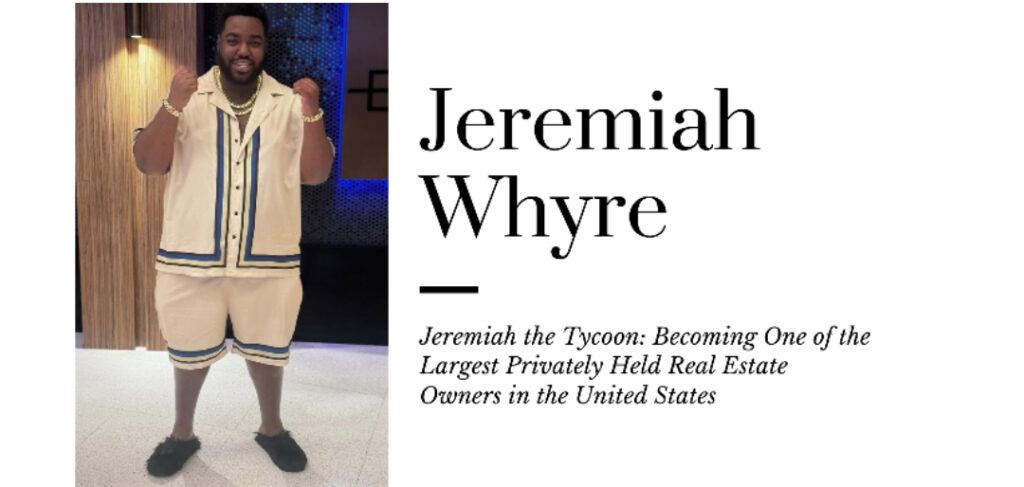
In an era where entrepreneurs often chase fast trends and short term wins, Jeremiah Whyre, widely known as Jeremiah the Tycoon, has taken a different path. Over the past several years, he has steadily positioned himself as one of the largest privately held real estate owners in the United States. With an estimated net worth of $300 million, according to recent industry reports, his portfolio reflects the scale of assets accumulated across real estate and affiliated ventures. What began as a vision rooted in financial independence has evolved into a diversified property portfolio built on discipline, calculated expansion, and long term asset control. His trajectory reflects a distinctly American mindset that values ownership, scalability, and generational wealth.
Capitalizing on Early Opportunities
Whyre’s foundation was not built in corporate boardrooms or through inherited advantage. Raised in a middle class household, he developed an early understanding of financial pressure and personal responsibility. Like many self made entrepreneurs across the country, he recognized that ownership creates freedom. During the early rise of cryptocurrency, he immersed himself in studying digital assets and blockchain technology. At a time when much of the public remained cautious, he approached the space with research and conviction. The experience sharpened his ability to evaluate risk, move decisively, and think ahead of market cycles. While digital markets were only the beginning, they provided the capital base and strategic discipline that would later fuel larger ambitions.
Building a National Real Estate Portfolio
Rather than allowing early financial gains to remain concentrated in volatile markets, Whyre redirected capital into tangible assets. Real estate became the cornerstone of his long term strategy. Beginning with carefully selected acquisitions, he focused on properties positioned for appreciation, cash flow stability, and operational scalability. As momentum built, so did geographic reach. His portfolio expanded across multiple states, reflecting a deliberate approach to market selection and asset class diversification. Residential and commercial holdings alike became part of a broader framework designed to endure beyond economic cycles. Each acquisition was treated not as a transaction, but as a building block within a growing national footprint.
A Privately Held Model at Scale
One defining element of Whyre’s expansion is his commitment to privately held ownership structures. In an industry where many large portfolios rely heavily on institutional capital or public markets, maintaining private control allows greater flexibility and long term strategic alignment. This structure supports streamlined decision making and consistent asset oversight. By retaining equity and operational authority, Whyre preserves independence while scaling across state lines. The approach mirrors a classic American business philosophy centered on control, stewardship, and sustained growth rather than short term speculation.
Blending Digital Insight with Tangible Assets
Although real estate stands at the center of his empire, Whyre’s early experience in cryptocurrency continues to influence his broader strategy. The fast paced environment of digital markets reinforced the value of research, timing, and adaptability. Those lessons translated directly into property acquisition and portfolio management. By combining technological awareness with traditional asset ownership, he developed a hybrid model that reflects the evolving face of American entrepreneurship. It is a model rooted in calculated expansion, disciplined reinvestment, and long horizon planning.
Through affiliated operations and property management initiatives, Whyre’s ventures support a workforce spanning multiple sectors. His emphasis remains on durable value creation and measured growth. As the U.S. real estate landscape continues to shift, Jeremiah Whyre represents a new generation of privately held ownership at scale. His rise signals how modern entrepreneurs are blending innovation with foundational assets, building portfolios designed not just for today’s market, but for decades to come.