In 2026, professional 3D scanning is increasingly defined by workflow efficiency rather than isolated hardware metrics. Engineers and industrial teams are looking for systems that reduce setup complexity, process data reliably, and operate independently of fixed workstations.
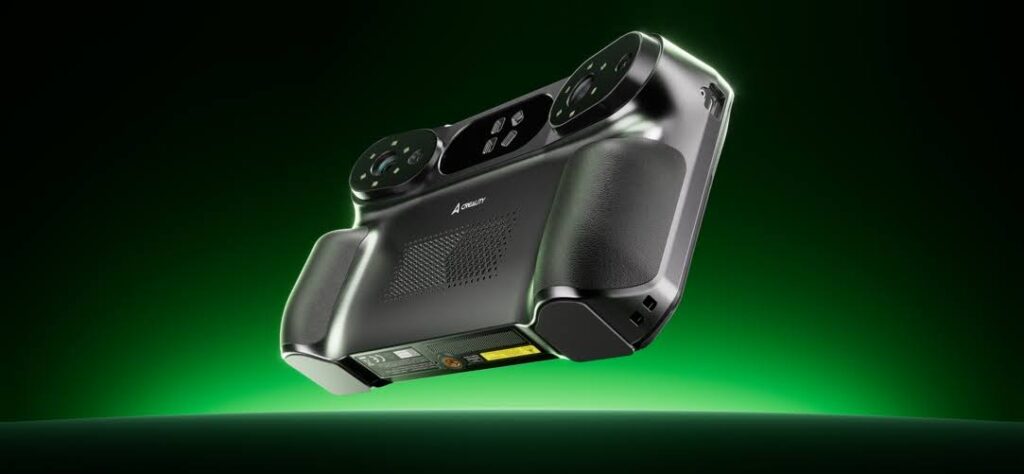
Creality’s Sermoon P1 addresses these expectations with a fully integrated handheld architecture that combines multi-mode laser scanning with onboard computing power.
Rather than functioning as a peripheral device dependent on a high-end PC, the P1 is engineered as a self-contained professional platform.
True Standalone Performance
One of the defining characteristics of the Sermoon P1 is its genuine standalone capability.
Powered by a Qualcomm 8-core processor, 24GB of RAM, and 256GB of high-speed storage, the device performs scanning, preprocessing, point cloud alignment, and model preview directly on its 6-inch HD touchscreen interface.
This eliminates the need for external computing hardware during data capture.
For professionals working in workshops, automotive repair environments, or on-site inspection scenarios, reducing dependence on external PCs simplifies deployment and improves mobility.
In 2026, integrated edge processing is no longer a novelty — it is increasingly expected in professional hardware.
22 + 7 + 1 Multi-Mode Blue Laser Matrix
Optically, the Sermoon P1 introduces a structured multi-mode laser system designed for different scanning scenarios.
It features:
- Single-line blue laser for deep hole and recessed structure scanning
- 7 parallel-line blue laser for fine-detail surface capture
- 22 cross-line blue laser for fast large-part scanning
- Four-lens NIR structured light system for markerless large-object and human body scanning
This configuration allows operators to switch scanning modes depending on geometry complexity and object scale, rather than relying on a single capture method.
The system is built to handle narrow gaps, intricate surfaces, and larger components without requiring multiple devices.
Professional Accuracy and Stability
The Sermoon P1 delivers up to 0.02 mm accuracy, making it suitable for professional reverse engineering, inspection, and product development workflows.
It also supports scanning speeds of up to 100 FPS, enabling smooth data capture across complex geometries.
Combined with FPGA-level image processing and onboard hardware optimization, the system is designed to maintain consistent frame rates and stable point cloud generation during extended scanning sessions.
In professional environments, repeatability and reliability often matter more than peak speed alone.
Wireless Data Transmission with Wi-Fi 7
Equipped with next-generation Wi-Fi 7, the Sermoon P1 supports low-latency, high-throughput data transmission when connected to a PC.
Large scan datasets can be transferred efficiently, reducing downtime between scanning and downstream modeling or inspection tasks.
For teams handling frequent or high-volume scanning projects, minimizing waiting time can significantly improve overall productivity.
Designed for On-Site Reverse Engineering
With dual swappable batteries, fast charging capability, and a compact integrated form factor, the Sermoon P1 is built for continuous professional use.
Weighing approximately 850 grams and measuring 209 × 129 × 54 mm, it balances portability with industrial-grade internal hardware.
Because the system does not require cables or fixed scanning stations during operation, it can be deployed directly in workshops, automotive garages, production lines, or field environments.
This mobility supports faster on-site reverse engineering and inspection workflows — a growing requirement in distributed manufacturing environments.
Integration with Professional Software Ecosystems
The Sermoon P1 integrates with mainstream professional software platforms used in reverse engineering, inspection, and design.
Compatibility with established CAD and inspection ecosystems ensures a smoother transition from data capture to modeling and manufacturing, reducing friction within existing enterprise workflows.
A Practical Direction for 2026 Professional Scanning
The Sermoon P1 does not attempt to redefine 3D scanning conceptually. Instead, it reflects a measurable shift in how professional scanners are engineered in 2026:
- Integrated onboard computing
- Multi-mode laser flexibility
- Reduced reliance on external infrastructure
- Wireless, portable deployment
- Industrial-grade accuracy with simplified workflows
For engineering teams, inspection departments, and automotive workshops, the value lies in reducing operational friction while maintaining precision.
In that sense, the Sermoon P1 represents a logical step forward — not through exaggerated claims, but through hardware architecture designed around real professional use.