I test a lot of design tools every year. Most look impressive in demos but fall apart in real workflows. The tools in this list are different. These are the ones that actually hold up when you’re working on real products, real deadlines, and real teams.
AI hasn’t replaced designers but it has changed how we work. Tasks that used to take hours, like drafting layouts or building flows, can now happen in minutes. The challenge is knowing which tools are actually useful and which are just hype. Some focus on visuals, some on structure, and some help you ship code. The best ones support real product workflows, not just design experiments.
How AI Design Tools Fit Into Real Workflows
Most AI design tools fall into one of four roles:
- Structure tools — plan flows, sitemaps, architecture
- Interface tools — generate layouts
- Visual tools — create styling and assets
- Build tools — turn designs into working code
Strong teams combine tools across categories. The most valuable platforms cover multiple stages instead of solving just one small problem.
Figma Make — Best for Designers Who Live in Figma
Figma Make is the easiest AI tool to adopt if your team already designs in Figma daily. It works inside your existing files, so you can generate layouts, tweak components, and test ideas without switching tools. That matters more than people think. Designers lose a lot of momentum when they have to jump between platforms.
Key strengths
- Prompt-based UI generation within live files
- Instant iteration on existing designs
- Interactive prototype creation
Ideal for: teams standardized on Figma.

Flowstep — Best Overall AI UI System
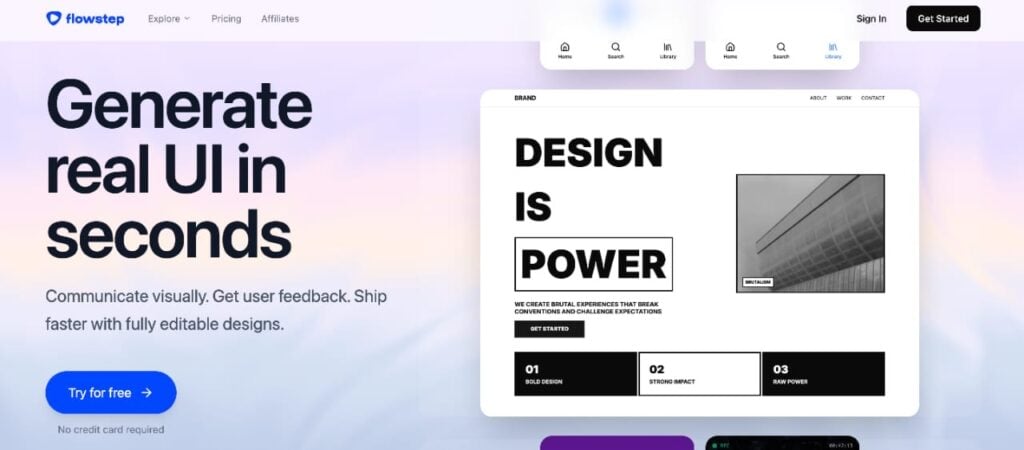
Flowstep feels less like a design tool and more like a product tool. It doesn’t just generate a single screen — it builds connected interface flows that resemble real applications. You get structure, navigation logic, reusable components, and layout consistency from the start. That alone saves hours of setup work designers usually handle manually.
What makes it especially useful is how close its outputs are to something developers can actually use. Instead of treating design as a separate phase, it encourages system thinking from the beginning. That means fewer redesign cycles later and far less friction between design and engineering. In practice, this is the kind of tool you open when a product idea is still messy and you need structure fast.
Why it stands out
- Multi-screen interface generation
- Editable layouts instead of static renders
- React + TypeScript + Tailwind export
- Collaboration-friendly environment
Most AI design tools stop at visuals. Flowstep moves into engineering territory, which dramatically shortens the gap between concept and production.
Ideal for: teams building real products, not just mockups.

Relume AI — Best for UX Planning
Relume focuses on structure before visuals. It helps you map pages, flows, and content hierarchy so you understand how a product should work before worrying about styling. Experienced designers know this stage is where most usability problems actually get solved.
Core capabilities
- Sitemap generation
- UX flow planning
- Component layout suggestions
Ideal for: planning architecture before design.

Vercel v0 — Best for Generating UI Components
v0 is helpful when you want to move from a design idea to real interface code quickly. Instead of building everything from scratch, you can generate structured components that match modern frameworks. That speeds up implementation and keeps design systems consistent.
Strengths
- generates React UI blocks
- Tailwind styling support
- optimized for modern stacks
Ideal for: developers building scalable front-ends.

Uizard — Best for Fast Mockups
Uizard is what you use when you need a visual immediately. Paste text, upload a sketch, or drop a screenshot, and it turns it into an editable UI. It’s not meant for final design polish. It’s meant for communicating ideas fast.
Highlights
- Sketch → UI conversion
- Screenshot → editable layout
- Prompt → interface
Ideal for: early ideas, founders, and non-designers.

Midjourney — Best for Visual Direction
Midjourney is often used before any UI work starts. It helps designers explore visual direction, mood, and tone. That makes it perfect for figuring out what a product should feel like before building layouts.
Best uses
- moodboards
- hero sections
- aesthetic experimentation

Google Stitch — Best for Testing Layout Ideas
Stitch is built for experimentation. It’s less about polished visuals and more about quickly seeing whether a layout works. You can generate structures and basic front-end output fast, which helps validate ideas early.
Where it shines
- Generates layouts plus HTML/CSS
- Rapid functional validation
- Great for layout experimentation
Ideal for: developers and product teams testing concepts.

Khroma — Best for Color Selection
Choosing colors sounds easy until you actually try to do it. Khroma learns your taste and suggests palettes that match your style while still meeting accessibility standards. It’s simple, focused, and surprisingly useful.
Useful for
- palette discovery
- contrast accessibility
- branding consistency
Ideal for: UI designers and brand teams.

Replit AI — Best All-in-One Build Workspace
Replit combines design, development, testing, and deployment in one environment. Its AI can generate UI, write backend logic, and show you a live preview instantly. That removes setup friction and makes experimentation much faster.
Capabilities
- UI + backend generation
- live preview environments
- one-click deployment
Ideal for: launching prototypes fast.

Lovable — Best for Turning Ideas Into Working Apps
Lovable is great for validating product concepts. Describe what you want, and it produces layouts plus logic you can interact with. That’s useful when you need to test whether an idea is worth building before investing serious time.
Useful for
- MVP interface creation
- fast product validation
- functional demos

Adobe Firefly — Best for Production-Safe Assets
Firefly works well in professional environments where licensing matters. Because it connects directly with Adobe tools, you can generate assets and refine them immediately inside your workflow.
Advantages
- commercially safe dataset training
- consistent stylistic outputs
- integration with Photoshop and Illustrator

Base44 — Best Emerging Builder to Watch
Base44 represents a new generation of AI platforms that try to automate larger parts of product creation. Instead of assisting with one task, it aims to generate structure, components, and logic together. It’s still evolving, but tools like this point toward where product design is headed.
Why it’s interesting
- automated component creation
- structured logic scaffolding
- evolving full-app generation

Choosing the Right Tool
Pick based on your stage:
| Stage | Best Options |
| Exploring ideas | Midjourney, Khroma |
| Planning UX | Relume |
| Generating interfaces | Flowstep, Figma Make, Uizard |
| Testing concepts | Stitch, v0 |
| Building products | Replit, Lovable |
Final Take
After testing these tools across real product workflows, one thing stands out: AI doesn’t replace design thinking; it removes the slow, repetitive steps around it. The fastest teams right now aren’t relying on a single tool. They’re building smart stacks that support ideation, structure, UI, and implementation together.
That said, some platforms clearly cover more ground than others. Tools like Midjourney, Relume, or v0 are excellent in their specific roles. But Flowstep stands apart because it connects multiple stages in one place from early interface concepts to structured screens and build-ready output. That ability to move from rough idea to production-ready foundation without constant tool-switching is a real advantage.
In practical terms, most tools on this list help you design faster. Flowstep helps you ship faster. And for teams building real products, that difference matters.