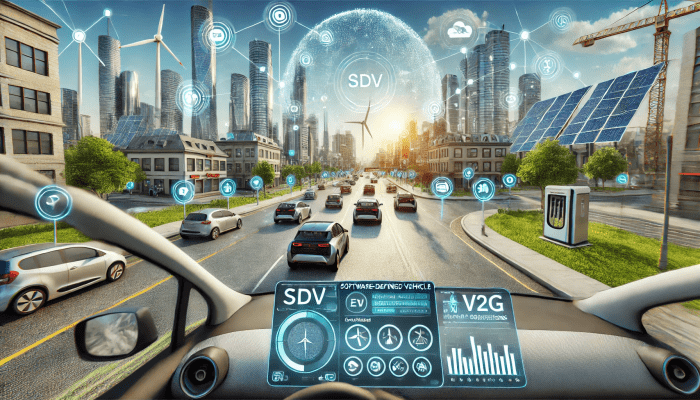
In 2026, the automotive industry has undergone its most radical transformation since the assembly line. We have officially entered the era of the Software-Defined Vehicle (SDV)—where a car’s value, performance, and safety are dictated by code rather than cylinders. As of February 2026, the global SDV market has hit a valuation of $360 billion, with 21% of OEM expenditure now dedicated solely to software architecture. For a modern Business, the “sale” of a car is no longer the end of the transaction but the beginning of a decade-long subscription relationship. Meanwhile, Digital Marketing has pivoted from selling “Horsepower” to selling “Time Recovery,” as Level 3 autonomy becomes a production-ready reality on global highways.
The Technological Architecture: The “Central Nervous System”
By 2026, the internal architecture of the car has been “flattened” and centralized.
-
Zonal E/E Architecture: The “rat’s nest” of wiring is gone. In 2026, vehicles use Zonal Controllers that group hardware by physical location rather than function, all feeding into a “Central Compute” brain. This Technology has reduced vehicle weight by 100kg on average, directly boosting EV range.
-
On-Edge AI Inference: Using chips like the Snapdragon Digital Chassis or NVIDIA Thor, 2026 cars process petabytes of sensor data locally. This “Edge AI” ensures the vehicle can make split-second safety decisions even in “Dead Zones” without 5G or satellite connectivity.
-
V2X (Vehicle-to-Everything): In February 2026, cities like Singapore and Munich have fully deployed C-V2X infrastructure. Cars now “talk” to traffic lights and other vehicles, creating a “Collective Awareness” that eliminates blind spots and prevents collisions before they are even visible to the human eye.
Artificial Intelligence: From Pilot to “Traffic Oracle”
In 2026, Artificial Intelligence has moved beyond simple lane-keeping into “Agentic Navigation.”
1. Agentic Co-Pilots (NOA 2.0)
Navigation on Autopilot (NOA) has reached maturity this February. 2026 models from Tesla, NIO, and Mercedes-Benz feature “Agentic AI” that doesn’t just follow a GPS line—it reasons. If a road is blocked by a local parade not on the map, the AI “looks” at the crowd, understands the context, and autonomously negotiates a detour.
2. The “Traffic Oracle” (City Brain Integration)
AI is now the “God-view” of urban mobility. In 2026, city-wide AI systems (like Alibaba’s City Brain or Singapore’s iTransport) act as Oracles, dynamically adjusting speed limits and traffic signal timings across entire districts to maintain a “Perfect Flow,” reducing commute times by 25%.
3. Level 3 & Level 4 Reality
February 6, 2026, marked a historic milestone: the UN announced global regulations for the safe introduction of self-driving vehicles. While Level 3 (eyes-off) is now common on highways, Level 4 (driverless) Robotaxis from Waymo and Zoox have officially expanded into cold-weather cities like Denver, proving that AI has finally mastered “Inclement Weather” driving.
Digital Marketing: The “Car-as-a-Service” (CaaS) Era
Digital Marketing for mobility in 2026 is built on Feature-on-Demand (FaaS).
-
The “Experience Skin” Hook: Car brands now market “Digital Cockpit Skins.” Much like a smartphone, users can subscribe to different “Vibes”—a “Minimalist Zen” interface for the morning commute or a “Cinematic Theater” mode for long trips, complete with AI-curated spatial audio.
-
AEO (Answer Engine Optimization) for “Mobility Flow”: As users ask their AI, “What’s the fastest, cheapest way to get to the airport with three bags?”, mobility providers are optimizing their “Intermodal Data” (combining car-share, rail, and e-scooters) to be the top-ranked recommendation.
-
The “Humanity Premium” in Ride-Hail: In a world of Robotaxis, high-end “Human-Driven” services are marketing themselves as a luxury niche, focusing on the “Empathy and Local Knowledge” that an algorithm cannot replicate.
Business Transformation: Subscriptions & Circularity
The internal Business of automotive has shifted from “Units Sold” to “Lifecycle Revenue.”
-
Software-Driven Revenue: By 2026, “Post-Purchase” features—like boosting horsepower via an OTA (Over-the-Air) update or unlocking “Autobahn Mode”—account for 15% of total OEM profit margins.
-
The Battery-as-a-Service (BaaS) Model: To lower the entry price of EVs, 2026 consumers often buy the car but lease the battery. This allows for “Battery Swapping” in under 3 minutes, turning a 40-minute charge into a pit-stop experience.
-
The Circular Car: In February 2026, the EU Digital Product Passport (Article 64) now applies to vehicles. Every component—from the rare-earth magnets to the seat fabric—is tracked for “Remanufacturability,” ensuring that 95% of the vehicle is recycled at the end of its life.
Challenges: Cybersecurity and the “Liability Handover”
The 2026 mobility revolution faces a “Safety Speedbump.”
-
The Cybersecurity Threat: As cars become “Computers on Wheels,” they are the new frontier for hackers. In 2026, “Automotive SOCs” (Security Operations Centers) monitor vehicle fleets in real-time, treating a software bug as a recall-level emergency.
-
The Liability Gap: When a Level 3 vehicle crashes, who is at fault? In 2026, new laws in California and Germany allow citations to be issued directly to AV Operators (the software makers), forcing a massive shift in how insurance companies calculate risk (Article 65).
Looking Forward: Toward “Universal Mobility”
As we look toward 2030, “Mobility” is moving toward “Gravity-Defying Connectivity.” We are approaching the era of Commercial eVTOLs (electric Vertical Take-Off and Landing), where the AI “Traffic Oracle” will manage not just the streets, but the “Urban Air Corridors,” making the 15-minute city a 3D reality.
Conclusion
The convergence of Technology, Business, Digital Marketing, and Artificial Intelligence has turned “The Car” into “The Ultimate Mobile Device.” In 2026, the winners are not those with the loudest engines, but those with the most Seamless Code. By embracing “Intelligent Mobility,” the leaders of 2026 are ensuring that while we move faster than ever, we arrive safer, greener, and more connected.