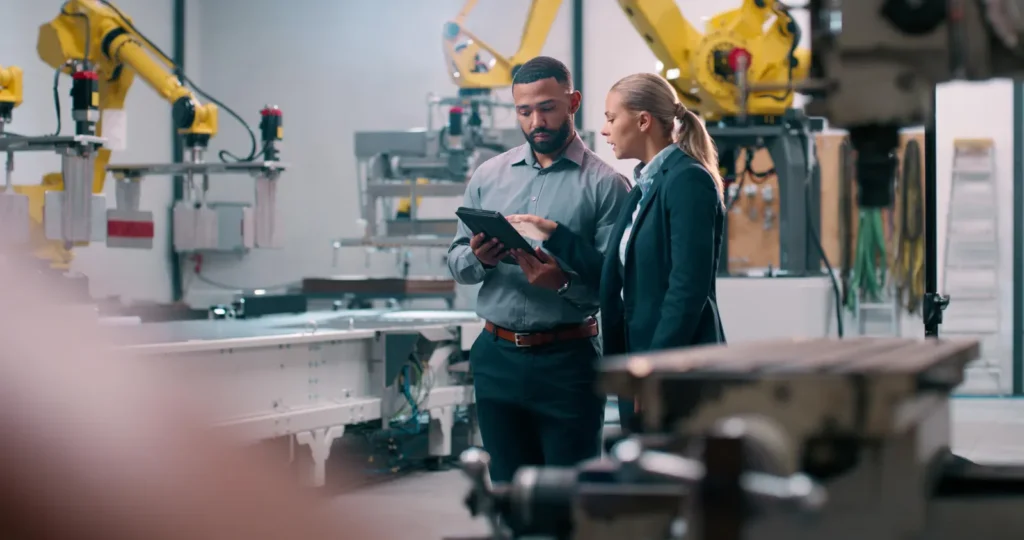
In 2026, the factory floor is no longer a place of rigid assembly lines and manual oversight; it has become a Symphony of Data. We have entered the era of the Digital Thread—a seamless flow of information that connects a product from its initial AI-generated blueprint to its eventual recycling. The smart manufacturing market is expected to reach a critical mass this year, with 80% of businesses now deploying Generative AI in production environments. For a modern Business, the goal has shifted from “Mass Production” to “Mass Autonomy” through Lights-Out Factories that run 24/7 without human intervention. Meanwhile, Digital Marketing has pivoted toward “Operational Transparency,” where a brand’s value is determined by the traceable, carbon-neutral “Digital Passport” of every item it creates.
The Technological Architecture: The Digital Thread
By 2026, a physical product is simply the final manifestation of a perfect digital dataset.
-
The Unified Digital Thread: This is the “connective tissue” of 2026 industry. It links CAD designs, supply chain logistics, shop-floor robotics, and post-sale maintenance data into a single, immutable record. This Technology allows a change in a design file to automatically update the programming of robots in a factory 3,000 miles away.
-
Lights-Out Manufacturing: In 2026, “Dark Factories” are no longer experimental. Enabled by advanced sensors and Industrial IoT (IIoT), these facilities operate without lighting or HVAC, as the resident robots don’t need them. Some facilities, like Fanuc’s self-replicating plants, now run unsupervised for up to 30 days at a time.
-
Rapid-Cycle Additive Manufacturing: 3D printing has moved from “Prototyping” to “Production.” AI-driven Print Optimization allows for “Hybrid Manufacturing,” where additive and subtractive processes are combined to create complex, lightweight parts that were previously impossible to cast or forge.
Artificial Intelligence: The Generative Engineer
In 2026, Artificial Intelligence has moved from “Monitoring” the factory to “Designing” the entire industrial lifecycle.
1. Generative Design for Production
Engineers no longer “draw” parts. They input constraints—weight, stress points, material cost, and thermal limits—and Generative AI outputs thousands of optimized blueprints. In 2026, this has led to components that are 30% lighter and 50% faster to manufacture, revolutionizing aerospace and EV sectors.
2. Agentic Shop-Floor Orchestration
The “Foreman” of 2026 is an AI Agent. Unlike old dashboards that just showed errors, Agentic AI now senses a looming machine failure or a supply delay and autonomously re-routes production to a different line or orders a replacement part via a Smart Contract (Article 41) before the human staff even arrives.
3. Foundation Models for Physical AI
We are seeing the rise of Vision-Language-Action (VLA) models. These allow robots to understand natural language commands and “see” unstructured environments. In 2026, a worker can tell a robot, “Clear the scrap from Station 4 and organize the remaining bolts,” and the robot can navigate the complex floor to execute the task without specific code.
Digital Marketing: From “Product Specs” to “Traceable Stories”
Digital Marketing for industrial brands in 2026 is built on the “Data-Backed Promise.”
-
Digital Product Passports (DPPs): Marketers now use the Digital Thread to sell “Verifiable Sustainability.” Every product features a QR code that reveals its entire journey—from the ethical mine where the raw lithium was sourced to the exact “Energy Signature” of its assembly.
-
GEO (Generative Engine Optimization) for B2B: As procurement officers ask their AI, “Which tier-2 supplier has the lowest defect rate for recycled aluminum components?”, manufacturers are optimizing their digital threads to be “AI-Readable,” ensuring their performance metrics are picked up by the sourcing algorithms.
-
The “Human-Centric” Brand: In an era of total automation, marketing has shifted to highlight the Human-in-the-Loop. Brands are positioning their human workers not as “laborers,” but as “AI Orchestrators” and “Creative Directors,” appealing to a consumer base that values “Human-Supervised Quality.”
Business Transformation: Manufacturing-as-a-Service (MaaS)
The internal Business model of industry has been “Cloud-ified.”
-
Micro-Factories & Nearshoring: Large, centralized factories are being supplemented by Modular Micro-Factories. These AI-managed “Pop-up” plants are located closer to the end consumer, reducing shipping costs and allowing for hyper-local customization.
-
Robots-as-a-Service (RaaS): For SMEs, the “High Capex” barrier has vanished. In 2026, you don’t “buy” a fleet of robots; you rent them on a subscription basis. This allows small manufacturers to scale their production up or down as easily as a software company scales its server usage.
-
The “Zero-Waste” Business Logic: AI-driven Predictive Demand has virtually eliminated “Overproduction.” Factories only build what the Digital Marketing signals (Article 43) say is already sold, turning the traditional “Make-to-Stock” model into a “Make-to-Demand” system.
Challenges: The Talent Gap and Cybersecurity
The 2026 industrial revolution faces two critical “System Failures.”
-
The “Cobot” Talent Crisis: There are over one million unfilled manufacturing jobs in the U.S. alone. The professional challenge of 2026 is “Upskilling”—turning traditional machinists into “Digital Thread Managers” who can troubleshoot AI-robot interactions.
-
Industrial Ransomware: A “Connected Factory” is a vulnerable one. In 2026, “Operational Technology” (OT) security is the #1 concern. A single hack into a Digital Thread could theoretically alter the dimensions of every part produced, leading to catastrophic structural failures in the field.
Looking Forward: Toward “Systemic Regeneration”
As we look toward 2030, the “Intelligent Factory” is moving toward “Circular Autonomy.” We are approaching a world where factories don’t just “Make” things; they also “Un-Make” them—automatically disassembling old products and feeding the raw materials back into the Digital Thread for the next generation of goods.
Conclusion
The convergence of Technology, Business, Digital Marketing, and Artificial Intelligence has turned manufacturing from a “Blue Collar” industry into a “Silicon” one. In 2026, the winners are those who realize that the most valuable thing they produce isn’t the physical object, but the data that defines it. By embracing the “Intelligent Factory,” the industrial leaders of 2026 are building a world that is faster, cleaner, and more resilient than ever before.
Would you like me to move on to the 45th article, perhaps exploring “The Intelligent Financial Sector: How AI Wealth Managers, Tokenized Assets, and ‘Central Bank Digital Currencies’ (CBDCs) are Redefining Money in 2026”?