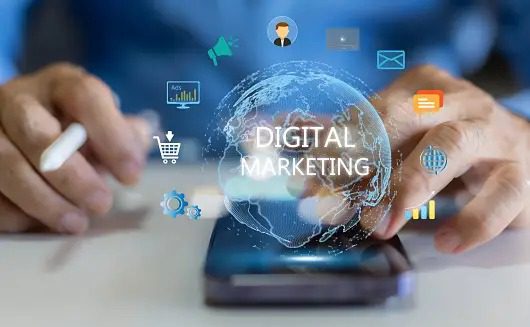
In 2026, the barrier between “Online” and “Offline” has vanished. We are living in the world of “Phygital” Marketing, where a consumer’s physical journey is seamlessly enhanced by a digital layer. Driven by the mass adoption of Augmented Reality (AR) glasses and the “Internet of Things (IoT),” Digital Marketing has moved out of the screen and into the streets. For a professional Business, this means that every physical product and every storefront is now a “Digital Touchpoint” capable of delivering hyper-personalized experiences in real-time.
The Rise of “Spatial Commerce”
With 6G connectivity now stable in major urban centers, Spatial Commerce has become a reality. When a consumer wearing AR glasses looks at a product in a storefront window, the Artificial Intelligence in their device recognizes the item and “Overlays” a digital menu.
This menu might show:
-
Personalized Pricing: Based on the user’s loyalty status.
-
Social Proof: Real-time reviews from the user’s “Trusted Circle” of friends.
-
Sustainability Data: A “Transparency Score” showing the item’s carbon footprint.
-
Virtual Try-On: The user can see a digital version of themselves wearing the item without ever stepping inside the store.
For the Business, this represents a “New Funnel.” The physical world is now the “Discovery Layer,” while the digital overlay is the “Conversion Layer.”
IoT as a “Data Sensor” for Marketing
In 2026, professional brands are using IoT (Internet of Things) to close the “Feedback Loop.” Smart packaging and connected products allow a brand to understand how their product is actually being used after the purchase.
For example, a “Smart Coffee Machine” can detect when a user is running low on pods and automatically send a “Personalized Refill Offer” to their phone. A pair of running shoes can track mileage and suggest a “Replacement Model” just as the cushioning begins to fail. This is not “Tracking”—it is “Service-as-a-Marketing-Strategy.” By providing genuine value through the product’s digital twin, the brand builds a level of “Stickiness” that traditional ads can never achieve.
The “Localized Signal” Advantage
One of the key lessons of Digital Marketing in 2026 is that “Local Signals” outperform “Generic Content.” Generative search engines and AR assistants prioritize brands that show “Physical Presence” and “Community Integration.”
Professional organizations are now creating “Hyper-Local Content Hubs.” Instead of one global Instagram account, a brand might have 500 “Local Community Nodes,” each managed by an AI that tailors the content to the specific cultural, weather, and event data of that city. This “Mass Localization” makes the brand feel like a “Local Neighbor” rather than a “Global Corporation.”For example, a “Smart Coffee Machine” can detect when a user is running low on pods and automatically send a “Personalized Refill Offer” to their phone. A pair of running shoes can track mileage and suggest a “Replacement Model” just as the cushioning begins to fail. This is not “Tracking”—it is “Service-as-a-Marketing-Strategy.” By providing genuine value through the product’s digital twin, the brand builds a level of “Stickiness” that traditional ads can never achieve.
Conclusion
“Phygital” Marketing is the final frontier of the consumer relationship. It acknowledges that humans are physical beings who live in a digital world. By using Technology like AR and IoT to enhance the physical reality, businesses can create “Magic Moments” that turn a simple transaction into a lifelong brand relationship.