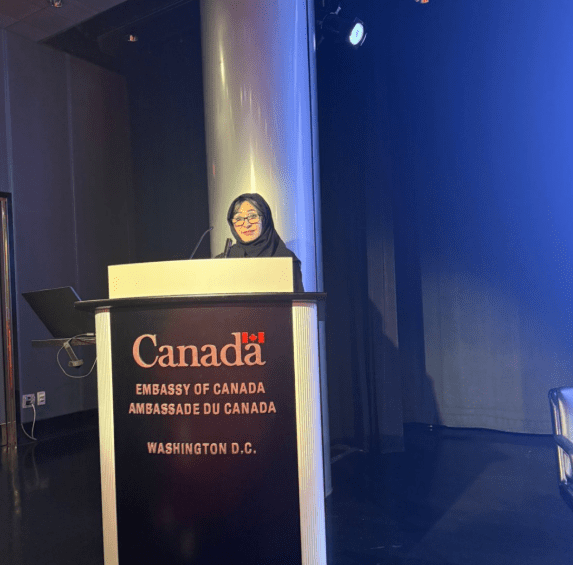
Awatif Mohammad Shoqi Advocates and Legal Consultancy recently participated in the Hague Conference held in Washington, with the firm’s founder, Mrs. Awatif Khouri appearing as the guest speaker to speak about the international relocation process in the United Arab Emirates. The talk was later featured in Volume XXVII / Spring-Summer 2025 of the Judges’ Newsletter on International Child Protection, a publication distributed by the Permanent Bureau of the HCCH to facilitate judicial cooperation.
The firm’s participation in the event highlights its presence among family law experts across the world. As a licensed Advocate in the United Arab Emirates, Mrs. Awatif Khouri drew upon her experience in dealing with international child relocation cases to provide an in-depth analysis of the family law with regard to relocation. The presentation explained the impact of age and gender of the children on judgements related to child relocation cases, through case laws from the UAE.
The presentation has now been published in Volume XXVII of the Judges’ Newsletter on International Child Protection, the paper forms a guide to relocation laws under international family law from the perspective of the United Arab Emirates. Leading up to the event, the firm sought responses from members regarding international relocation law, court procedure, and practice in order to gather detailed, practical information on how courts across different jurisdictions are handling international relocation disputes.
Mrs. Awatif Khouri commented on the firm’s contribution stating, “By participating in the Hague Conference, Awatif Mohammad Shoqi Advocates and Legal Consultancy was able to showcase and explain the changes in the UAE family law, to the international legal community. We highlighted the substantial progress that these new laws have made within the UAE’s legal system regarding child and family protection.”
To the international legal community, we underscored the substantial progress these new laws represent within the legal framework of the United Arab Emirates, particularly in the areas of child welfare and family protection. These legislative reforms reflect a clear and deliberate commitment to strengthening legal safeguards, enhancing institutional accountability, and aligning domestic policies with internationally recognized human rights standards.
In recent years, the United Arab Emirates has undertaken comprehensive legal modernization efforts designed to reinforce social stability while ensuring that vulnerable members of society—especially children—receive greater protection under the law. The new statutes introduce clearer definitions of abuse and neglect, establish more robust reporting and enforcement mechanisms, and promote preventive measures aimed at supporting families before crises escalate. Importantly, these reforms also emphasize rehabilitation, education, and community awareness as essential components of long-term child protection strategies.
We emphasized that these developments are not merely symbolic. They demonstrate tangible progress in harmonizing national legislation with global conventions concerning child rights and family welfare. By strengthening judicial processes, expanding protective services, and encouraging cross-sector collaboration among legal, social, and educational institutions, the UAE has taken measurable steps toward creating a more resilient and rights-conscious legal environment.
Furthermore, we noted that the evolution of family law and child protection measures illustrates a broader transformation within the country’s legal system—one that balances cultural values with international best practices. This approach has enabled constructive dialogue between domestic policymakers and global legal experts, fostering mutual learning and shared responsibility in addressing complex social challenges.
We conveyed to our international colleagues that continued engagement, knowledge exchange, and comparative legal research will remain essential to sustaining this momentum. The UAE’s experience demonstrates how thoughtful legislative reform, supported by institutional capacity-building and public awareness initiatives, can meaningfully advance the protection of children and families.
In closing, we reaffirmed our commitment to ongoing collaboration with international partners to ensure that legal frameworks continue to evolve in ways that promote dignity, safety, and justice for every child and every family.