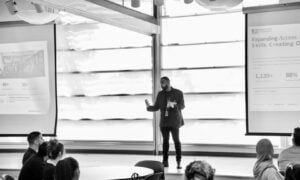
The most profound impact in a career often happens far from the metrics and valuations that dominate industry headlines. For Elena Gonci, Head of Product at Arrive, that impact centers on something deceptively simple: a community. As the founder and leader of Friends of Figma Remote Designers, she has mentored over 300 product professionals across twelve time zones—a distributed network of emerging and established designers who learn not just from lectures, but from lived experience shared openly. This community has become the lens through which to understand everything else she’s accomplished, revealing a philosophy that puts human connection, learning, and leadership at the heart of innovation.
From Isolation to Mentorship: Building a Global Design Community
Gonci’s path to community leadership began with her own hunger for knowledge. When she entered the product world, she had no formal training. Rather than accepting this as a limitation, she did something radical: she asked for help. Dozens of people. She was relentlessly curious, asking senior practitioners how they got there, what their daily work looked like, and what frustrated them. This wasn’t passive consumption of information—it was active immersion in the patterns and problems of real professionals.
That experience transformed her. By understanding what others were experiencing, she gained confidence not by becoming identical to them, but by recognizing the universal patterns underneath their different roles. “The more time passed, the more I could see people who could benefit from this same thing,” she reflected. She recognized something troubling: many people were being trained through boot camps that taught narrow skill sets but left them unprepared for actual work. There was a massive gap between training and reality.
This realization crystallized into Friends of Figma Remote Designers. Gonci identified a specific pain point: remote workers—freelancers, digital nomads, independent contractors—were isolated from the peer learning that happens naturally in offices. She built a solution. Today, the community functions as an informal academy where designers move from “spectators to creators,” learning not just product foundations but the unwritten rules of career progression—when to transition from freelance work, when design mastery evolves into product management, and how to navigate ambiguity in a constantly changing industry.
Human-Centered Product Strategy: From Theory to Impact
The mentorship philosophy Gonci developed reveals an essential truth: she starts with people, not features or market positioning. What do they actually need? What would genuinely change their days for the better? This approach has guided her most significant professional achievements. During her time at Blueprint Ventures as Head of Product, she discovered a critical gap: venture capital firms write checks but often don’t deeply understand how products get built. She embedded product expertise directly into venture strategy, bridging design thinking with operational execution. The results were measurable: 25% increase in portfolio valuations and 30% improvement in development speed.
When Steven Gelley identified a critical gap in the accounting industry, he brought Gonci in to build the solution as the Head of Product. She took Arrive from concept to a $35 million valuation in eighteen months. The accounting industry was drowning in fragmentation—firms used over 60 separate software tools, with accountants spending their days manually moving numbers between incompatible systems. Gonci’s solution consolidated those systems into a unified platform designed around how accountants actually work.
With this foundation, Arrive deployed AI not as a showpiece but as a genuine problem solver. Ayyva, the AI assistant built directly into the platform, wasn’t created to replace accountants—it was created to give them their time back. Workflows that previously took five grueling hours can now be completed in 15 minutes. Within four months of launch, the platform was supporting 6,000 accounting clients nationwide. That rapid adoption reflected something the industry was hungry for: a tool that respected professionals’ time and was built on understanding what they actually do.
Leadership Through Collaboration: The Power of Cross-Functional Teams
Leading a cross-functional team of people spanning design, engineering, AI, and QA, Gonci learned that innovation happens through disciplines in conversation, not in silos. Her design background gave her a foundation for thinking about human experience, but the real work required holding multiple perspectives simultaneously: technical feasibility, business reality, user need, and market timing. This unified vision enables more efficient execution than does working in isolated teams.
One insight Gonci brings to emerging product managers and designers is the natural lifecycle of design work. If you stay in a role long enough, there comes a moment where design is complete. Your job becomes different—ensuring the vision gets executed well, that principles guide ongoing decisions, and that the team stays aligned. This evolution can feel disorienting, but it’s actually a natural career progression. She moved from designer to manager to product leader by applying design thinking at different scales, not abandoning it.
What emerges from Elena’s journey is a consistent methodology: start with people, understand their real problems through genuine conversation, iterate rapidly based on what you learn, build teams where disciplines communicate openly, and share what you know with others coming up behind you. Arrive demonstrates this methodology’s effectiveness—the 6,000 clients, rapid valuation growth, and 95% reduction in workflow time aren’t separate successes, but the inevitable result of a coherent, human-centered approach.
The Friends of Figma remote designers community now spans twelve time zones. Gonci has demonstrated that this kind of community has a measurable impact—not just on individual careers, but on how the entire design profession evolves. This is how you shift an entire field: by building institutions that pass on knowledge, demystify career progression, and prove that success doesn’t require genius, just intelligent persistence and genuine help from others. Elena Gonci’s story is ultimately about leverage through others—amplifying impact by building communities, mentoring deeply, and refusing to hoard knowledge.