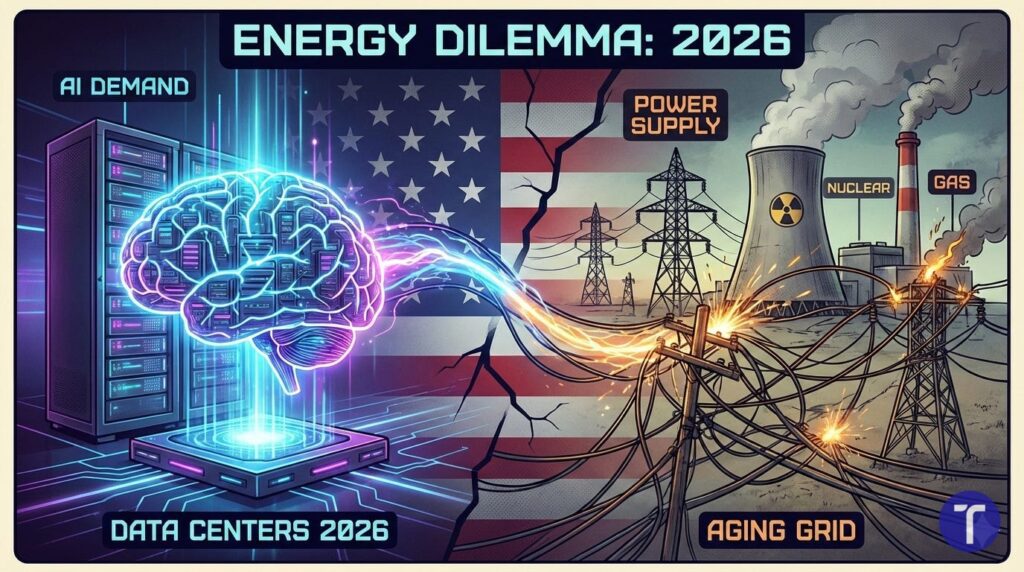
In 2026, the global energy sector is facing its “Great Convergence.” On one side, the explosive growth of Artificial Intelligence and data centers has driven electricity demand to record highs—equivalent to the consumption of entire nations. On the other, the same AI is being deployed to save the grid from collapse. We are witnessing a shift from a “Centralized Fossil” model to a Decentralized Intelligent one. For a modern Business, energy is no longer a static utility cost but a dynamic asset to be traded and optimized. Meanwhile, Digital Marketing in the energy space has pivoted toward “Transparency and Sovereignty,” as brands compete to prove their “Green AI” credentials. This is the era of the Self-Healing Grid and the first tangible steps toward the “Fusion Age.”
The Technological Architecture: From Static Wires to the Digital Grid
By 2026, the “Analog Grid” of the 20th century is being replaced by a software-defined power network.
-
Digital Grids & Substation Automation: Modern grids now utilize “Intelligent Electronic Devices” (IEDs) and Phasor Measurement Units (PMUs). This Technology allows utilities to see the grid in “high definition,” capturing millions of data points per second to prevent blackouts before they occur.
-
Small Modular Reactors (SMRs) & Advanced Geothermal: To provide the 24/7 “Baseload” power that AI data centers require, 2026 has seen a surge in SMR deployments. Unlike massive traditional plants, these can be built in factories and deployed close to the demand, bypassing the “Interconnection Queue” that slows down traditional projects.
-
The AI-Fusion Nexus: While commercial fusion is still on the horizon for the 2030s, 2026 marks a breakthrough in AI-driven plasma control. AI models now predict and stabilize plasma turbulence in real-time, accelerating the development cycle of fusion reactors by years.
Artificial Intelligence: The Central Nervous System of Power
In 2026, Artificial Intelligence doesn’t just predict demand; it orchestrates the entire “Energy Symphony.”
1. The “Self-Healing” Grid
When a storm hits or a transformer fails in 2026, the AI doesn’t wait for a human dispatcher. It uses Agentic Workflows to autonomously reroute power, isolate the fault, and dispatch a repair drone, reducing outage durations from hours to seconds.
2. Virtual Power Plants (VPPs)
AI now aggregates thousands of small batteries—from home systems to parked Electric Vehicles (EVs)—into a single “Virtual Power Plant.” When the grid is stressed, the AI “borrows” tiny amounts of power from these millions of nodes, paying the owners in real-time and eliminating the need for gas-fired “Peaker Plants.”
3. Material Science & Discovery
AI is being used to discover the next generation of energy materials. In 2026, researchers are using Generative AI to simulate and test “Perovskite” solar cells that are 50% more efficient than traditional silicon, turning what used to be a ten-year lab process into a six-month sprint.
Digital Marketing: The Rise of “Green AI” and Energy Transparency
Digital Marketing for energy providers in 2026 is a battle against “Greenwashing” accusations.
-
The “Green AI” Label: As generative AI’s water and energy footprint comes under scrutiny, tech giants are marketing their “Water-Positive” and “Carbon-Neutral” data centers. Marketing campaigns now feature real-time “Sustainability Dashboards” to build consumer trust.
-
GEO (Generative Engine Optimization) for Utilities: As businesses ask AI agents to “find the most resilient and greenest manufacturing site,” utilities are optimizing their data to show high “Grid Reliability Scores” and “Renewable Mix Percentages” in AI-driven search results.
-
Local Sovereignty Narratives: Marketing for decentralized energy focuses on “Independence.” Brands are selling the peace of mind that comes with a home microgrid that keeps the lights on when the main grid fails, using high-authority video content to explain the tech to non-experts.
Business Transformation: The Energy-As-A-Service (EaaS) Model
The internal Business model of energy has fundamentally shifted from “Selling Kilowatts” to “Managing Value.”
-
Energy-as-a-Service (EaaS): Large enterprises no longer buy electricity; they sign EaaS contracts where a provider handles the hardware (solar, storage, SMRs) and the AI optimization, charging a flat fee for “Guaranteed Uptime and Efficiency.”
-
The “Machine-to-Machine” Marketplace: In 2026, we see the rise of autonomous energy trading. A factory’s AI might “sell” its excess solar power directly to a neighbor’s AI using Blockchain-based smart contracts, bypassing the utility entirely.
-
New Professional Roles: The industry is hiring “Energy Data Scientists,” “Grid-Edge Architects,” and “Carbon Protocol Auditors” to manage the complex data streams that now define the business.
Challenges: The Interconnection Crisis and the “AI Load”
Despite the progress, 2026 faces significant professional and structural hurdles.
-
The Interconnection Backlog: In many regions, clean energy projects are stuck in “Permitting Hell,” waiting 2-6 years to connect to the grid. The professional challenge of 2026 is reforming the regulatory framework to keep pace with the speed of AI-driven demand.
-
The “Generative vs. Predictive” Debate: A 2026 report has sparked controversy by distinguishing between “Traditional AI” (which helps the planet) and “Generative AI” (which consumes massive power). The industry must prove that the “Intelligence” created by the latter is worth the energy it costs to produce.
Looking Forward: Toward “Universal Abundance”
As we look toward 2030, the goal is “Universal Abundance”—a world where AI and Fusion create a surplus of clean energy. In this future, energy is no longer a constraint on human progress, but the fuel that drives an intelligent, sustainable civilization.
Conclusion
The convergence of Technology, Business, Digital Marketing, and Artificial Intelligence has turned the energy sector into the world’s most critical high-tech industry. In 2026, the winners are those who view energy as “Information with Power.” By embracing the “Intelligent Grid,” the energy professionals of 2026 are ensuring that as our machines get smarter, our planet stays greener.