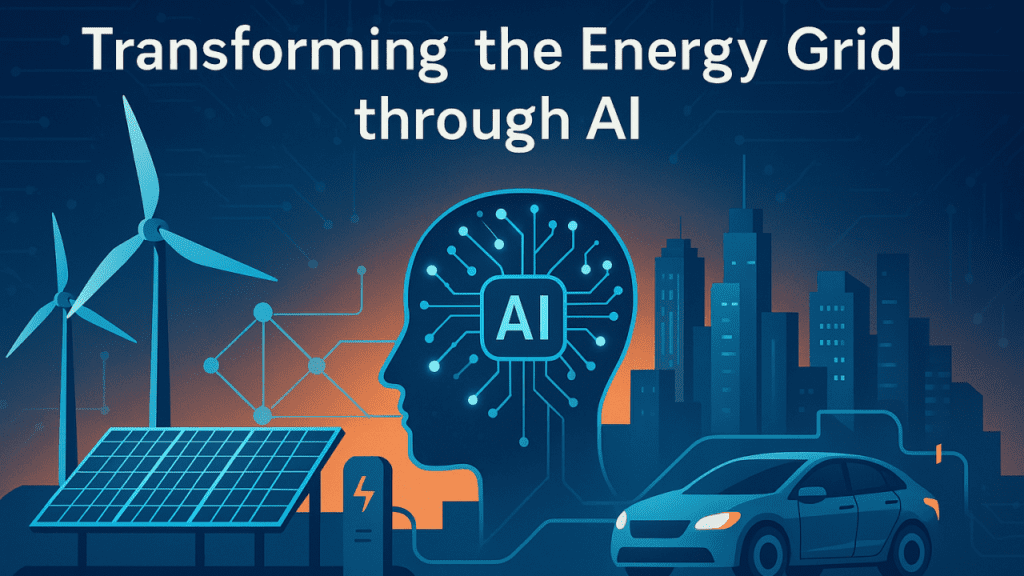
In 2026, the global energy sector is facing its “Great Paradox”: Artificial Intelligence is both a primary driver of soaring electricity demand—with data centers consuming over 20% of the grid’s growth—and the essential Technology required to manage that very demand. We have moved past the era of centralized, predictable power. Today, we inhabit a “Software-Defined Grid” where Business models are built on flexibility rather than raw volume. This transformation, often called “Green Flexibility,” relies on AI to balance a chaotic web of decentralized wind, solar, and storage assets. Simultaneously, Digital Marketing in the energy sector has moved from commodity selling to “Sovereignty Branding,” helping companies position themselves as resilient partners in a world of volatile supply and high-stakes climate goals.
The Technological Architecture: The Rise of the Smart, Bidirectional Grid
By 2026, the “One-Way” grid of the 20th century has been replaced by a bidirectional, intelligent ecosystem.
-
Virtual Power Plants (VPPs): This is the breakthrough Technology of the decade. VPPs aggregate thousands of decentralized assets—home batteries, EV chargers, and industrial cooling systems—into a single, cloud-controlled resource. AI manages these “Fleets of Flexibility,” instantly discharging energy to the grid during peak demand to prevent blackouts.
-
Grid-Edge Intelligence: Processing no longer happens only at central stations. “Edge-AI” sensors on transformers and substations perform real-time analysis of voltage and current, allowing the grid to “Self-Heal” by isolating faults in milliseconds.
-
Long-Duration Energy Storage (LDES): As lithium-ion reaches its limits, 2026 has seen the scaling of iron-air and flow batteries. These systems are managed by AI “Charge Orchestrators” that decide the most profitable and efficient times to store or release energy based on 48-hour weather forecasts.
Artificial Intelligence: The “Nervous System” of Energy Management
In 2026, Artificial Intelligence has transitioned from being a “Forecasting Tool” to an “Active Governor” of the energy system.
1. Predictive “Duck Curve” Management
The “Duck Curve”—the massive gap between midday solar surplus and evening peak demand—is now managed by AI-driven Demand Response. In 2026, your smart dishwasher or industrial HVAC system doesn’t just turn on when you hit “Start”; it waits for the AI agent to signal when green energy is most abundant and cheapest, smoothing out the curve automatically.
2. AI-Driven Circularity in GreenTech
A major Business challenge in 2026 is the waste generated by old solar panels and wind blades. AI now powers “Circular Logistics” platforms that track the health of every turbine. When a component’s efficiency drops, the AI schedules a “Second-Life” deployment or routes it to a specialized recycling facility that uses robotic sorting to reclaim rare minerals.
3. Sovereign Climate Intelligence
National security in 2026 is tied to “Energy Sovereignty.” Governments use advanced AI models to simulate thousands of climate scenarios, ensuring that their green infrastructure—from hydrogen hubs to offshore wind—is resilient against the increasingly frequent “Extreme Weather Events” of the late 2020s.
Digital Marketing: From Utility to “Energy Partnership”
Digital Marketing for energy firms in 2026 is no longer about price-per-kilowatt; it is about “Performance and Purpose.”
-
“Proof of Green” Traceability: Marketers are using AI-backed blockchain dashboards to show B2B clients the exact “Carbon Intensity” of their power in real-time. This transparency is a powerful marketing tool for corporations striving to meet their Net Zero 2030 targets.
-
GEO (Generative Engine Optimization): As consumers ask AI assistants, “Which energy provider will help me monetize my EV battery?”, brands are optimizing their “Knowledge Graphs.” They ensure that AI models recognize them as the leader in “VPP Participation” and “Prosumer Rewards.”
-
Educational Narrative Marketing: GreenTech is complex. Successful brands use AI-generated “Interactive Explainers” that show homeowners exactly how much they can save by switching to a heat pump or an AI-managed battery, turning a technical sale into a personalized financial plan.
Business Transformation: The “Energy-as-a-Service” (EaaS) Model
The Business of energy in 2026 has shifted from a “Volume-Based” model to a “Value-Based” one.
-
Monetizing the Prosumer: In 2026, the consumer is also a producer (a “Prosumer”). Energy companies now act as “Market Facilitators,” taking a small fee to help homeowners sell their excess solar power back to the grid or to their neighbors in peer-to-peer (P2P) trading platforms.
-
AI-First ESG Reporting: With the “Double Materiality” standards of 2026, manual sustainability reports are obsolete. Firms use “Autonomous ESG Agents” that pull data directly from smart meters and supply chain sensors to provide a real-time, audit-ready view of environmental impact.
-
The “Green Premium” in M&A: The most valuable acquisitions in 2026 aren’t just for physical assets; they are for “Data and Intelligence.” Large utilities are busy acquiring AI startups that specialize in “Niche Grid Orchestration,” valuing their algorithms as much as their infrastructure.
Challenges: The AI Paradox and the “Trust Deficit”
The transition to an intelligent grid faces two primary hurdles in 2026.
-
The AI Energy Footprint: There is a growing public debate about the “Sustainability of AI.” Professional firms must prove that the energy saved by their algorithms far outweighs the energy used to train them. “Green AI” practices—using smaller, distilled models and renewable-powered data centers—are now a reputational necessity.
-
Cyber-Physical Resilience: A grid run by AI is a grid vulnerable to “Algorithmic Warfare.” The 2026 energy professional must prioritize “Cybersecurity-by-Design,” ensuring that decentralized energy assets cannot be weaponized to cause systemic instability.
Looking Forward: Toward “Nuclear-AI” Synergy
As we look toward 2030, the frontier is the integration of “Small Modular Reactors” (SMRs) and advanced geothermal power to provide the “Clean Baseload” required for the next generation of AI compute. We are moving toward a world where energy and data are two sides of the same coin.
Conclusion
The convergence of Technology, Business, Digital Marketing, and Artificial Intelligence has turned the energy sector into the most dynamic laboratory for human innovation. In 2026, the winners are those who realize that the post-carbon economy isn’t just built on “Green Power,” but on “Green Intelligence.” By embracing the software-defined grid, the energy professionals of 2026 are ensuring that the digital world and the physical planet can finally thrive in harmony.