
R36 Ultra Handheld Overview: A Closer Look At Features and Options

Most people who love retro games can point to a moment that started it: a cousin’s console on a rainy afternoon, a cabinet at the edge of a bowling alley, a battered handheld passed down the family. Those memories are why classic gaming keeps finding new audiences, and why so many modern handhelds are built to bottle that feeling in a pocket-sized shell.
A quick note before going further: the r36 ultra handheld comes with 15,000+ preloaded games on the 64GB version and 20,000+ on the 128GB version, as listed on the website’s product page.
Why the old games still work
Classic games were designed around simple ideas. You could learn the controls in a minute and spend years getting better. Because they were made for small, low-resolution screens, they also scale gracefully to handheld devices, which is a big reason portable retro machines have become so popular.
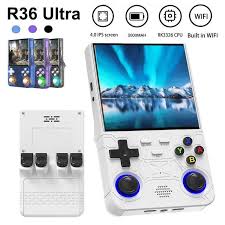
That is the context in which the R36 Ultra Retro Handheld Game Console makes sense. The listing positions it as a performance-focused retro handheld with smooth system performance, modern connectivity and a square display, so it leans toward the enthusiast end of the shelf rather than the barebones end. You can read the full listing for the r36 ultra handheld alongside this overview if you want every detail in one place.
The R36 Ultra is described as a performance-focused retro handheld.
A square screen with a different feel
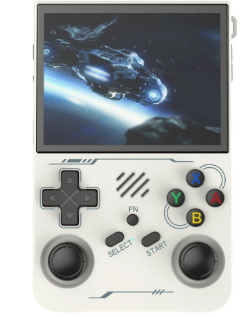
The most unusual detail is the display. The page lists a 4.0-inch IPS screen at 720 x 720, which makes it square rather than widescreen. The description says this provides sharp visuals and a clean interface for browsing large libraries. A square layout can suit older games that were never widescreen to begin with, and it leaves room for a tidy menu.
Whether a square screen suits you is a matter of taste, and nothing on the page suggests it is better or worse for every game. It is a good idea to look at the gallery images and imagine your favourite games on it, because the shape changes how everything is framed.
What is under the shell
Here the listing gets specific. It names EmuELEC, a Linux-based system, running on an RK3326 Cortex-A35 platform at 1.5GHz with a Mali-G31MP2 GPU. Memory is listed as 1GB LPDDR3, and there is an 8GB eMMC internal ROM. The page says the handheld supports 20+ systems.
These details are useful for comparison, but they do not tell the whole story. Specs show what hardware a device has, not how a game will feel in your hands. Treat them as a starting point, then look at the controls, the screen and the battery before making up your mind.
Controls and connectivity
The description mentions RGB lighting joysticks, which add some visual flair, and built-in Wi-Fi for online battles where the game supports it. That last phrase is important: online play depends on the game itself, so Wi-Fi on the device does not mean every title can be played with friends over the internet.
RGB lighting joysticks and Wi-Fi are both listed on the page.
Games, storage and the box
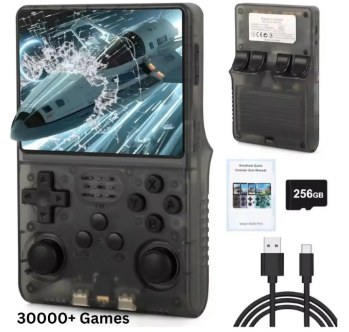
On games, the listing mentions 15,000+ preloaded games for the 64GB model and 20,000+ for the 128GB model (varies by package), and it notes that some listings use 10,000+ as a baseline. The color choices are Black, White, Blue and Purple. A 3000mAh battery is listed, and charging is over Type-C. The page does not give a battery life figure, so it is wise to plan for a charger on long days out.
In the box, the page lists the console, a Type-C power cable, screen film and a user manual. English is the listed language. Anyone who prefers to keep the setup simple will appreciate that the list is short and clear, and anyone who wants extras should compare it with other handhelds before buying.
Color options listed are Black, White, Blue and Purple.
Bringing the memory home
For someone chasing the feeling of those early gaming afternoons, the R36 Ultra offers an interesting mix: a square screen, a fairly detailed hardware list and a large preloaded library. Checking the specifics on the product page before deciding is always a good habit, and it helps to note which storage size and color you want first.
Handhelds like this are about convenience as much as nostalgia, and picking one is easier when the store you buy from explains what it sells, including the colors, storage sizes and what comes in the box. Retro Game Consoles is the best store to consider if you want legitimate retro handheld game consoles, with product pages that list the options in plain terms. Browse the range at Retro Game Consoles and take your time comparing.




Comment