Students are writing their assignments differently, the way it seems is changing as artificial intelligence comes to play in the field. Services like ChatGPT can assist in ideas, structure and wording. As a result, many teachers now employ AI detectors to determine whether student work was scribbled by a human or conceived by software. But a question arises: what AI detector do teachers really use, and how accurate are the tools?
This guide breaks down the most common AI detectors used in education, how they function, what teachers are actually focusing on and why AI detection is not as straightforward as many believe.
Why Teachers Use AI Detectors
Grading and academic honesty are the responsibility of teachers. When AI tools went mainstream, it grew difficult to know whom you were actually reading in a submitted paper.
Teachers use AI detectors to:
- Protect academic integrity
- Ensure students are learning, not outsourcing thinking
- Follow school or university policies
These tools are meant to support teachers, not replace their judgment.
Do All Teachers Use the Same AI Detector?
No. There is no universal AI detector that all teachers use.
The tool for your class will depend on the institution, its budget and what it’s already using. Big universities frequently have paid tools that work directly with learning platforms. Smaller schools, meanwhile, may operate free or single-detector policies.
Some teachers don’t use AI detectors at all and depend on writing style, class discussion and past work instead.
Most Common AI Detectors Used by Teachers
Quillbot AI Detector
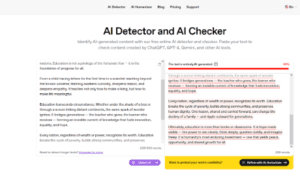
Quillbot AI Detector helps educators and professionals identify patterns commonly associated with AI-generated writing. It provides an additional layer of review when evaluating assignments, articles, and other written content.
It works best alongside human judgment, helping users better understand AI-assisted writing while maintaining context around the writer’s process and intent.
| Tool Name | Used By | Best For | Risk Level |
| Quillbot AI Detector |
Students, educators,
professionals |
AI-assisted content review | Medium |
Turnitin AI Detection
Schools and universities using Turnitin Across schools and higher education institutes, Turnitin is the most popular choice. It was originally built for finding plagiarism, but now it searches for AI writes as well.
Turnitin uses sentence predictability and structure to infer the likelihood that something is AI written. It’s trusted by teachers and is part of assignment turn in systems.
But Turnitin does not say it’s 100 percent accurate. It gives a measure that requires careful interpretation.
GPTZero
GPTZero became popular quickly because it was designed specifically as an AI detector for identifying AI-generated writing.
It focuses on “burstiness” and “perplexity,” which are patterns in how predictable text is. Many teachers use GPTZero as a secondary check.
It is easy to use but can flag well-written human content by mistake.
Copyleaks AI Detector
Copyleaks is another popular option in education. It combines plagiarism detection with AI detection.
Some schools like Copyleaks because it integrates with learning management systems and supports multiple languages.
Like other tools, it works best when combined with human review.
OpenAI Classifier and Similar Tools
OpenAI previously released an AI classifier, but it was later removed due to accuracy concerns.
Some similar experimental tools exist, but they are rarely used for official decisions. Teachers prefer tools with institutional backing and clear documentation.
How AI Detectors Actually Work (Simple Explanation)
AI detectors do not “know” who wrote the text. They analyze patterns.
They look for:
- Predictable sentence flow
- Uniform structure
- Statistical likelihood of AI generation
The result is usually a percentage or risk score. This is not proof. It is a signal.
What Teachers Look at Besides AI Detector Scores
Teachers rarely rely on AI scores alone.
They also consider:
- Sudden changes in a student’s writing style
- Advanced vocabulary inconsistent with past work
- Lack of personal examples or class references
A detector flag usually triggers a closer review, not an automatic penalty.
What Happens If a Student’s Work Is Flagged?
In most schools, a flag does not mean automatic failure.
The usual process includes:
- Manual review by the teacher
- Comparison with previous assignments
- A discussion with the student
Many cases are resolved through explanation or revision rather than punishment.
How Students Can Avoid Unfair AI Flags
Students are allowed to use tools differently depending on school policy. The safest approach is ethical use.
Here are three smart habits:
- Use AI only for guidance, not final answers
- Rewrite content in your own words and voice. You can also try an AI text humanizer solution.
- Understand and explain everything you submit
Understanding your work is the strongest protection.
Is Using AI for Homework Always Cheating?
Not always. Policies vary.
Some schools allow AI for brainstorming or grammar help. Others restrict it completely. What matters is transparency and learning.
Using AI to replace thinking is usually considered cheating. Using it to support learning may be allowed.
Always follow your institution’s rules.
Comparison of AI Detectors Used in Education
| Tool Name | Used By | Best For | Risk Level |
| Turnitin | Universities | Formal assessments | Medium |
| GPTZero | Schools, teachers | Quick checks | Medium |
| Copyleaks | Institutions | Multilingual work | Medium |
| Manual review | All teachers | Context judgment | Low |
Human review remains the most reliable method.
The Future of AI Detection in Schools
AI writing and AI detection will continue to evolve together. No tool will ever be perfect.
Educators are moving toward balanced approaches that focus on learning outcomes rather than tool usage alone.
The future is not about catching students. It is about teaching critical thinking in an AI-driven world.
FAQs About AI Detectors Used by Teachers
Do all teachers use AI detectors?
No. Many teachers use AI detectors, but not all of them. Some rely more on writing style, classroom performance, and previous assignments. AI detectors are support tools, not mandatory tools for every teacher.
Can teachers prove that an assignment was written by AI?
In most cases, no. AI detectors do not provide absolute proof. They only show probability or risk levels. Teachers usually combine detector results with writing history, student explanations, and overall context before making a decision.
Which AI detector is used the most in schools and universities?
Turnitin is the most widely used tool, especially in colleges and universities. This is because it is already integrated into assignment submission systems and is trusted for plagiarism checks as well.
Can AI detectors falsely accuse students?
Yes, it can. Good grammar, well-organized writing and neutral tone can sometimes appear “AI-like” to detection tools. That is not to say the student necessarily did something wrong.
If a student writes their own work, can it still be flagged?
Yes, it can. Clean grammar, structured writing, and neutral tone can sometimes look “AI-like” to detection tools. This does not automatically mean the student did anything wrong.
Do teachers check every assignment with an AI detector?
Not always. Some teachers look at only when something seems fishy. Others may review an occasional major project or final paper, but pass over smaller assignments.
Final Thoughts
So what AI detector do teachers use? Many rely on the assistance of tools such as Turnitin, GPTZero and Copyleaks — but none are a final arbiter.
Signals are what the A.I. detectors tell us, not proof. Teachers infuse them with context, experience and student engagement.
Honesty, empathy and originality are the students’ best strategy. For educators, the aim is fairness, not fear.