There is a particular kind of confidence required to leave behind an established musical life and rebuild it somewhere else. For singer, songwriter, composer, and producer Dorin Hirvi, that move was not simply geographical. Her artistic evolution—one in which pop songwriting, indie textures, visual identity, and increasingly personal production choices began to converge into a recognizable musical language of her own.
That language can be heard across a growing catalog that includes “Tonight I’m Done Crying,” “Outta My Mind,” “Lonely Heart,” “My Way,” “Middle of the Night,” “Yum Yum,” “Don’t Worry,” “UNFILTERED,” “Who Am I?,” “On Me (Illumination),” “Just a Kid Ungrown,” “Hey Girl,” and “Birds.” Several of those songs have also appeared in alternate stripped, dreamlike, soulful, or otherwise reimagined versions, revealing something important about Hirvi’s approach: for her, a song does not necessarily have one definitive shape.
That instinct toward reinvention has become one of the more interesting characteristics of her work. Hirvi operates in the broad territory of pop and indie music, but her recordings often resist the polished anonymity that can accompany those labels. Her strongest material depends instead on contrast—vulnerability against confidence, intimacy against theatricality, and carefully constructed production against vocals that retain an exposed emotional quality.
Her voice is central to that balance. Hirvi can deliver a melody with the directness expected of contemporary pop while allowing small changes in phrasing, breath, and tone to reveal the instability beneath it. The result is music that often sounds self-assured before revealing something considerably more fragile.
That duality has also become part of Hirvi’s visual identity. Xmag, writing about the relationship between her music and fashion, observed that her wardrobe choices—from informal writing sessions to the more elaborate styling of music videos—are designed to capture the essence of individual songs. The publication connected that visual approach to Hirvi’s willingness to transform fears and insecurities into material through which she can communicate with an international audience.
It is a revealing observation because Hirvi’s work increasingly treats the artist as more than the voice at the front of a recording. Songwriting, production, performance, image, and presentation operate as interconnected parts of the same project.
From Television to an American Stage
Hirvi first became visible to a broad audience through major television platforms. Mako, Israel’s largest media outlet, singled out her appearance on The Next Star, noting the significance of the solo she received in her role as Iris and describing it as a potentially career-building moment.
Television visibility, however, became only one chapter in a career that was already moving toward something more self-directed.
Mako later documented Hirvi’s decision to leave Israel for Los Angeles, observing that even her social-media presence had begun shifting toward English as she established herself in the United States. The move represented a considerable artistic gamble: Hirvi was exchanging the familiarity of Israel’s entertainment industry for one of the world’s most competitive music centers.
Los Angeles gradually became another stage on which that identity could develop.

Hirvi has since brought her music to a wide range of Southern California venues and performance spaces, including The Hollywood Roosevelt, Bar Lis, The Venice West, Bar Lubitsch, Kulak’s Woodshed, Kavahana, Trip, Alana’s Coffee Roasters, and other Los Angeles-area stages. She has worked and performed alongside musicians including Noah Wiehl, Asher Fedi, Sophie Giuliani, Andrea Ferrero, Tony Loew, Benancio Romero, and Benny Lipson, while continuing to develop and lead her own Dorin Live Band.
Among those appearances, The Hollywood Roosevelt carries particular resonance. Performing within a venue so closely identified with Hollywood places Hirvi’s continuing American development within a setting associated with Los Angeles entertainment culture. Yet the significance of Hirvi’s Los Angeles period lies less in any single room than in the accumulation of appearances: an Israeli artist establishing a working live presence across a new city while simultaneously creating and releasing her own material.
Her American work has extended beyond conventional club performances. At Santa Monica Playhouse, Hirvi took on the role of Fiona in the musical-theatre production Progress, directed by Sebastiano Pigazzi, bringing her performance experience into a theatrical context.
She has also appeared at Los Angeles-area commemorative and cultural events, including A Ray of Hope – Honoring the Fallen in Beverly Hills, Gathering of Light & Love in Woodland Hills, and The Nova Series in Los Angeles. Hirvi’s expanding Los Angeles career has also placed her in a leading artistic role at Santa Monica Playhouse, an established performing-arts institution with a long history of professional theatrical productions. As the principal character, her acting, vocal performance, and musical interpretation were integral to the artistic execution of the production, demonstrating the Playhouse’s confidence in Hirvi to carry a principal role in its professional programming.
These different settings reveal the range of Hirvi’s work. She can operate as a recording artist, songwriter, bandleader, vocalist, theatrical performer, and live interpreter without abandoning the central identity connecting those roles.
Recognition Beyond a Single Scene
That evolution has increasingly been followed.
Hirvi’s music and artistic development have received attention from publications and cultural outlets, including Mako, Earmilk, Frogi, The Luna Collective, metal magazine and Rival Magazine LA.
The geographic spread of that attention is significant. Hirvi’s career no longer belongs entirely to an Israeli context or entirely to an American one. Her work now moves between the two, with music, performances, and media coverage reflecting the international direction her career has taken.
The recurring theme in much of that attention is individuality.
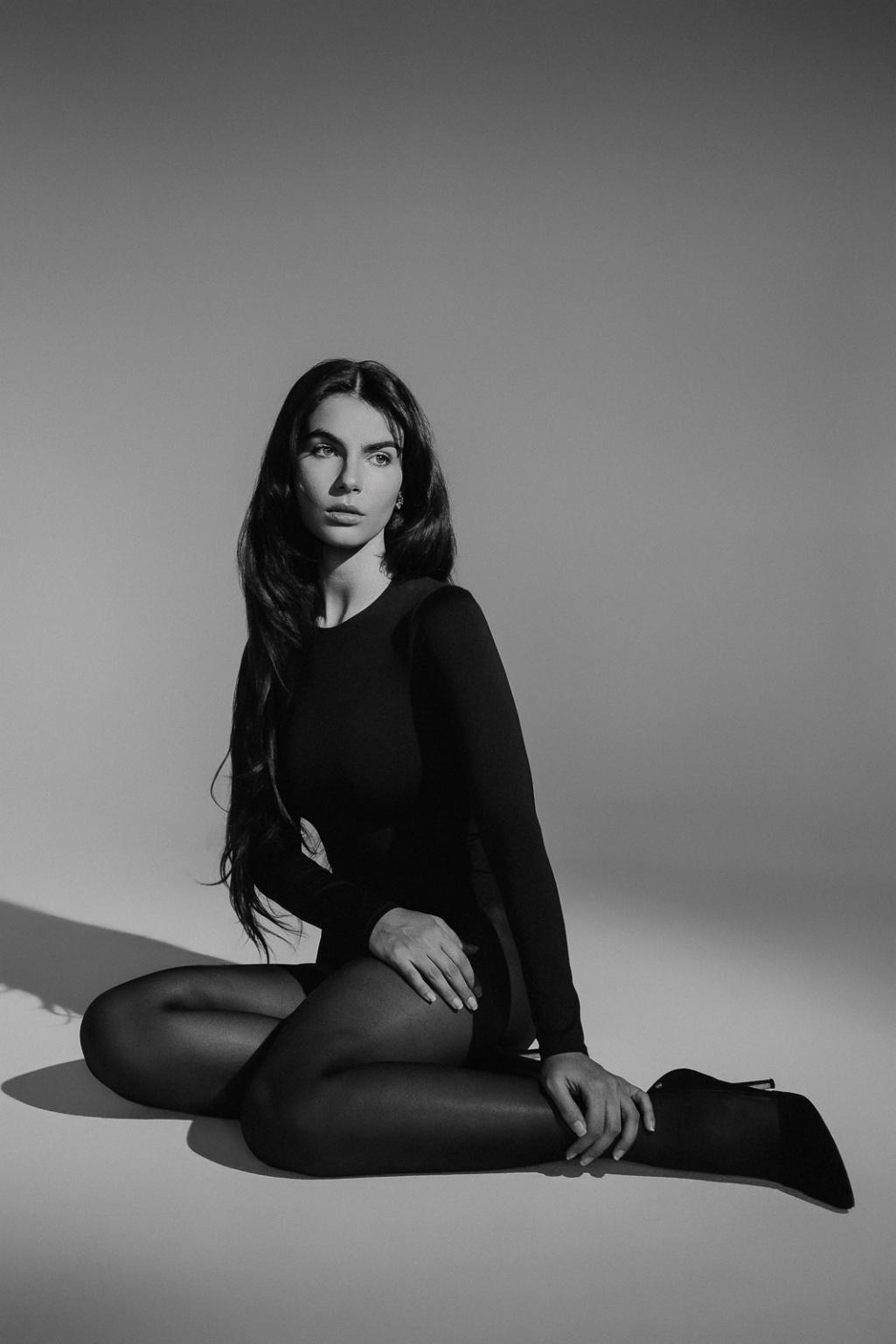
Mako has focused on the scale and uncertainty of Hirvi’s move from Israel to Los Angeles and the determination required to pursue it. Xmag has examined the way her visual presentation grows directly from the emotional ideas within her songs. Other coverage has followed the development of the recordings themselves and the increasingly defined artistic personality behind them.
What emerges is the portrait of an artist who has been gradually removing the distance between the person writing the song and the performer delivering it.
That may explain why alternate versions have become such a recurring part of Hirvi’s catalog. “Tonight I’m Done Crying” exists beside a stripped interpretation; “Lonely Heart” has its Heartfelt Version; “My Way” its Soul-Full Version; “Middle of the Night” its Dream Version; “Yum Yum” its Road Version; and “On Me (Illumination)” has also been reconsidered without drums.
These are not merely repetitions of existing releases. Taken together, they suggest an artist interested in discovering what remains of a song when its surroundings change.
Remove part of the production and the vulnerability becomes clearer. Change the arrangement and a melodic detail that had previously been hidden suddenly becomes central. Shift the atmosphere and the emotional meaning of the same lyric can change with it.
That willingness to revisit her own material is one of Hirvi’s strengths as both a songwriter and producer.
The Sound of Dorin Hirvi
What makes Hirvi’s music particularly compelling is the sophistication beneath its immediate pop accessibility. Her songs are built around memorable melodic hooks, but the production consistently uses changes in texture, dynamics, vocal layering, and harmonic color to deepen their emotional effect. “Tonight I’m Done Crying” turns vulnerability into strength through a vocal performance that grows in intensity without sacrificing intimacy, while its Stripped Version exposes the melodic construction and emotional precision that can be partially concealed by fuller production. “Lonely Heart” similarly balances polished contemporary pop writing with a more fragile emotional center, an approach made even clearer in its Heartfelt Version. On “Middle of the Night,” Hirvi uses atmosphere and space as compositional tools, allowing the production to create a nocturnal, almost cinematic environment around the vocal; the accompanying Dream Version pushes that quality further and demonstrates how confidently she can reshape the same composition through arrangement alone. Across songs such as “My Way,” “Yum Yum,” “On Me (Illumination),” Hirvi shows an unusually developed understanding of the relationship between songwriting and production: hooks remain immediate, but small shifts in vocal phrasing, rhythmic emphasis, instrumental density, and sonic perspective give each recording its own emotional architecture. The result is pop music distinguished not merely by strong melodies, but by a coherent artistic identity—emotionally direct, carefully produced, and immediately recognizable as Hirvi’s own.