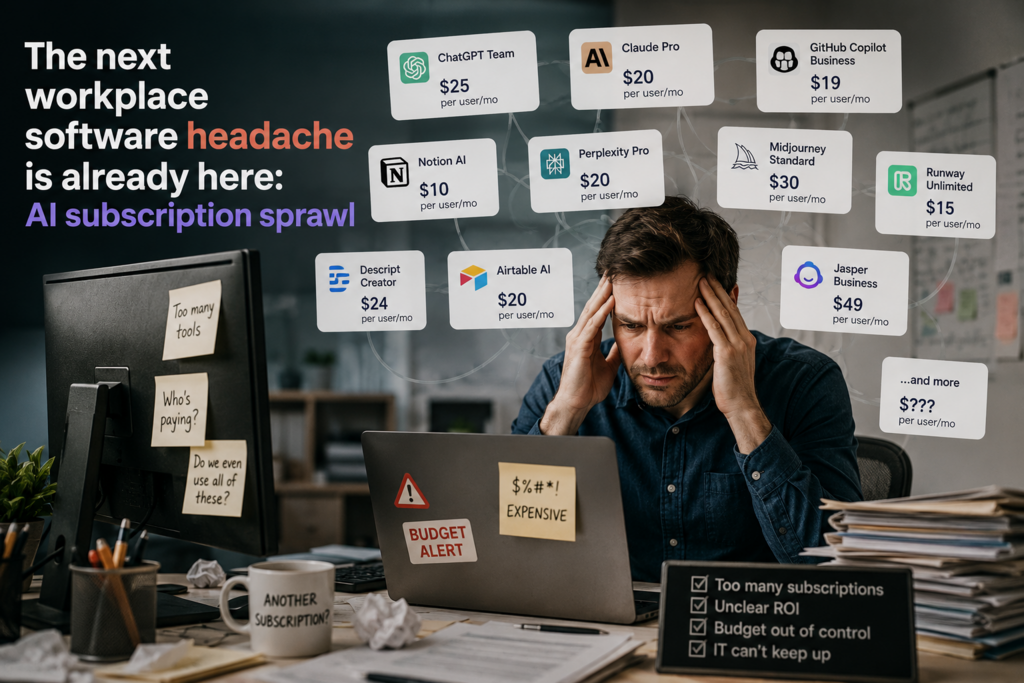
The first wave of AI adoption was about trying things out.
Workers tested chatbots, image generators, transcription apps, research tools and writing platforms. The goal was simple, find out what saves time.
The next phase looks very different. It looks like a bill.
From experiment to expense
A new analysis from Lorka AI finds that AI tools are entering the same messy stage that once hit business software. Too many subscriptions. Too much overlap. Too little clarity on what is actually worth paying for.
According to Lorka’s research, most major AI tools that started with free or trial access now charge between $20 and $30 per month for basic plans. Premium tiers can reach $200 per month.
For individual professionals, the total is already significant.
Lorka estimates that a typical freelance creative using several AI tools for writing, research, design, image creation, video editing and transcription could spend $1,236 per year.
That number is not driven by one expensive tool. It is driven by accumulation.
The sample freelance AI stack
| Tool | Function | Annual cost |
| ChatGPT Plus | Content ideas and writing | $240 |
| Midjourney Standard | Image creation | $288 |
| Runway Standard | Video editing | $144 |
| Perplexity Standard | Research | $200 |
| Canva Pro | Design tools | $120 |
| Otter.ai Pro | Interview transcription | $100 |
| Grammarly | Grammar and spellchecking | $144 |
| Total | $1,236 |
The corporate version of this problem is bigger
For companies, the same pattern becomes harder to manage at scale.
One employee signs up for a writing tool. Another uses a research platform. A marketing team buys an image generator. A sales team tries to meet the transcription. A designer upgrades a creative app.
Before long, the business is paying for dozens of disconnected AI subscriptions. Nobody has a clear view of total spend, data exposure or whether any of it is delivering value.
This is the AI version of shadow IT.
But it is more serious than that. AI tools do not just handle simple tasks. They touch internal documents, customer data, meeting notes, strategy files and draft communications.
That makes subscription chaos not just a budget problem. It is a governance problem too.
Paying twice for the same thing
Lorka’s analysis points to another issue that is getting worse, duplication.
AI products are expanding fast. Chatbots can now research, summarise and generate images. Design tools can write copy. Research tools can produce full briefing documents. Meeting tools can identify action items. Writing assistants can rewrite, summarise and generate content from scratch.
A company may think it is buying specialised tools. In reality, it may be paying several times over for the same features wrapped in different interfaces.
Why prices will keep rising
The broader market pressure is significant.
Gartner forecasts worldwide AI spending will reach $2.52 trillion in 2026. That is a 44% rise year on year. AI infrastructure alone is projected to exceed $1.36 trillion in 2026.
Running AI is expensive. Data centres, energy, cooling systems, chips and model development all carry enormous costs. As AI companies try to turn mass adoption into real revenue, more free users will be pushed toward paid plans.
Menlo Ventures estimates there are between 1.7 and 1.8 billion AI users globally. Only around 3% pay for premium services. The firm described that gap as one of the largest monetisation gaps in recent consumer technology history.
That gap explains why pricing pressure is only just getting started.
What business leaders should do now
The answer is not to stop buying AI tools. It is to treat them like serious software, not experiments.
Start with an audit. Leaders should ask which tools are being used, who owns them, what data they handle, what tasks they support and whether those features already exist somewhere else in the business.
Then consolidate. If one platform can handle research, writing and image creation at a good enough level, separate tools for each task may not be needed. If a specialist tool stays on the list, it should have a clear use case and a measurable return.
The boom is not over. The bills are just arriving.
That shift changes the question companies should be asking about AI.
It is no longer, are we using AI? Most businesses are at least testing it.
The better question is, are we using it in a way that improves output without creating unnecessary cost and risk?
AI promised to make work more efficient. Without discipline, it can also make software budgets more chaotic.
The AI boom is not over. It is just entering its expense-report phase.