In a trading ecosystem increasingly dominated by speed, alerts, and constant engagement, Bobby stands out for what it deliberately avoids. Rather than encouraging traders to react faster or trade more often, the platform is built around a single premise: that most losses in day trading stem from a lack of discipline, not a lack of information.
After taking a closer look at Bobby, it becomes clear that the platform is less concerned with predicting markets and more focused on shaping trader behavior.
A Different Take on Day Trading Technology
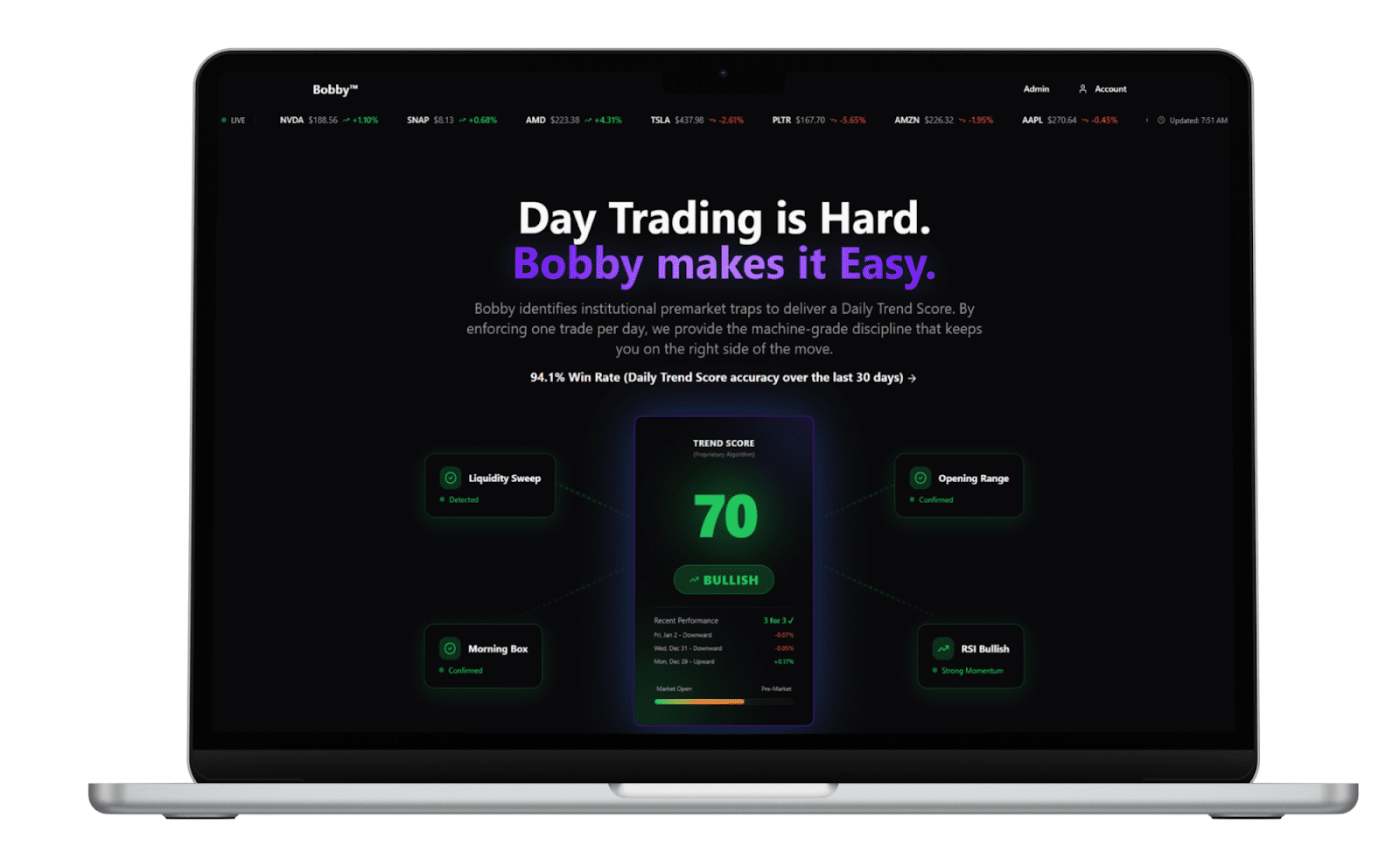
Most retail trading tools emphasize real-time indicators, frequent signals, or complex chart overlays. Bobby takes a different route. The platform centers around a proprietary Trend Score, which distills complex market behavior into a single directional framework designed to answer one question each morning: is the market’s first move more likely to be up or down?
The Trend Score is not positioned as a prediction or a signal feed. Instead, it functions as directional context. By focusing on alignment rather than entries and exits, Bobby aims to reduce the constant decision-making that often leads traders to overtrade or flip bias throughout the session.
This approach reflects a broader shift in trading technology, where simplification is increasingly seen as a feature rather than a limitation.
“Most trading platforms are designed to keep people engaged,” said Danyal Ali, CEO of Bobby. “We built Bobby to do the opposite. The goal isn’t to create more activity, it’s to create better decisions. Discipline is the hardest part of trading, and technology finally makes it possible to support that in a structured way.”
Discipline as a Product Feature
One of the most notable aspects of Bobby is its emphasis on what it calls “discipline as a service.” Rather than relying on traders to manage their own impulses, the platform is designed to enforce structural constraints. These include focusing on a single market, a single directional bias, and a limited window around the market open.
By narrowing the scope of action, Bobby attempts to remove many of the emotional triggers that drive poor decision-making, such as chasing late moves, reacting to noise, or feeling compelled to trade simply because the market is open.
This philosophy is reinforced by the way Bobby is distributed. Instead of operating as a traditional alert service, the platform is often experienced through a shared community environment, where traders can observe how others apply the same directional framework and, just as importantly, when they choose not to trade.
Addressing Modern Market Behavior
Bobby’s design is rooted in the idea that modern markets behave differently than they once did. Large participants frequently probe liquidity, create false early moves, and exploit predictable retail behavior. As a result, price action can appear convincing while still being misleading.
Rather than attempting to outpace these dynamics, Bobby focuses on identifying broader patterns of alignment before the open and maintaining that orientation as the session begins. The goal is not to capture every move, but to avoid being pulled into the wrong side of the market by short-term noise.
This focus on restraint aligns with growing research around trader performance, which consistently shows that overtrading and emotional decision-making are among the primary drivers of retail losses.
A Platform Built Around Behavior, Not Hype
What stands out most after examining Bobby is its lack of traditional marketing promises. The platform does not advertise guaranteed outcomes, or constant opportunities. Instead, it positions itself as a tool for traders who are already familiar with market risk and are looking for structure rather than excitement.
Bobby’s creators appear to be targeting a specific type of trader: one who values clarity over complexity and is willing to trade less in exchange for consistency.
Ali added that Bobby was built around the idea that restraint is a competitive advantage. “For too long, day trading has been treated like a game of speed. In reality, most traders don’t lose because they’re slow. They lose because they do too much. Bobby is designed to help traders slow down and stay oriented when the market is at its most chaotic.”
The Bigger Picture
As artificial intelligence and automation continue to shape financial markets, platforms like Bobby suggest a different application of technology. Rather than removing humans from the process entirely, Bobby uses technology to support better human decision-making.
Whether this discipline-first approach gains broader adoption remains to be seen. But as markets become faster and noisier, tools that prioritize restraint may become increasingly relevant.
For traders who feel overwhelmed by constant signals and reactive trading environments, Bobby represents a thoughtful attempt to rethink what modern trading software should optimize for: not speed, but discipline.
Disclosure: Bobby is a trading technology platform and does not provide investment advice. Trading involves risk, and no tool or framework guarantees outcomes. Users are responsible for their own trading decisions.