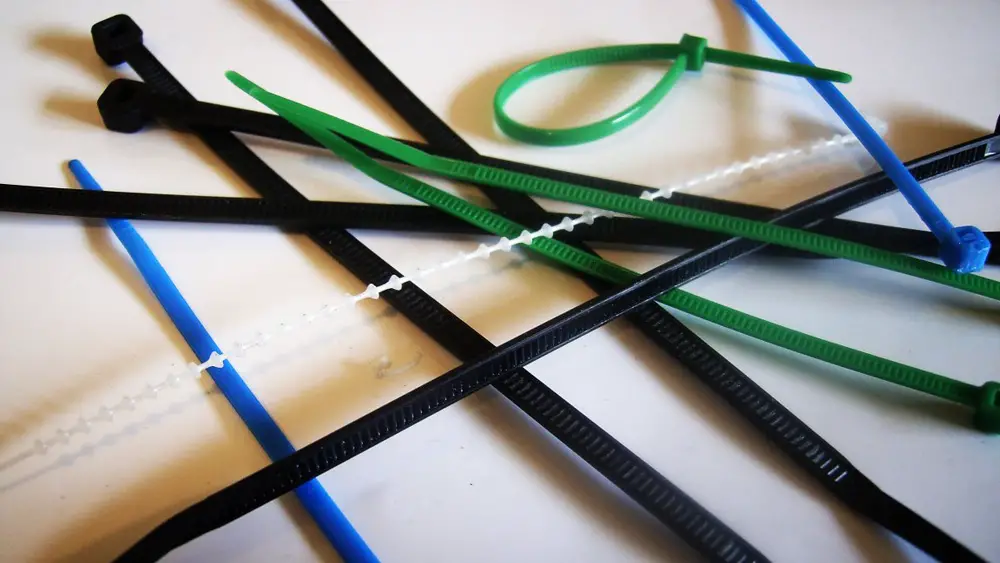
Cable ties aka zip ties are useful tools that are utilized in tens and thousands of manners for industrial, commercial, recreational, and residential areas. Despite their numerous uses, they are perhaps the least celebrated tools. With their ease of use, they do not need any specialization at the end of the user but different types of cable ties do have their specialized uses.
Though there are wide varieties of cable ties used for myriads of purposes with their highly specialized versions, they work basically in the same manner. The tail of a strap is pushed inside its head forming a loop. At the head-end of the tie, there is a ratcheting lever that locks the tail into one-way ramps on the strap itself. What variety of cable ties will be useful for you will depend entirely on the purpose for which you are buying the cable tie. So, here we are with a detailed guide to help you pick and purchase the right cable ties for your purpose.
What are cable ties used for?
Cable ties, in simplest terms, are fasteners that are used to hold items securely together. They were originally used for holding electrical cables together and hence got the name cable ties. But, they are also known by different names including tie wrap, zip tie, hose tie, etc. The most common use of cable ties is of securing bundles of cables but the usability of cable ties is not limited to this function only.
Without a doubt, cable ties are one of the best solutions to keep wires secure and neatly arranged together. But, they are also used for security purposes. For example, cable ties are used to secure boxes of parcels and container trucks to ensure that no tampering has been done with the objects in transition.
The following are the industries where frequent uses of cable ties are seen –
- Aerospace Industry – Aircraft have complex electrical systems hence varieties of cable ties are used to keep things sorted and under control.
- Solar Industry – Cable ties with high resistance to UV rays and chemicals like chloride are readily used in the solar panel industry.
- Railway Industry – Just like the aerospace industry, the railway industry too has to deal with varieties of cables that need to be kept organized for efficiency. Cable ties come in handy.
- Marine Industry – Marine industry requires highly durable solutions for keeping their wires sorted and there’s no better option than cable ties.
- Telecom Industry – Telecom industry needs maximized network efficiency and cable ties allow the quick and efficient building of category wires and cables.
- Construction and Mining Industry – Both the construction and mining industry requires cable ties for their bundling needs that require a material that can withstand harsh conditions.
When were zip ties invented?
Zip ties were invented in 1958 by an electrical company Thomas & Betts. They were released under the brand name ‘Ty-Rap’. These Ty-Raps were originally designed for wire harnesses of airplanes. Since the original work required sturdiness, these wraps had a metal tooth. The nylon and plastic designs came at later stages.
Types of Cable tie
Cable ties are available in different varieties based on their size, color, and the material with which they are made. Let us talk about different types of cable ties in brief.
- Miniature Cable Ties – These are small and highly durable cable ties best suited for smaller, light-duty cable bundling.
- Intermediate Cable Ties – These are durable and reliable zip ties ideal for medium-duty applications.
- Standard Tie Wraps – These are superior-quality cable ties that are reliable and highly durable.
- Heavy-Duty Cable Ties – These are applicable to heavy-duty purposes.
- Extra-Heavy Duty Cable Ties – These are meant for extra heavy-duty bundling of wires and cables.
- Specialty Cable Ties – These are meant to withstand harsh and extreme conditions of temperature and chemicals.
- Hook and Loop Cable Ties – These are soft and flexible cable ties that prevent the bundled wires from any damage.
- Mounted Head Cable Ties – These cable ties allow the user to attach the secured bundle to any other surface.
- Metal Detectable Cable Ties – These cable ties are used at places where contamination has to be avoided. This is the reason they are typically used in the food, beverage, and pharmaceutical industries.
- Releasable Cable Ties – These bundling solutions have the specialty of being reused. These are equipped with a releasable ratchet.
- Ladder Style Cable Ties – These are suitable for intermediate bundling and retail application.
Cable Tie Materials Explained
As discussed earlier, cable ties are manufactured using different materials basically including nylons and stainless steel. Though there are broadly two materials there are different varieties of each based on the quality and grade of the materials.
Nylon, for example, refers to a large group of plastics and polymers. So, a nylon cable tie can be of different quality based on the exact grade of nylon material used. Mostly, cable ties are manufactured using nylon 6 and nylon 6/6 both of which exhibit an excellent balance of strength, ductility, and resistance to heat.
Similarly, cable ties are manufactured using stainless steel of different qualities and grades. They also differ as coated and non-coated stainless steel cable ties.
Bonus Tips
How to remove zip ties without cutting
Cable ties are typically meant for single use but they can be easily reused if you can employ little tricks and tactics. The easiest way to achieve this feat of reusing a cable tie is to insert a small flat object between the ratchet and the pawl and then pull the pawl out. If you do this carefully, you can easily pull open a tied cable tie without damaging the tie. If you succeed in doing this you will be able to reuse the tie without any hassle.
Zip tie alternatives
Though cable ties are perfect for their function in industrial, commercial, and household purposes you may sometimes want to have a few alternatives. Depending on your particular use, you may try the following zip-tie alternatives.
- Cable lacing – a very old method of tying harnesses and cable looms.
- Strapping or bundling – the method of tying objects with a strap, mostly used in the packaging industry.
- Binding knots – a traditional method that includes different styles of knotting, including surgeon knot and constrictor knot, for keeping things bound securely.
- Velcro hook and loop strips – A hook-and-loop strip that can stick together to hold objects in their secured place.
- Twist ties – a fastener with metal wire encased in plastic that is used to tie objects by twisting them.
- Rapstrap fastener – a plastic strap that is used to bundle and tie objects together.