In regulated cleanroom environments, door systems are not secondary architectural elements. They are active control points that influence airflow stability, pressure balance, surface integrity, and operator behavior. Every door cycle introduces a moment of risk, and how that risk is managed depends largely on the type of door system selected and how it integrates with surrounding partitions.
As cleanrooms evolve to support higher throughput, stricter contamination limits, and more frequent access, the choice between hinged doors on partition walls and sliding door systems becomes more consequential. Both options are widely used, and both can meet regulatory requirements on paper. The practical question is which system performs more reliably under real operating conditions, where human movement, cleaning protocols, and wear over time shape contamination outcomes.
How cleanroom hinged doors on partition walls function in practice
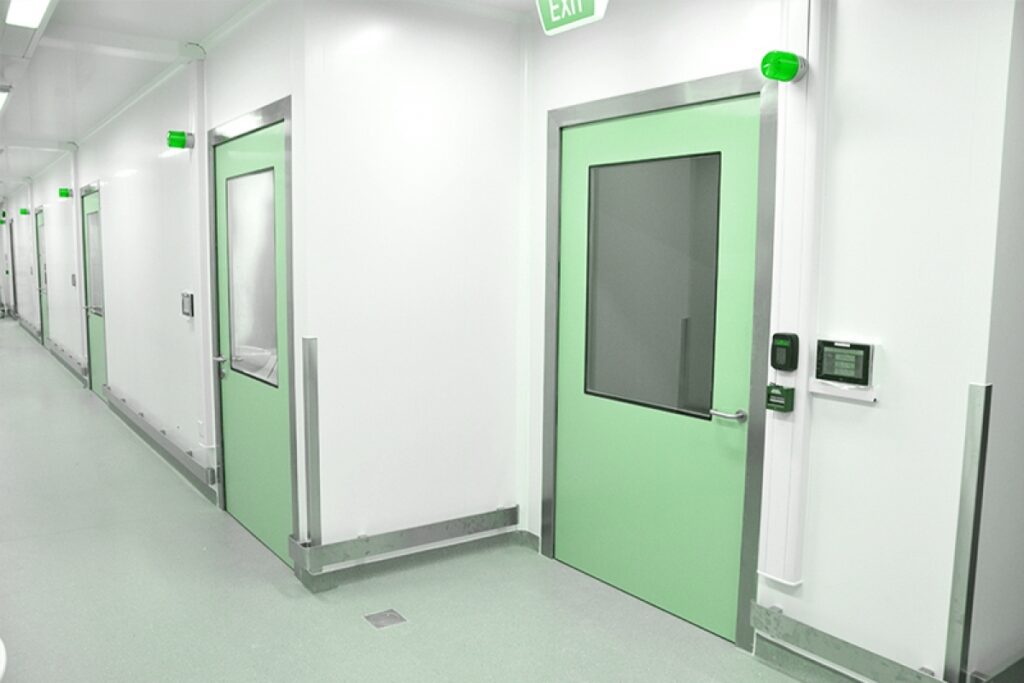
Hinged doors mounted directly within partition wall systems operate as defined, sealed access points. They open on a fixed arc, return to a closed position predictably, and rely on perimeter sealing to maintain separation between clean zones. In regulated environments, cleanroom hinged doors on partition walls are often selected because they integrate structurally with the wall system rather than acting as independent moving elements.
This integration matters. When doors and partitions are designed as a single assembly, surface continuity improves, pressure integrity is easier to maintain, and cleaning protocols are more consistent. Hinged systems also create a clear physical signal to operators: the door is either open or closed, with no intermediate state.
Why integration with partition walls affects contamination control
Door–wall junctions are common contamination weak points.
- Seals fail faster when doors are mounted independently of walls
- Misalignment creates micro-gaps that collect particles
- Cleaning effectiveness declines at complex junctions
Integrated hinged doors reduce these risks by simplifying interfaces.
Sliding door systems in cleanroom applications
Sliding doors operate on tracks or rails, allowing panels to move laterally rather than swing. In cleanrooms, they are often chosen to save space or reduce door swing into controlled areas. Sliding systems can appear attractive where floor space is constrained or where traffic patterns are complex.
However, sliding mechanisms introduce additional components—tracks, rollers, guides—that must remain clean, aligned, and sealed. These components experience repeated mechanical wear under frequent use.
Practical characteristics of sliding systems
Sliding doors behave differently under daily operation.
- Panels remain partially exposed during movement
- Tracks collect particles and cleaning residue
- Closure relies on precise alignment rather than gravity
These characteristics influence long-term performance in regulated spaces.
Airflow and pressure stability during door operation
Airflow disruption during door cycles is unavoidable, but its magnitude and recovery time vary by door type. Hinged doors create a brief, predictable disturbance as the door opens and closes along a fixed path. Once closed, the system returns to its sealed state.
Sliding doors often remain partially open for longer periods, especially during high traffic. This extended opening alters pressure gradients and increases the time contaminants can migrate between zones.
Impact on contamination recovery
Recovery time matters more than momentary disturbance.
- Hinged doors close fully and decisively
- Sliding doors may pause mid-travel
- Pressure normalization is slower with extended openings
In environments with frequent access, these differences accumulate.
Cleaning and surface maintenance considerations
Cleanroom doors are subjected to frequent, aggressive cleaning. Hinged doors typically present flat, continuous surfaces with minimal mechanical exposure. Hinges are accessible and can be specified for cleanroom compatibility.
Sliding systems introduce horizontal surfaces and recessed components that are harder to clean consistently. Tracks, in particular, become collection points for particles and residues.
Maintenance burden over time
Ease of cleaning influences long-term compliance.
- Flat surfaces clean faster and more reliably
- Hidden components degrade unnoticed
- Wear accelerates where cleaning is inconsistent
Simpler systems generally age more predictably under cleanroom protocols.
Wear, alignment, and long-term reliability
Mechanical wear affects contamination control indirectly. Hinged doors rely on robust pivots and closers that tolerate repeated cycles with minimal drift. Alignment issues are usually visible and correctable early.
Sliding doors depend on precise track alignment. Small deviations increase friction, prevent full closure, or compromise sealing. These issues often develop gradually and are discovered only after contamination indicators rise.
Reliability under high usage
High-cycle environments amplify mechanical differences.
- Hinged systems show wear at known points
- Sliding systems distribute wear across multiple components
- Diagnosis and correction take longer with sliding mechanisms
Predictable wear supports proactive maintenance.
Operator behavior and compliance effects
Design influences behavior. Hinged doors signal closure clearly and discourage partial opening. Operators tend to complete the open–close cycle fully before proceeding.
Sliding doors are more likely to be left partially open during movement or propped unintentionally, especially when moving carts or equipment. These behaviors extend exposure time without obvious violation.
Behavioral implications of door choice
Human factors matter in regulated spaces.
- Clear closure reduces reliance on reminders
- Partial openings increase contamination windows
- Simpler motion supports consistent use
Design that aligns with natural behavior reduces enforcement burden.
Space efficiency versus contamination risk
Sliding doors are often chosen to save space, particularly in narrow corridors or tight rooms. This benefit is real, but it must be weighed against contamination risk introduced by extended opening time and complex mechanics.
In many regulated environments, space efficiency is secondary to contamination stability.
Evaluating the trade-off
The cost of space savings can be indirect.
- Increased cleaning effort
- Longer recovery after access
- Higher monitoring and validation load
Space gains should be justified against these operational costs.
Regulatory performance and audit considerations
From a regulatory standpoint, both hinged and sliding doors can meet standards if properly specified and maintained. However, audits often focus on consistency, cleanliness, and evidence of control.
Systems that are easier to clean, inspect, and maintain tend to perform better during audits, not because they are inherently more compliant, but because their condition is easier to verify.
Inspection and validation implications
Auditors look for clarity and repeatability.
- Visible seals and surfaces simplify inspection
- Fewer hidden components reduce uncertainty
- Predictable operation supports documentation
Door systems that behave consistently reduce audit friction.
System-level view of door performance
Cleanroom performance emerges from how components interact, not how they perform individually. This systems-based perspective is well established in cleanroom engineering, where airflow, materials, and human movement interact continuously. An overview of this integrated approach is available in Wikipedia’s explanation of cleanroom technology, which describes how environmental control depends on coordinated design choices.
From this perspective, door systems should be evaluated based on how they support overall stability, not just how they function in isolation.
When hinged doors on partition walls perform better
Hinged doors integrated into partition walls tend to perform better when:
- Access frequency is high
- Pressure stability is critical
- Cleaning cycles are aggressive
- Long-term reliability matters more than space savings
In these environments, predictability and simplicity outweigh compactness.
When sliding systems may be appropriate
Sliding doors can be suitable when:
- Space constraints are severe
- Access frequency is low
- Traffic is controlled and deliberate
- Maintenance resources are readily available
Their use requires stricter discipline and monitoring.
Closing perspective: choosing based on operational reality
The choice between hinged doors on partition walls and sliding systems is not purely architectural. It is an operational decision with long-term implications for contamination control, maintenance effort, and regulatory confidence. Both systems can function in regulated environments, but they behave differently under real conditions.
For facilities where contamination risk must be controlled consistently rather than corrected reactively, door systems that integrate cleanly with partition walls and behave predictably tend to perform better over time. The most effective cleanroom designs align physical systems with how people actually work, ensuring that compliance is built into daily operation rather than enforced after the fact.