
CocoHumanizer Review : A Free AI Humanizer With Unlimited Use

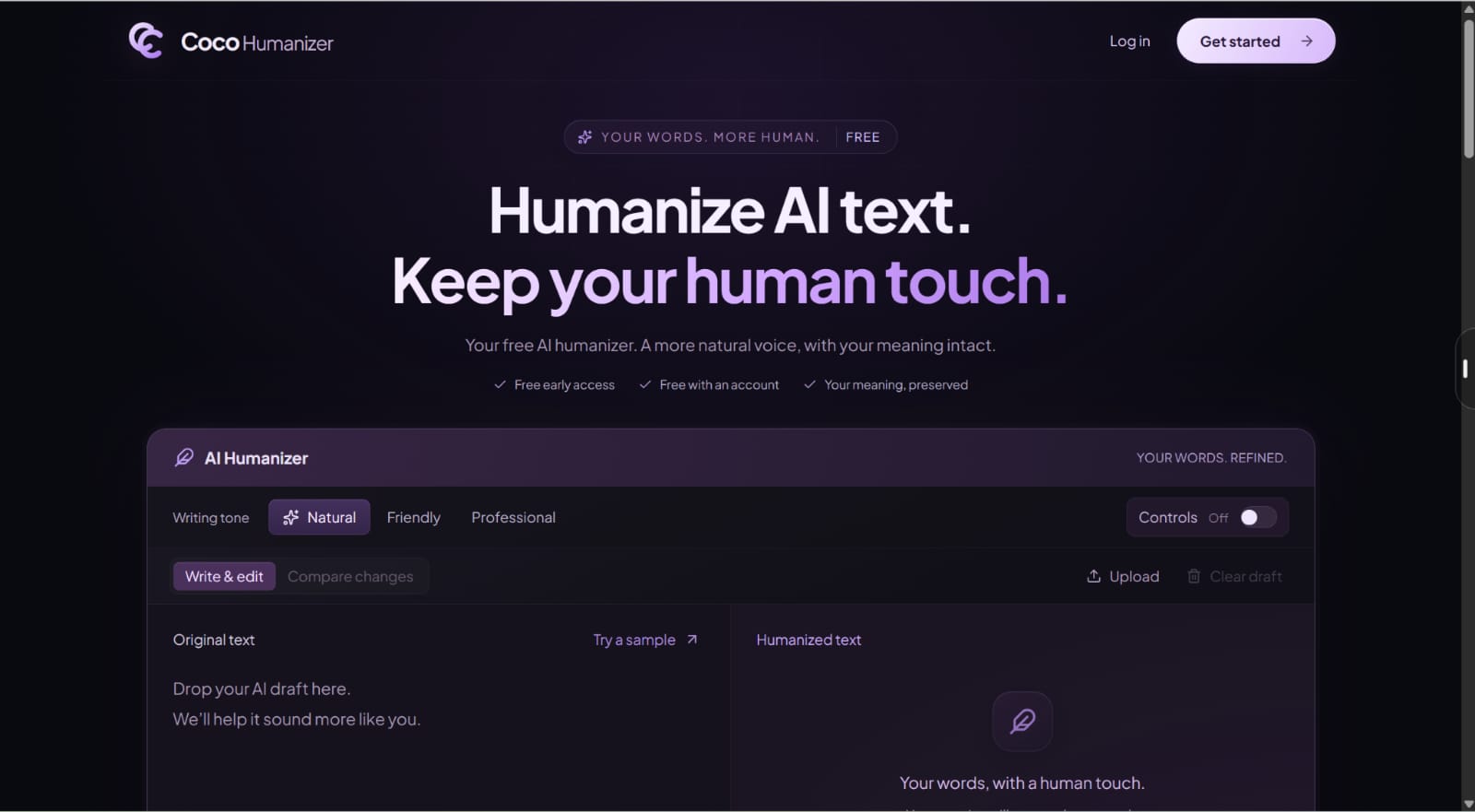
CocoHumanizer Review : A Free AI Humanizer With Unlimited Use
AI-generated writing is now everywhere, but one problem remains: a lot of it still sounds like AI.
The sentences may be grammatically correct, yet the wording often feels too polished, repetitive, or predictable. That is exactly the problem AI humanizer tools are trying to solve.
One newer option is CocoHumanizer, an AI humanizer built to make AI-generated text sound more natural without changing the original message too much.
What immediately makes CocoHumanizer stand out is its pricing model. Instead of offering only a small number of free credits, CocoHumanizer currently provides free unlimited humanization after users log in.
In this CocoHumanizer review, we will look at its main features, how it works, its pros and cons, and whether it is worth using in .
What Is CocoHumanizer?
CocoHumanizer is an online AI humanizer that rewrites AI-generated text into more natural, readable, and human-like writing.
It can be used with content created by tools such as ChatGPT, Claude, Gemini, and other AI writing assistants.
The basic idea is simple:
- Generate or prepare your draft.
- Paste it into CocoHumanizer.
- Choose your preferred writing style.
- Let the tool rewrite the text.
- Review and edit the result.
Unlike traditional paraphrasing tools that mainly swap words for synonyms, CocoHumanizer focuses more on sentence rhythm, tone, structure, and readability.
That makes it suitable for people who want their AI-assisted writing to feel less mechanical.
What Makes CocoHumanizer Different?
There are already many AI humanizers available, so the obvious question is: why use CocoHumanizer?
The biggest difference is accessibility.
Many competitors advertise themselves as free but place strict limits on the number of words you can process. Once those credits run out, you are asked to purchase a subscription.
CocoHumanizer currently takes a simpler approach.
After creating an account and logging in, users can make unlimited humanization requests for free.
There may still be limits on how much text can be processed in one request, but users are not forced into a monthly credit system just to continue using the tool.
For users who humanize content regularly, this is probably CocoHumanizer’s strongest advantage.
CocoHumanizer Features
Free Unlimited AI Humanizer
The main feature is the free AI humanizer itself.
Users can repeatedly submit content for rewriting without having to buy additional credits.
This makes CocoHumanizer especially attractive for bloggers, marketers, students, writers, and other users who work with AI-generated text frequently.
Multiple Writing Styles
Not every piece of text should sound the same.
A blog article should not necessarily use the same tone as a business email, and marketing copy may require a different voice from an academic draft.
CocoHumanizer provides different writing styles to help users control the result.
These include options such as:
Natural — suitable for general-purpose writing and everyday content.
Friendly — better for conversational writing and a more relaxed tone.
Professional — useful for workplace communication, reports, proposals, and business writing.
These modes make the tool more flexible than a basic one-click rewrite service.
Rewrite Controls
Users can also adjust how much the original content should be changed.
This matters because sometimes you only want to improve a few awkward phrases, while other times the entire passage needs to be rewritten more substantially.
Having different rewrite settings gives users more control over the final output.
Preserve Important Words
One of the risks of using any rewriting tool is accidentally changing important information.
Brand names, product names, technical terms, numbers, and specific phrases may need to stay exactly the same.
CocoHumanizer allows users to preserve important terms during the rewriting process.
This is particularly useful for marketers, businesses, technical writers, and anyone working with specialized terminology.
File Uploads
CocoHumanizer also supports document-based workflows.
Instead of copying everything manually, users can upload supported files such as DOCX, TXT, and text-based PDF documents.
That is helpful when working with longer drafts or existing documents.
How Good Is the Humanized Text?
The quality of an AI humanizer depends heavily on the original content.
If the input is extremely generic, repetitive, or badly structured, no rewriting tool can instantly turn it into excellent writing.
However, CocoHumanizer works well as a second editing layer.
Its main strength is making text feel less uniform.
AI writing often contains patterns such as:
- Similar sentence lengths
- Excessive transition phrases
- Overly formal wording
- Repeated conclusions
- Predictable paragraph structures
A humanizer can break up some of these patterns.
CocoHumanizer generally aims to make the text sound more relaxed and natural while maintaining the original message.
That makes it useful as part of an editing workflow rather than as a replacement for human review.
CocoHumanizer for AI-Generated Articles
Bloggers and content marketers are likely to be one of the main audiences for CocoHumanizer.
AI tools can speed up research and drafting, but raw AI content often needs editing before publication.
CocoHumanizer can help improve sections that sound overly robotic or repetitive.
For example, you might use ChatGPT to create a first draft, then use CocoHumanizer to improve the wording, and finally manually fact-check and polish the article.
This kind of workflow can be much faster than rewriting every sentence manually.
CocoHumanizer for Emails and Business Writing
CocoHumanizer is also useful for shorter content.
AI-generated emails often sound too formal or generic.
A message such as:
I hope this email finds you well. I am writing to inquire regarding the status of our previous discussion.
may be technically correct, but few people naturally communicate that way in everyday business conversations.
A humanizer can turn this type of wording into something shorter and more natural.
The Professional and Friendly modes make CocoHumanizer useful for:
- Sales emails
- Client communication
- Internal messages
- Proposals
- Follow-up emails
- LinkedIn content
CocoHumanizer for Students
Students are another group likely to use AI humanizer tools.
CocoHumanizer can be used to improve the readability of drafts, notes, summaries, and essays.
However, students should use it responsibly.
Schools and universities have different rules about AI-assisted writing. Humanizing AI-generated text does not change the need to follow those rules.
The best use case is to treat CocoHumanizer as an editing assistant rather than a shortcut for submitting work you did not create or understand.
Can CocoHumanizer Bypass AI Detectors?
This is one of the most common questions surrounding AI humanizers.
Changing sentence structure and wording can influence how AI detection systems analyze text. However, no tool can reliably guarantee that every piece of writing will receive a specific result from every AI detector.
AI detectors also change frequently and may produce different results for the same text.
For that reason, CocoHumanizer is more useful when viewed as a tool for improving naturalness, readability, and writing quality rather than as a guaranteed AI detection bypass.
The most reliable workflow is still:
AI draft → humanize → manually review → edit in your own voice
CocoHumanizer vs. a Regular Paraphraser
CocoHumanizer and paraphrasing tools overlap, but they are not exactly the same.
A paraphraser usually focuses on replacing words and restructuring sentences.
An AI humanizer focuses more on making the overall writing feel natural.
For example:
Original AI text:
In today’s rapidly evolving digital landscape, businesses are increasingly leveraging artificial intelligence to enhance operational efficiency.
A basic paraphraser might write:
In today’s fast-changing digital environment, companies are increasingly using artificial intelligence to improve operational efficiency.
That is different, but it still sounds very similar.
A humanizer may instead produce something closer to:
More businesses are turning to AI to save time and make everyday operations more efficient.
The second version is simpler and closer to how a person might naturally express the same idea.
CocoHumanizer Pros and Cons
Pros
Free to use
The free pricing model is one of its biggest advantages.
Unlimited usage after login
Users do not have to constantly monitor credits.
Easy to understand
The workflow is straightforward even for first-time users.
Different writing styles
Users can choose a tone that better fits their content.
Good for different types of writing
It can be used for articles, emails, essays, marketing copy, and business communication.
Helps preserve meaning
The tool is designed to rewrite without unnecessarily changing the original message.
Important terms can be protected
Useful for brands, technical content, and specialized writing.
Cons
Login is required
You need an account to access unlimited use.
Results still require review
AI rewriting is not perfect, and some sentences may still need manual editing.
It does not replace good writing
A weak original draft usually still needs human judgment.
No AI detector guarantee
Like any humanizer, results can vary across detection systems.
Is CocoHumanizer Really Free?
At the time of writing, yes.
CocoHumanizer currently allows users to create an account, log in, and access the AI humanizer without paying for a subscription.
Registered users can make unlimited humanization requests.
This is a significant difference compared with tools that offer only a short free trial or small daily allowance.
For users who simply want a functional free AI humanizer without immediately entering payment details, CocoHumanizer is easy to try.
Who Is CocoHumanizer Best For?
CocoHumanizer makes the most sense for people who already use AI writing tools.
That includes:
- Bloggers
- SEO professionals
- Content marketers
- Freelance writers
- Students
- Business professionals
- Social media managers
- Founders
- People who regularly use ChatGPT or Claude
If you only use AI occasionally, you may not need a dedicated humanizer.
But if AI-generated drafts are already part of your normal workflow, CocoHumanizer can save time during the editing process.
Is CocoHumanizer Worth Using in ?
Yes, particularly because it is currently free.
CocoHumanizer does not try to replace the writer. Instead, it provides an additional rewriting layer between AI-generated content and the final version.
The multiple tone options, rewrite controls, file uploads, and unlimited free usage give it more practical value than many simple paraphrasing tools.
Its main weakness is the same one shared by almost every AI rewriting product: you still need to read the output.
The best results come when users combine AI tools with their own judgment rather than automatically publishing whatever the tool generates.
Final CocoHumanizer Review
CocoHumanizer is a solid option for anyone looking for a free AI humanizer in .
Its strongest selling point is unlimited usage for registered users, which removes one of the biggest frustrations associated with competing AI writing tools.
The interface is easy to use, there are enough customization options to handle different writing styles, and the tool can fit naturally into workflows involving ChatGPT, Claude, Gemini, and other AI assistants.
It is particularly useful for turning rough AI drafts into more readable and natural starting points.
For people who regularly use AI to write articles, emails, marketing copy, essays, or business content, CocoHumanizer is worth testing.
Overall rating: 4.7/5
Frequently Asked Questions
What is CocoHumanizer?
CocoHumanizer is an AI humanizer that rewrites AI-generated text to make it sound more natural, readable, and human-like.
Is CocoHumanizer free?
Yes. CocoHumanizer currently provides free access after users create an account and log in.
Does CocoHumanizer offer unlimited use?
Yes. Registered users can currently make unlimited humanization requests, although individual input limits may apply.
Can CocoHumanizer humanize ChatGPT text?
Yes. It can be used with text generated by ChatGPT, Claude, Gemini, and other AI writing tools.
Can I use CocoHumanizer for essays?
Yes. CocoHumanizer can help improve the naturalness and readability of essay drafts. Students should still follow their institution’s AI-use policies.
Is CocoHumanizer the same as a paraphrasing tool?
Not exactly. Paraphrasers mainly rewrite wording, while CocoHumanizer focuses more broadly on tone, flow, sentence structure, and naturalness.
Does CocoHumanizer guarantee undetectable AI content?
No AI humanizer can reliably guarantee the same result across every AI detection platform. CocoHumanizer is better used to improve writing quality and make AI-generated drafts sound more natural.







Comment