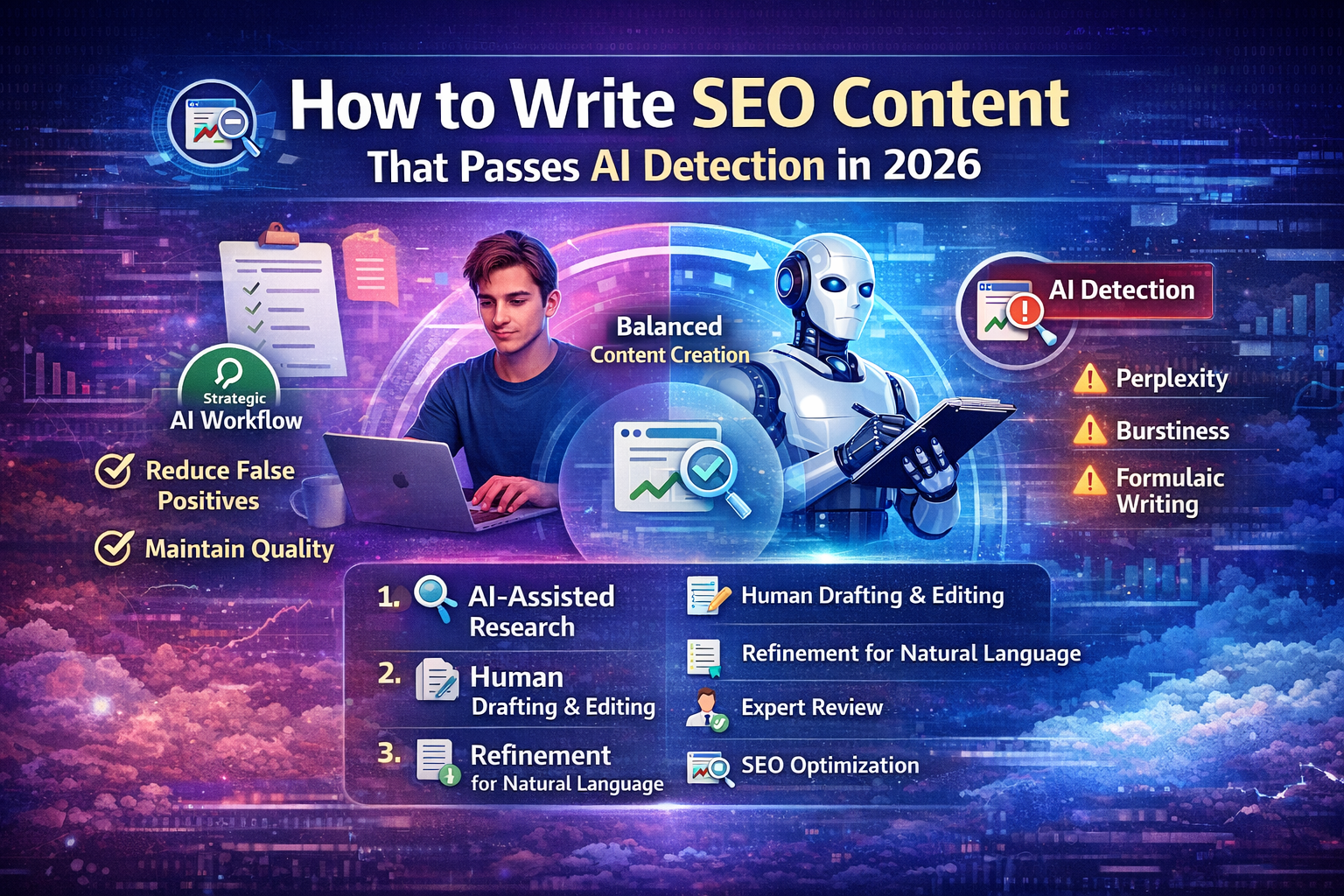
The content marketing landscape shifted in 2025 when search engines and publishers deployed AI detection systems. Businesses using AI for blog posts and marketing copy faced a new challenge: content was being flagged or rejected.
Yet AI tools remain valuable for content teams. In 2026, successful marketers use them strategically while ensuring output maintains quality and reduces false positives. This guide reveals the workflow for creating AI-assisted content that ranks and converts.
Why AI Detection Matters for Your Business
AI detection has direct business implications affecting your bottom line.
Google’s Evolving Stance on AI Content
Google’s position has evolved from skepticism to a more nuanced approach. According to their March 2024 helpful content update, Google evaluates content quality based on Experience, Expertise, Authoritativeness, and Trustworthiness (E-E-A-T) rather than penalizing AI content per se.
However, publishers and platforms increasingly screen submissions. Research suggests that many publishers now use AI detection tools, with significant percentages rejecting content scoring high on AI probability.
Business Implications of Detection
When content gets flagged, several challenges emerge:
Search Performance: Content perceived as low-quality may perform worse in rankings. Google’s algorithms increasingly correlate certain patterns with thin content.
Publisher Rejection: Guest posts and contributed articles may be rejected when editors detect AI authorship, damaging relationships.
Brand Perception: Clients running content through detection tools may question authenticity if scores indicate heavy AI use.
Competitive Disadvantage: While creating detectable content, competitors using better workflows may capture rankings and traffic.
The solution isn’t eliminating AI—it’s using it strategically while maintaining human elements that create value.
Understanding AI Detection Systems
Before creating content that reduces false positives, understand what detection systems identify.
What Detection Tools Measure
AI detectors like GPTZero, Originality.ai, and Copyleaks analyze linguistic patterns:
Perplexity: Measures text predictability. AI content follows predictable patterns because language models select statistically likely sequences. Human writers make unexpected choices.
Burstiness: Humans vary sentence length naturally. We write short punchy sentences. Then elaborate with longer, complex constructions. AI tends toward consistent, medium-length sentences.
N-gram Analysis: Systems examine word sequence patterns. AI models favor certain combinations appearing frequently in training data.
Structural Patterns: AI often follows formulaic organization. While structure isn’t wrong, excessive uniformity may signal automation.
The False Positive Problem
AI detectors aren’t perfectly accurate. A Stanford University study found that detection tools disproportionately flag non-native English speakers’ writing, with false positive rates varying significantly.
This particularly affects:
- Non-native speakers whose formal writing mimics AI patterns
- Writers using grammar tools extensively
- Technical content requiring specific terminology
- Well-edited professional writing
Understanding detection helps avoid triggering false positives while legitimately using AI assistance.
Strategic AI Content Workflow
Creating effective content requires balancing efficiency with authenticity. Here’s the workflow successful businesses use.
Step 1: AI-Assisted Research
AI tools excel at research and brainstorming:
Use AI for:
- Keyword research and search intent analysis
- Competitor content gap identification
- Topic clustering and planning
- Outline generation
- Initial research compilation
Example: “Analyze top-ranking articles for [keyword]. Identify themes, angles, and gaps our article should address.”
Step 2: Human-Led Drafting with AI Support
Use AI as a writing assistant, not the author:
Effective Use:
- Generate introduction options, then rewrite your favorite
- Expand bullet points into paragraphs for heavy editing
- Suggest transitions between your written sections
- Provide alternative phrasings when stuck
Avoid:
- Complete AI-written sections without revision
- Accepting first drafts as final
- Using AI paragraphs unchanged
The goal is AI-enhanced human writing.
Step 3: Refinement for Natural Language
Even substantially human-drafted content may contain AI-influenced patterns—predictable phrasing, uniform structure, and characteristic word choices.
Understanding what AI humanizers do helps address these patterns. These tools analyze content for machine-typical markers and modify them to match authentic writing characteristics. Unlike simple paraphrasing, humanization technology understands context while varying rhythm and diversifying vocabulary.
This refinement is valuable when:
- You’ve used AI substantially during research
- Content needs to pass publisher screening
- You’re in competitive SEO spaces
- Your team includes non-native speakers who may trigger false positives
Tools like AI humanization platforms automate this process, analyzing drafts for AI-typical patterns while maintaining SEO keywords, structure, and formatting. Marketing teams report significant time savings compared to manual rewriting while achieving consistently lower detection scores.
Step 4: Expert Review and Value Addition
Your content needs expertise only humans provide:
Add Value Through:
- Original data from company research or customer insights
- Specific examples from industry experience
- Perspectives based on domain expertise
- Case studies and real-world applications
- Personal anecdotes illustrating key points
This expertise layer is what E-E-A-T guidelines measure—and what AI cannot replicate.
Step 5: Technical SEO Optimization
Final refinement before publishing:
SEO Checklist:
- Target keyword in title, H1, opening, and conclusion
- LSI keywords naturally distributed
- Descriptive subheadings with secondary keywords
- Internal links to related content
- External links to authoritative sources
- Optimized meta description
- Image alt text with relevant keywords
Avoiding Over-Optimization: Keyword usage should feel natural. Forced keywords or unnatural repetition hurts readability and may trigger quality filters.
Advanced Strategies
Beyond basics, these techniques help content pass sophisticated detection while maintaining efficiency.
Technique 1: Hybrid Drafting
Alternate between human and AI sections:
- Write introduction and conclusion yourself
- Use AI for middle sections from detailed outlines
- Heavily edit AI sections, rewriting 40-50% of paragraphs
- Add personal examples throughout
- Read aloud and revise unnatural phrases
Technique 2: Voice-to-Text Foundation
Start with your actual voice:
- Record 10-15 minutes explaining your topic
- Transcribe with tools like Otter.ai
- Clean up transcript
- Use AI to improve structure
- Refine to remove AI-introduced patterns
- Add SEO elements
Content starting with your voice carries inherent authenticity.
Technique 3: Strategic Model Mixing
Different AI models have different signatures. Mixing creates unique patterns:
- Use ChatGPT for outlining
- Use Claude for drafting
- Use Jasper for specific sections
- Manually integrate and edit everything
Common Detection Triggers to Avoid
Certain practices reliably produce detectable content:
Using AI-Generated Examples: AI-created case studies often sound generic. Always use real data.
Accepting First Drafts: Initial AI output needs substantial revision. Content with minimal changes produces consistently detectable patterns.
AI for Introductions/Conclusions: Detection tools scrutinize opening and closing paragraphs. These should be predominantly human-written.
Neglecting Fact-Checking: AI frequently generates plausible but inaccurate information. According to MIT research, AI hallucinations remain a significant challenge. Always verify facts independently.
Generic Jargon: Phrases like “in today’s fast-paced world” appear frequently in AI content. Use specific, concrete language.
Measuring Success Beyond Detection
While reducing false positives matters, content must perform in search and drive results.
Key Performance Indicators
Detection Scores: Aim for low AI probability on major tools. Test with GPTZero, Originality.ai, and Copyleaks before publishing.
Search Rankings: Track keyword positions. Content that passes detection but doesn’t rank needs SEO improvements.
Engagement Metrics: Monitor time on page, scroll depth, and bounce rate. Authentic content keeps readers engaged.
Conversion Performance: Measure whether content drives actions—signups, demos, purchases.
Backlink Acquisition: Quality content attracts links naturally. If content isn’t being cited, it may lack depth.
Continuous Improvement
Establish monthly content audits:
- Run published content through detection tools
- Compare scores with search performance
- Identify patterns in highest-performing content
- Refine workflow based on results
- Train team on successful techniques
Building Team Capabilities
Your workflow depends on team competence.
Core Competencies Needed
- Understanding detection mechanics and triggers
- Effective prompt engineering
- Critical editing skills for AI drafts
- Domain expertise for unique insights
- SEO fundamentals informing structure
Process Documentation
Create SOPs documenting:
- Your AI content workflow with decision points
- Quality checklists for each stage
- Examples of effective AI integration
- Detection threshold requirements
Quality Control
Implement multi-layer review:
First Pass: Writer self-edits using detection tools
Second Pass: Peer review for authenticity
Third Pass: SEO specialist ensures optimization
Final Pass: Subject matter expert validates accuracy
Looking Ahead
Understanding technology trends helps future-proof your strategy.
Emerging Detection Capabilities
Detection technology continues evolving:
Watermarking: Some AI companies are exploring invisible watermarks in generated text.
Behavioral Analysis: New methods may examine writing patterns across multiple pieces.
Semantic Fingerprinting: Advanced systems could analyze meaning and argument structure beyond surface patterns.
These developments make superficial editing less effective, reinforcing genuine human involvement.
Google’s Direction
Based on algorithm updates and guidance, Google appears to be emphasizing:
Quality Over Source: Focus on whether content provides genuine value rather than creation method.
E-E-A-T Signals: Increasing emphasis on demonstrable expertise and original research.
User Satisfaction: Greater weight on engagement data as proxies for quality.
Businesses that thrive will create genuinely valuable content regardless of tools used.
Implementation Timeline
Transform your process with this 30-day plan:
Week 1: Assessment
- Audit existing content with detection tools
- Analyze which pieces rank best and score lowest
- Interview team about current AI usage
- Establish baseline metrics
Week 2: Workflow Design
- Map new AI-assisted process
- Test refinement tools
- Create SOPs for each stage
- Identify training needs
Week 3: Pilot Program
- Apply new workflow to 5-10 pieces
- Document time investment
- Test detection scores
- Gather team feedback
Week 4: Refinement and Scaling
- Adjust based on pilot results
- Train entire team on finalized process
- Establish ongoing monitoring
- Set quarterly performance goals
Conclusion
Successful 2026 content strategies recognize AI tools as powerful assistants amplifying human creativity and expertise when used appropriately.
Content that reduces false positives isn’t about tricking algorithms—it’s about maintaining authentic human elements that create value. Your insights, experience, and audience understanding remain irreplaceable.
The workflow outlined reflects how leading businesses operate: using AI for research, drafting assistance, and optimization while keeping strategic decisions, expert analysis, and authentic voice in human hands.
As detection technology advances, one principle remains: valuable, expertly-crafted content serving reader needs will perform well. The tools matter less than the value delivered.
Implement this workflow systematically, measure results rigorously, and refine continuously. Your content will not only achieve lower detection scores but deliver the rankings, engagement, and business results that matter most.