The Executive Leather Chair, A Foundation of Status and Efficiency
The Executive Leather Chair has long served as a visual declaration of power, status, and attention to detail. It transcends the typical boundaries of office furniture, becoming a cornerstone of both spatial aesthetics and professional image. However, the definition of the executive chair is currently being reshaped by modern hybrid work trends. With working from home becoming the norm , the chair can no longer be used only for short meetings or signing documents; it must now reliably handle the sustained load of an eight-hour, high-intensity workday.
This shift creates a core dilemma: How does one achieve the perfect balance between traditional “Solemn Aesthetics” and modern “Dynamic Ergonomics”? A successful executive chair investment must integrate the aesthetic statement with the efficient tool.This means purchasing decisions must look past superficial leather and bulky appearance, delving into the durability of materials science, the essence of ergonomic design, and the ability to seamlessly adapt across different spatial settings.
The Three Pillars of Executive Chair Investment
For professionals seeking long-term value, the core considerations for selecting an executive leather chair can be summarized into these three pillars:
- Materials Science: Focus on the grade of leather or synthetic material, its durability (Longevity), and the aesthetic value it gains over time.
- Ergonomics: Differentiate between chairs that only offer short-term “plushness” and those with genuine engineering that provides long-term, dynamic support for the spine.
- Spatial Adaptability: Ensure the chair can convey authority in a formal boardroom while simultaneously integrating gracefully into the warm environment of a home office, enabling a seamless transition.
The high initial investment of an executive chair must be justified by extended lifespan and sustained comfort. If the chair shows signs of collapsed seating or peeling leather after just a few years , its “executive” status and investment value quickly diminish. Therefore, professional assessment of materials and structure is crucial.
Investment Considerations: Material Science and Lasting Durability
The choice of upholstery for an executive leather chair determines whether its appearance appreciates or depreciates over time. Investing in a high-end executive chair is fundamentally a vote of confidence in materials science and durable craftsmanship.
Genuine Leather Grading and Aesthetic Value Curve
Genuine leather remains the material of choice for executive chairs due to its unique texture, breathability, and the distinct aesthetic it develops over time.
- Full Grain Leather: This is the highest grade of leather, retaining its full natural pore structure, thus offering optimal breathability and feel. The unique value of full-grain leather lies in its ability to develop a natural Patina over time.5 This natural process of oxidation and oil absorption imparts a rich, seasoned, and sophisticated appearance, which supports its premium price point.
- Top Grain and Corrected Grain Leather: The surface of this leather is often processed and embossed to enhance abrasion resistance and stain protection. While corrected leather sacrifices some of the natural feel and patina potential of full-grain leather, its durability can be measured by professional standards like the Martindale Abrasion Test, ensuring decent performance in moderate commercial use.
The Durability Trap of Synthetics and High-Tech Solutions
Not all products labeled “leather chairs” possess the necessary durability for executive settings. When purchasing mid-to-low-end executive chairs, consumers must be aware of the material’s “lifespan decay model.”
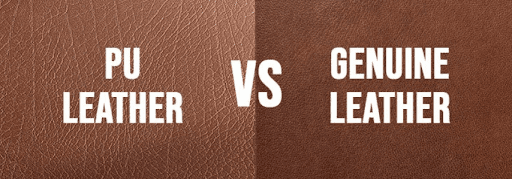
- The Decay Model of Low-Cost Materials: Many budget products use standard PU faux leather or bonded leather. Bonded leather is made from pulverized leather scraps re-glued with adhesives, resulting in low strength and a high tendency for hydrolysis, cracking, and peeling. Such materials resist neither friction nor moisture , leading to rapid aesthetic deterioration within a few years, becoming “embarrassing”. For instance, some mass-market chairs (like certain La-Z-Boy models) offer a bulky, sofa-like plushness, but user reviews indicate that the faux leather or low-grade leather wears out quickly. This rapid material failure is an inherent flaw of low-cost PU or bonded leather.

- The Rise of High-Performance Synthetics: Silicone PU Leather: High-performance synthetics have emerged to address the short lifespan and poor durability of traditional PU. Silicone PU Leather is highly regarded as it is specifically engineered for high durability. Compared to traditional PU, silicone leather is generally more durable, eco-friendly, and breathable, making it suitable for high-end applications.7 Functionally, silicone leather boasts superior resistance to hydrolysis and is easy to clean, possessing strong water resistance. This is crucial for daily maintenance, especially against spills and friction in a home environment. For example, the Eureka Royal Series chair utilizes high-quality Silicone PU. This technology extends the reliable lifespan of the synthetic leather to four to five years or more (depending on intensity) , successfully overcoming the short lifespan of traditional PU and providing a reliable balance of cost and function.

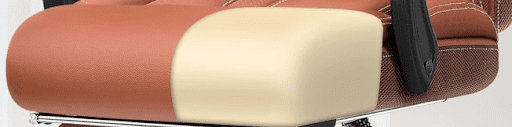
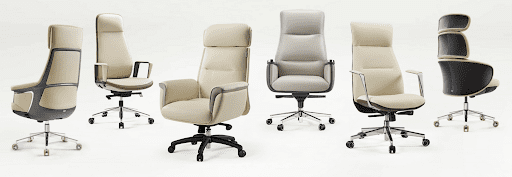
In the home office setting, chairs face a higher demand for material practicality. Unlike the low-frequency use of a boardroom chair, a home office chair is subject to high-intensity daily use and risks from children, pets, or spills. The water-resistant and easy-to-clean properties of Silicone PU give it a practical advantage over the often delicate nature of genuine leather in a family environment.
Table 1: Comparison of Common Leather and Synthetic Materials and Durability Metrics
| Material Type | Durability (Representative Lifespan) | Aesthetic Feature (Evolution Over Time) | Core Challenge/Consideration |
| Full Grain Leather | Excellent (10–20+ Years) | Develops unique Patina, texture improves over time | High cost, requires professional maintenance, sensitive to humidity |
| Top/Corrected Grain | Good (5–10 Years) | High surface consistency, good abrasion resistance | Less supple feel than full grain |
| High-Performance Silicone PU | Excellent (4–5+ Years) | Smooth surface, color stable, high water resistance | Lacks natural leather tactility |
| Standard PU Faux Leather | Fair (1–3 Years) | Prone to cracking and peeling | Low resistance to hydrolysis and friction, shortest lifespan |
| Bonded Leather | Poor (1–2 Years) | Appearance deteriorates rapidly, easily fragments | Low strength, inconsistent quality |
III. The Science of Comfort: The Essence of Ergonomic Design
The comfort of an executive leather chair cannot be judged solely by the initial sit. True comfort stems from precise Sustained Sitting Engineering. The ergonomic design must integrate spinal health into the traditional administrative aesthetic. Simply meeting the ANSI/BIFMA standard 8 is only a commercial minimum and does not guarantee comfort for eight hours or address cushion decay.4
Distinguishing “Executive Aesthetics” from “Dynamic Support”
The greatest challenge in executive leather chair design is balancing elegant, straight lines with the necessary dynamic support.
- Static Support Archetype:Herman Miller Eames Executive Chair
The Eames Executive Chair (or Soft Pad) is the benchmark for high-end executive aesthetics. Its design emphasizes clean lines and the stability of the aluminum frame, aiming to convey formality through visual balance. However, this classic upright backrest, while maintaining a professional look, struggles to offer the dynamic, depth-adjustable lumbar support championed by modern ergonomics. For users focused on computer work who need to lean forward or read, this static support can result in a lack of effective curvature support for the lumbar spine.

- Dynamic Fit Breakthrough: Eureka Mathias‘s Non-Vertical Padding Innovation
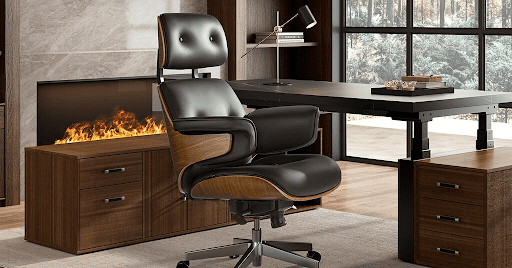
For professionals seeking maximum sustained comfort while retaining an executive look, structural engineering innovation is vital. The Eureka Mathias executive chair successfully tackles the lumbar support problem. Its core innovation lies in the fact that the foam padding in the lumbar area does not extend straight down vertically. Through a unique shape and zonal density, the Mathias backrest better follows the natural curve of the human body, providing cushioning and active rebound to maintain the healthy S-curve of the spine during long sitting periods. This non-vertical padding design offers superior comfort for sustained sitting compared to the fixed support of the Eames Executive, proving that executive chairs can absolutely deliver both formal appearance and long-term ergonomic health.

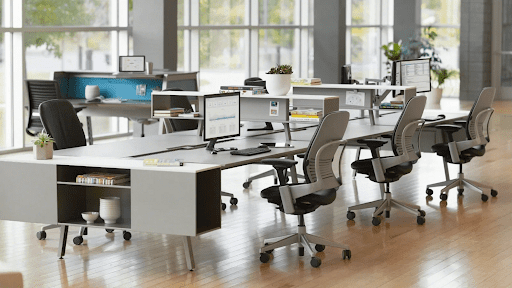
- Comprehensive Adjustment and Dynamic Adaptability: Steelcase Leap (Leather)
If the user demands extreme adjustability and dynamic adaptation, the Steelcase Leap series is renowned for its “LiveBack” technology, where the backrest contours to the user’s spine in real-time. The leather version retains this full dynamic adaptability and is one of the best choices for balancing function and administrative aesthetic. However, its highly engineered appearance is often considered less visually grand or less aesthetically integrated than pure executive chairs like the Eames or Mathias.
Beware of Cushion “Fatigue Collapse”
The durability of an executive leather chair depends not just on the upholstery but crucially on the internal padding. The most common failure mode in low-end chairs is the rapid loss of cushion elasticity.
For example, some mass-market chairs (like certain La-Z-Boy models) initially offer a highly cushioned, “sofa-like comfort” via thick padding, but user feedback frequently indicates the seat feels like “sitting on cardboard” after just a few months.4 This is because the low-density filling (typically low-cost polyurethane foam) quickly loses its resilience, causing body weight to press directly onto the hard seat pan and pelvic bones. This phenomenon confirms that ergonomics cannot be achieved merely by adding features or thickness; it requires sophisticated materials science and structural engineering investment.
High-end executive chairs, such as the premium padding in the Eames Executive or the structural foam in the Eureka Mathias, must possess high resilience and long-lasting density to ensure consistent support that does not decay over time. Users should be wary of overly bulky, low-priced leather chairs, as this design often signals a short lifespan and rapid structural failure.
IV. Brand Matrix Comparison: From Classic to Innovation
The choice of an executive leather chair is an expression of one’s personal context of power. Different brands and models represent distinct philosophies toward work, life, and aesthetics.
Classic and Authority: Herman Miller Eames Executive Series

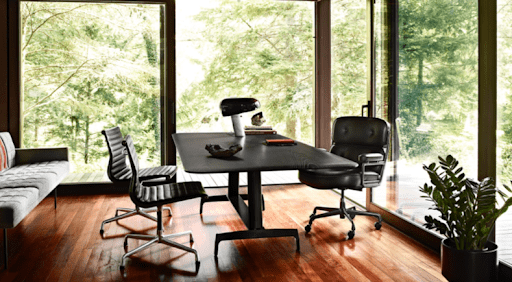
The Herman Miller Eames Executive Chair and Soft Pad Executive Chair are the epitome of high-end executive aesthetics. They are suited for formal spaces that need to communicate timeless value and high taste. The Eames design emphasizes premium genuine leather, exquisite aluminum castings, and impeccable proportions.9 Choosing an Eames chair signals “Classic Authority”—a design strength that doesn’t need complex adjustments to prove its function. However, as noted, their pursuit of design purity results in a compromise on absolute ergonomic adjustability, making them better suited for fixed-posture meeting scenarios or less intensive work.
Modern Function and Value: Eureka Ergonomics
Eureka Ergonomics’ executive chair series aims to integrate the high-performance ergonomics required for intensive work into a modern executive look, representing Efficient Authority—a scientific approach to productivity and health management.
- Eureka Mathias: The Function-First Executive Chair
The Mathias pushes ergonomic performance to the forefront. Its core advantage is the innovative non-vertical lumbar support mentioned earlier, making it especially suitable for professionals who sit for long hours daily. Aesthetically, the Mathias maintains sufficient executive presence while offering a more advanced support system in unseen areas, perfectly adapting to a modern or light luxury home office.

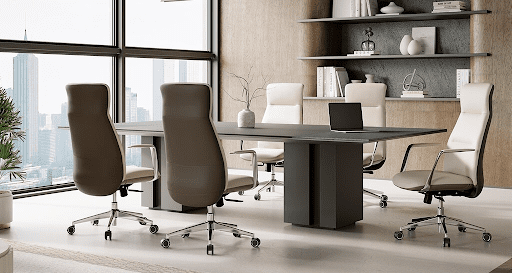
- Eureka Royal Series: The Ideal Modern Conference Solution
The Royal Series is sleek and minimalist, making it more suitable for large-scale configuration. By utilizing high-quality Silicone PU Leather (offering 4–5+ years of durability 7), it balances cost and function while maintaining a modern aesthetic. This solves the high maintenance cost associated with genuine leather in traditional boardrooms. With durable, easy-to-clean silicone leather, the Royal offers a better solution for modern companies prioritizing sustainability and cost-effectiveness in their meeting spaces.
The Functional Flagship: Steelcase Leap Leather

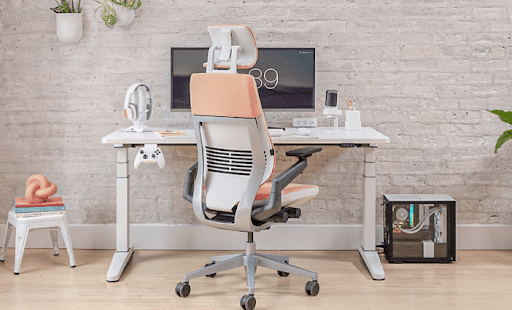
The Steelcase Leap series is a recognized benchmark for dynamic ergonomics. Its leather version provides an administrative aesthetic upgrade, making it one of the best choices for balancing function and form.3 The Leap retains its complex adjustment mechanism and engineered structure, offering unmatched professionalism, but its visual weight and formality are generally lower than the Eames Executive. It is best suited for professional workstations where function and high-intensity work are the absolute priority.
Mass Market and the Bulky Trap: La-Z-Boy & Serta
Brands like La-Z-Boy and Serta are well-known but typically operate in the mid-to-low-end market. They feature a bulky, oversized design, aiming to provide a thick, American-style “sofa-like” comfort via multilayered padding.12 However, they often use bonded leather or low-end PU, coupled with low-density foam, resulting in a short lifespan and rapid comfort decay.3 Due to their heavy appearance and the risk of cheap PU degradation, these chairs are better suited for traditional home offices with strict budgets and lower usage intensity, but buyers must be fully aware of the durability risks.
Table 2: Core Executive Leather Chair Model Comparison Matrix
| Model/Brand | Ergonomics Core Advantage | Aesthetic Style/Visual Weight | Material Focus | Best Fit Scenario |
| HM Eames Executive | Static support, premium padding | Timeless Classic, High Elegance (High) | Top-tier Genuine Leather, Cast Aluminum | Boardrooms, CEO Offices |
| Eureka Mathias | Dynamic Non-Vertical Lumbar Support, Sustained Sitting Friendly | Modern Business, Understated Luxury (Mid-High) | Premium Leather/High-Performance Synthetic | Home Office, High-Intensity Personal Office |
| Eureka Royal | Excellent Overall Support, Modern Curve | Sleek Streamline, High Modernity (Mid) | High-Quality Silicone PU Leather | Modern Conference Rooms, Value-Driven Durability |
| Steelcase Leap (Leather) | LiveBack Dynamic Adaptation, Fully Adjustable | Modern Functional, Highly Engineered (Mid) | Premium Leather, Structural Frame | Professional Workstations Focused on Function |
| La-Z-Boy/Serta (Typical) | Emphasizes Plushness/Deep Padding | Traditional Bulky, Sofa-like Feel (High/Perceived Cheapness) | Bonded Leather/Low-end PU, Short Lifespan | Casual Home Office, Budget-Oriented |
V. The Art of Adaptation: Application in Boardrooms and Home Offices
The central question in choosing an executive leather chair is its “perfect fit” across different spaces. This adaptability is not just functional but aesthetic and visual.
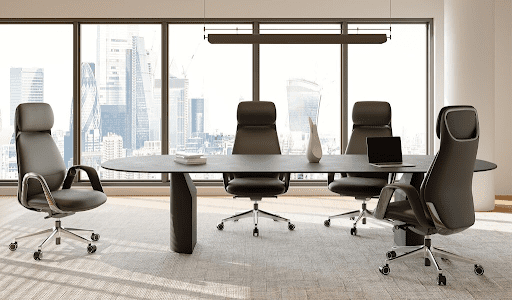
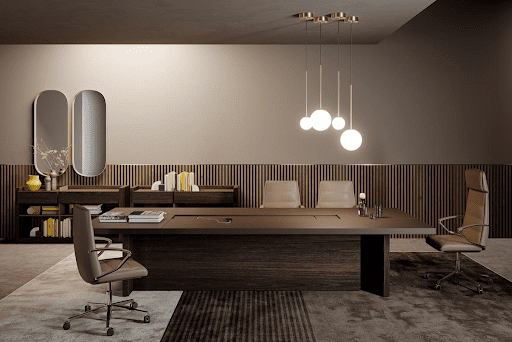
Boardrooms and Formal Office Spaces: Cohesion and Visual Weight
In formal boardrooms or executive offices, the chair must possess sufficient “visual weight” to match the solemnity of the environment while maintaining unity and professionalism.
- Desk Pairing: Executive leather chairs should be paired with desks that have clean lines and a sense of heft, such as floating slate tables or dark solid wood conference tables.

- Decor and Lighting: Decor in a formal setting should adhere to minimalist principles. Lighting should use high-CRI task lights and uniform ambient lighting to accentuate the leather’s texture and the chair’s silhouette, ensuring the focus remains on decision-making and efficiency.

Home Office and Study Integration: Creating a Seamless Transition
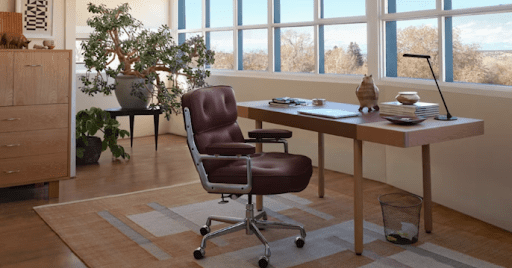
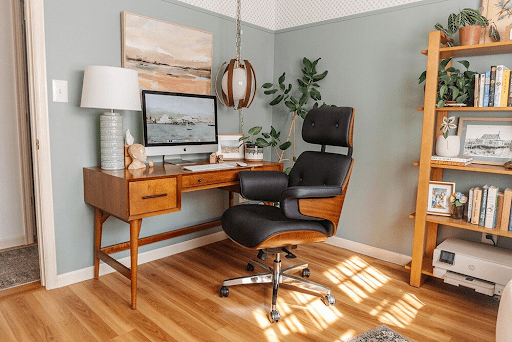
As the line between work and living space blurs, the home executive chair faces the challenge of avoiding visual conflict with residential furniture.1 The executive chair should be treated as an elegant piece of home decor, blending seamlessly rather than jarringly inserting itself into the family environment.
- Aesthetic Durability and Weight Management: The chair must possess “aesthetic durability”—a design that resists rapid changes in home fashion. Designs with “timeless appeal” like the Eames 2 have a natural advantage. Simultaneously, overly bulky chairs, especially those heavy models made with cheap PU, should be avoided, as they appear cumbersome and clash with refined home decor.
- Color and Material Coordination: The core strategy is “Soft Integration”. Prioritize leather chairs in neutral tones (black, white, gray, caramel brown) to harmonize with the home office’s wood finishes, walls, and rugs.
- Integration Tactics (Blending Tactics): To blur the lines between work and leisure, decorative table lamps, plants, and artwork should replace traditional office supplies on the desk. The use of textiles is crucial: placing a rug under the chair that coordinates with the study’s main colors visually connects the “work area” with the “leisure area”.
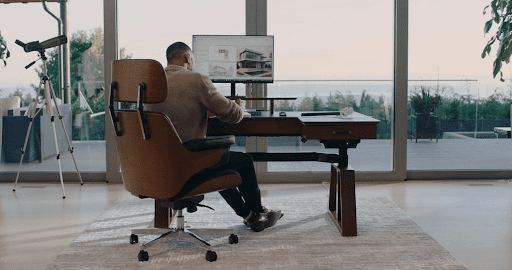
- Home Adaptability is a Function: True perfect adaptation means visual integration into the home while maintaining professional function. Home office chairs require high-grade support because users typically move less than they would in a corporate office. For high-efficiency home professionals, the executive chair made of both wood and leather is the top choice; its understated modern executive look achieves perfect home integration.
VI. Conclusion: Defining Your Executive Standard
The selection of an executive leather chair is a complex investment that involves materials science, deep ergonomic analysis, and spatial aesthetics. As modern work paradigms evolve, the criteria for evaluating executive chairs have shifted from mere visual impact to long-term performance and durability. Read more about Silicone PU Leather,Eureka Royal Series,Eureka Mathias
Investment Philosophy Summary
The wise investor should abandon the fallacy of cheap, bulky chairs relying on low-density padding for “fake comfort.” The focus of a genuine, long-term value investment should be on the professionalism of the structural engineering and the durability of high-end materials (top-tier genuine leather or high-performance Silicone PU). It is crucial to understand that a chair that is bulky but uses bonded or low-end PU will quickly suffer from “aesthetic degradation” and rapidly become a visual blight in a refined home environment, ultimately leading to investment failure.
Brand and Scenario Matching Recommendation
The final choice depends on the user’s definition of the “executive standard”:
- For Timeless Authority and Design Purity: The Herman Miller Eames Executive Chair is the undisputed choice.
- For Top-Tier Ergonomic Design integrated into the modern home: The Eureka Mathias, with its innovative non-vertical lumbar support, provides an excellent solution for sustained health, making it ideal for high-intensity professionals.
- For Cost-Effective and Durable Modern Conference Solutions: The Eureka Royal, utilizing high-quality Silicone PU, offers exceptional value for money while maintaining a sharp, modern business aesthetic.
A perfectly adapted executive leather chair not only elevates the taste of your space but also serves as the cornerstone of your professional image and long-term health investment. In every scenario, it must be synonymous with efficiency, well-being, and elegance.